Pearson+ LogoPearson+ Logo
Ch. 15 - Recombinant DNA Technology and Its Applications
Sanders - Genetic Analysis: An Integrated Approach 3rd Edition
Sanders3rd EditionGenetic Analysis: An Integrated ApproachISBN: 9780135564172Not the one you use?Change textbook
Chapter 15, Problem 31a

You have cloned a gene for an enzyme that degrades lipids in a bacterium that normally lives in cold temperatures. You wish to transfer this gene into E. coli to produce industrial amounts of enzyme for use in laundry detergent.
How would you accomplish this?

Verified step by step guidance
1
Identify the gene of interest: Isolate the gene encoding the lipid-degrading enzyme from the cold-adapted bacterium. Use techniques such as PCR (Polymerase Chain Reaction) to amplify the gene sequence.
Choose an appropriate vector: Select a plasmid vector that is compatible with E. coli. Ensure the vector contains a strong promoter for high expression, an origin of replication, and a selectable marker (e.g., antibiotic resistance gene).
Insert the gene into the vector: Use restriction enzymes to cut both the plasmid vector and the gene of interest at specific sites, creating complementary sticky ends. Ligate the gene into the plasmid using DNA ligase to form a recombinant plasmid.
Transform E. coli: Introduce the recombinant plasmid into E. coli cells using a transformation method such as heat shock or electroporation. Plate the transformed cells on a medium containing the appropriate antibiotic to select for cells that have taken up the plasmid.
Optimize expression conditions: Grow the transformed E. coli under conditions that maximize enzyme production. This may involve adjusting temperature, pH, or nutrient composition to ensure proper folding and activity of the cold-adapted enzyme.

Verified video answer for a similar problem:

This video solution was recommended by our tutors as helpful for the problem above.
Video duration:
2m
Was this helpful?

Key Concepts

Here are the essential concepts you must grasp in order to answer the question correctly.

Gene Cloning

Gene cloning is a molecular biology technique used to create copies of a specific gene. This process typically involves isolating the gene of interest, inserting it into a vector (like a plasmid), and then introducing this vector into a host organism, such as E. coli. The cloned gene can then be expressed to produce the desired protein, in this case, an enzyme that degrades lipids.
Recommended video:
Guided course
07:
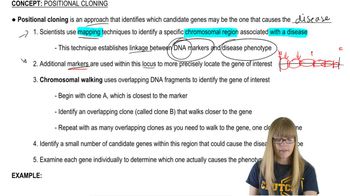
Positional Cloning

Transformation

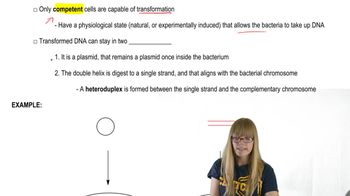
Transformation is the process by which a cell takes up foreign DNA from its environment. In the context of E. coli, this can be achieved through methods such as heat shock or electroporation, which make the bacterial cell membrane permeable to the plasmid containing the cloned gene. Successful transformation allows the bacteria to express the new gene and produce the enzyme.
Recommended video:
Guided course
05:48
Transformation

Protein Expression and Purification

Once the gene is successfully transferred into E. coli, the next step is to induce protein expression, which involves activating the gene so that the bacteria produce the enzyme. After expression, the enzyme must be purified from the bacterial cells to be used in applications like laundry detergents. Techniques such as affinity chromatography can be employed to isolate the enzyme based on its specific properties.
Recommended video:
Related Practice
Textbook Question

A three-gene system of additive genes (A, B, and C) controls plant height. Each gene has two alleles (A and a, B and b, and C and c). There is dominance among the alleles of each gene, with alleles A, B, and C dominant over a, b, and c. Under this scheme, the dominant genotype for a gene contributes 10 cm to height potential, and the recessive genotype contributes 4 cm. What is the height potential of the F₁ progeny of the homozygous plants identified in (a) and (b) of this problem?

481
views
Textbook Question

A three-gene system of additive genes (A, B, and C) controls plant height. Each gene has two alleles (A and a, B and b, and C and c). There is dominance among the alleles of each gene, with alleles A, B, and C dominant over a, b, and c. Under this scheme, the dominant genotype for a gene contributes 10 cm to height potential, and the recessive genotype contributes 4 cm. What are the phenotypes and proportions of each phenotype among the F₂?

695
views
Textbook Question

The RAS gene encodes a signaling protein that hydrolyzes GTP to GDP. When bound by GDP, the RAS protein is inactive, whereas when bound by GTP, RAS protein activates a target protein, resulting in stimulation of cells to actively grow and divide. As shown in the accompanying sequence, a single base-pair mutation results in a mutant protein that is constitutively active, leading to continual promotion of cell proliferation. Such mutations play a role in the formation of cancer. You have cloned the wild-type version of the mouse RAS gene and wish to create a mutant form to study its biological activity in vitro and in transgenic mice. Outline how you would proceed.

799
views
Textbook Question

You have cloned a gene for an enzyme that degrades lipids in a bacterium that normally lives in cold temperatures. You wish to transfer this gene into E. coli to produce industrial amounts of enzyme for use in laundry detergent.

You have managed to produce transgenic E. coli expressing mRNA of your gene, but only a low level of protein is produced. Why might this be so? How could you overcome this problem?

529
views
Textbook Question
About 1% of occurrences of nonautoimmune type 1 diabetes are due to loss-of-function alleles in the insulin gene. Individuals heterozygous for such mutations develop diabetes as infants or in the first few years of their lives. Outline how you might approach gene therapy for such a disease and what difficulties you might encounter.
396
views
Textbook Question

Describe how having the Cas9 gene at a genomic locus unlinked to the guide RNA and target site locus in an engineered gene drive system could slow the propagation of the gene drive allele in a population into which a small number of individuals carrying both the gene drive allele and the Cas9 locus are released.

471
views