Pearson+ LogoPearson+ Logo
Ch. 15 - Recombinant DNA Technology and Its Applications
Sanders - Genetic Analysis: An Integrated Approach 3rd Edition
Sanders3rd EditionGenetic Analysis: An Integrated ApproachISBN: 9780135564172Not the one you use?Change textbook
Chapter 15, Problem 30

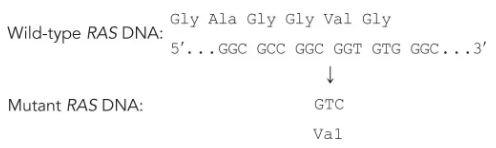
The RAS gene encodes a signaling protein that hydrolyzes GTP to GDP. When bound by GDP, the RAS protein is inactive, whereas when bound by GTP, RAS protein activates a target protein, resulting in stimulation of cells to actively grow and divide. As shown in the accompanying sequence, a single base-pair mutation results in a mutant protein that is constitutively active, leading to continual promotion of cell proliferation. Such mutations play a role in the formation of cancer. You have cloned the wild-type version of the mouse RAS gene and wish to create a mutant form to study its biological activity in vitro and in transgenic mice. Outline how you would proceed.

Verified step by step guidance
1
Step 1: Identify the specific mutation in the RAS gene sequence that leads to the constitutively active mutant protein. This can be done by comparing the wild-type RAS gene sequence to the mutant sequence and pinpointing the single base-pair change responsible for the altered activity.
Step 2: Design a primer for site-directed mutagenesis. This primer should contain the desired mutation (single base-pair change) and be complementary to the wild-type RAS gene sequence, except for the specific nucleotide to be altered.
Step 3: Perform site-directed mutagenesis using a PCR-based method. Amplify the RAS gene using the designed primer and a high-fidelity DNA polymerase to introduce the mutation into the gene. Ensure that the reaction conditions are optimized for specific and accurate amplification.
Step 4: Verify the introduction of the mutation by sequencing the PCR product. This step ensures that the desired mutation has been successfully incorporated into the RAS gene without introducing any unintended changes.
Step 5: Clone the mutant RAS gene into an appropriate expression vector for further study. This vector can then be used to express the mutant protein in vitro or to generate transgenic mice for in vivo studies of its biological activity.

Verified video answer for a similar problem:

This video solution was recommended by our tutors as helpful for the problem above.
Video duration:
1m
Was this helpful?

Key Concepts

Here are the essential concepts you must grasp in order to answer the question correctly.

RAS Protein Function

The RAS protein is a critical signaling molecule that regulates cell growth and division. It functions as a molecular switch, toggling between an active form bound to GTP and an inactive form bound to GDP. When activated by GTP, RAS interacts with various downstream effectors to promote cellular processes such as proliferation. Understanding this mechanism is essential for studying mutations that lead to uncontrolled cell growth, as seen in cancer.
Recommended video:

Mutagenesis Techniques

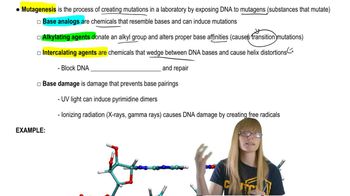
Mutagenesis refers to the process of inducing mutations in a gene to study its function. Techniques such as site-directed mutagenesis allow researchers to create specific alterations in the DNA sequence of the RAS gene, resulting in a mutant protein. This approach is crucial for investigating how particular mutations affect RAS activity and contribute to cancer development, enabling the exploration of potential therapeutic targets.
Recommended video:
Guided course
04:29
Induced Mutations

Transgenic Mouse Models

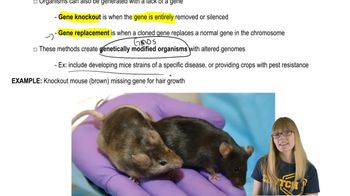
Transgenic mouse models are genetically modified organisms that carry foreign genes or mutations, allowing researchers to study gene function and disease mechanisms in a living system. By introducing the mutant RAS gene into mice, scientists can observe the biological effects of the mutation in vivo, including its role in tumorigenesis. These models are invaluable for understanding the complexities of cancer biology and testing potential treatments.
Recommended video:
Guided course
09:12
Transgenic Organisms and Gene Therapy
Related Practice
Textbook Question

Vitamin E is the name for a set of chemically related tocopherols, which are lipid-soluble compounds with antioxidant properties. Such antioxidants protect cells against the effects of free radicals created as by-products of energy metabolism in the mitochondrion. Different tocopherols have different biological activities due to differences in their retention by binding to gut proteins during digestion. The one retained at the highest level is α-tocopherol, whereas γ-tocopherol is retained at less than 10% of that efficiency. In Arabidopsis, α-tocopherol is the most abundant tocopherol in leaves, whereas γ-tocopherol is the most abundant in seeds. An enzyme encoded by the VTE4 gene can convert γ-tocopherol to α-tocopherol. How would you create an Arabidopsis plant that produces high levels of α-tocopherol in the seeds?

512
views
Textbook Question

A three-gene system of additive genes (A, B, and C) controls plant height. Each gene has two alleles (A and a, B and b, and C and c). There is dominance among the alleles of each gene, with alleles A, B, and C dominant over a, b, and c. Under this scheme, the dominant genotype for a gene contributes 10 cm to height potential, and the recessive genotype contributes 4 cm. What is the height potential of the F₁ progeny of the homozygous plants identified in (a) and (b) of this problem?

481
views
Textbook Question

A three-gene system of additive genes (A, B, and C) controls plant height. Each gene has two alleles (A and a, B and b, and C and c). There is dominance among the alleles of each gene, with alleles A, B, and C dominant over a, b, and c. Under this scheme, the dominant genotype for a gene contributes 10 cm to height potential, and the recessive genotype contributes 4 cm. What are the phenotypes and proportions of each phenotype among the F₂?

695
views
Textbook Question

You have cloned a gene for an enzyme that degrades lipids in a bacterium that normally lives in cold temperatures. You wish to transfer this gene into E. coli to produce industrial amounts of enzyme for use in laundry detergent.

How would you accomplish this?

494
views
Textbook Question

You have cloned a gene for an enzyme that degrades lipids in a bacterium that normally lives in cold temperatures. You wish to transfer this gene into E. coli to produce industrial amounts of enzyme for use in laundry detergent.

You have managed to produce transgenic E. coli expressing mRNA of your gene, but only a low level of protein is produced. Why might this be so? How could you overcome this problem?

529
views
Textbook Question
About 1% of occurrences of nonautoimmune type 1 diabetes are due to loss-of-function alleles in the insulin gene. Individuals heterozygous for such mutations develop diabetes as infants or in the first few years of their lives. Outline how you might approach gene therapy for such a disease and what difficulties you might encounter.
396
views