Pearson+ LogoPearson+ Logo
Ch. 15 - Recombinant DNA Technology and Its Applications
Sanders - Genetic Analysis: An Integrated Approach 3rd Edition
Sanders3rd EditionGenetic Analysis: An Integrated ApproachISBN: 9780135564172Not the one you use?Change textbook
Chapter 15, Problem 31b

You have cloned a gene for an enzyme that degrades lipids in a bacterium that normally lives in cold temperatures. You wish to transfer this gene into E. coli to produce industrial amounts of enzyme for use in laundry detergent.
You have managed to produce transgenic E. coli expressing mRNA of your gene, but only a low level of protein is produced. Why might this be so? How could you overcome this problem?

Verified step by step guidance
1
Step 1: Understand the problem. The gene for the lipid-degrading enzyme originates from a bacterium adapted to cold temperatures. When transferred to E. coli, the gene is expressed at the mRNA level, but protein production is low. This suggests a problem with translation or protein stability in the new host organism.
Step 2: Consider codon usage. Different organisms have varying preferences for codons that encode the same amino acid. If the gene from the cold-adapted bacterium uses codons that are rare in E. coli, the ribosome may struggle to efficiently translate the mRNA into protein. To address this, you could optimize the codon usage of the gene to match E. coli's preferred codons.
Step 3: Evaluate protein folding and stability. Proteins from cold-adapted organisms may require specific conditions to fold properly. E. coli, which grows at higher temperatures, might not provide the optimal environment for the enzyme to fold and function. You could try expressing the protein in E. coli grown at lower temperatures or co-expressing chaperone proteins to assist in proper folding.
Step 4: Assess promoter strength and regulatory elements. The promoter driving the expression of the gene might not be strong enough in E. coli, leading to low levels of mRNA and protein. You could replace the existing promoter with a stronger, E. coli-compatible promoter to enhance transcription and subsequent protein production.
Step 5: Investigate post-translational modifications. If the enzyme requires specific modifications (e.g., glycosylation) that E. coli cannot perform, the protein may be non-functional or unstable. In this case, you could consider using a different host organism, such as yeast, that can perform the necessary modifications.

Verified video answer for a similar problem:

This video solution was recommended by our tutors as helpful for the problem above.
Video duration:
1m
Was this helpful?

Key Concepts

Here are the essential concepts you must grasp in order to answer the question correctly.

Gene Expression Regulation

Gene expression regulation refers to the mechanisms that control the timing and amount of gene product (protein) produced in a cell. In bacteria like E. coli, factors such as promoter strength, ribosome binding sites, and transcription factors can significantly influence how efficiently a gene is expressed. If the cloned gene's regulatory elements are not optimal for E. coli, it may lead to low protein production.
Recommended video:
Guided course
02:09
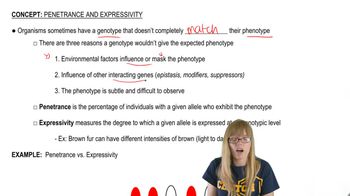
Penetrance and Expressivity

Codon Optimization

Codon optimization involves modifying the DNA sequence of a gene to use codons that are more frequently used by the host organism, in this case, E. coli. Different organisms have preferences for certain codons, and using less common codons can result in inefficient translation and low protein yield. By optimizing the gene sequence for E. coli, one can enhance the translation efficiency and increase protein production.
Recommended video:
Guided course
11:43
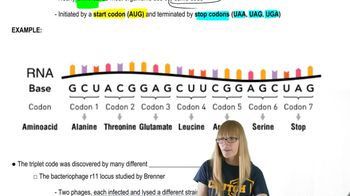
The Genetic Code

Post-Translational Modifications

Post-translational modifications (PTMs) are chemical changes that occur to a protein after its synthesis, affecting its activity, stability, and localization. E. coli may not perform the same PTMs as the original organism from which the gene was cloned, potentially leading to an inactive or unstable enzyme. Understanding and engineering the necessary PTMs can help improve the functionality and yield of the expressed protein.
Recommended video:
Guided course
04:30
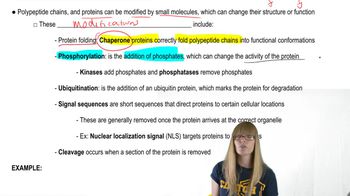
Post Translational Modifications
Related Practice
Textbook Question

A three-gene system of additive genes (A, B, and C) controls plant height. Each gene has two alleles (A and a, B and b, and C and c). There is dominance among the alleles of each gene, with alleles A, B, and C dominant over a, b, and c. Under this scheme, the dominant genotype for a gene contributes 10 cm to height potential, and the recessive genotype contributes 4 cm. What are the phenotypes and proportions of each phenotype among the F₂?

695
views
Textbook Question

The RAS gene encodes a signaling protein that hydrolyzes GTP to GDP. When bound by GDP, the RAS protein is inactive, whereas when bound by GTP, RAS protein activates a target protein, resulting in stimulation of cells to actively grow and divide. As shown in the accompanying sequence, a single base-pair mutation results in a mutant protein that is constitutively active, leading to continual promotion of cell proliferation. Such mutations play a role in the formation of cancer. You have cloned the wild-type version of the mouse RAS gene and wish to create a mutant form to study its biological activity in vitro and in transgenic mice. Outline how you would proceed.

799
views
Textbook Question

You have cloned a gene for an enzyme that degrades lipids in a bacterium that normally lives in cold temperatures. You wish to transfer this gene into E. coli to produce industrial amounts of enzyme for use in laundry detergent.

How would you accomplish this?

494
views
Textbook Question
About 1% of occurrences of nonautoimmune type 1 diabetes are due to loss-of-function alleles in the insulin gene. Individuals heterozygous for such mutations develop diabetes as infants or in the first few years of their lives. Outline how you might approach gene therapy for such a disease and what difficulties you might encounter.
396
views
Textbook Question

Describe how having the Cas9 gene at a genomic locus unlinked to the guide RNA and target site locus in an engineered gene drive system could slow the propagation of the gene drive allele in a population into which a small number of individuals carrying both the gene drive allele and the Cas9 locus are released.

471
views
Textbook Question

Would a gene drive system spread rapidly through a population in a species that tends to self-mate (e.g., Arabidopsis, C. elegans)? In a species in which the breeding cycle is slow (e.g., humans)?

517
views