Pearson+ LogoPearson+ Logo
Ch. 15 - Recombinant DNA Technology and Its Applications
Sanders - Genetic Analysis: An Integrated Approach 3rd Edition
Sanders3rd EditionGenetic Analysis: An Integrated ApproachISBN: 9780135564172Not the one you use?Change textbook
Chapter 15, Problem 22a

You have identified five genes in S. cerevisiae that are induced when the yeast are grown in a high-salt (NaCl) medium. To study the potential roles of these genes in acclimation to growth in high-salt conditions, you wish to examine the phenotypes of loss- and gain-of-function alleles of each. How will you do this?

Verified step by step guidance
1
Step 1: Begin by creating loss-of-function alleles for each of the five genes. This can be achieved through techniques such as gene deletion (using homologous recombination) or RNA interference (RNAi) to knock down gene expression. Ensure that the yeast strains with these alleles are viable under normal conditions.
Step 2: Generate gain-of-function alleles for each gene. This can involve overexpressing the genes using strong promoters or introducing mutations that enhance the activity of the encoded proteins. Use plasmids or integration methods to introduce these alleles into the yeast genome.
Step 3: Grow the yeast strains (both loss-of-function and gain-of-function mutants) in high-salt (NaCl) medium. Monitor their growth rates, survival, and other phenotypic traits such as cell morphology or stress response markers to assess their ability to acclimate to high-salt conditions.
Step 4: Compare the phenotypes of the mutant strains to wild-type yeast grown under the same high-salt conditions. Identify any differences in growth or survival that suggest a role for the genes in salt acclimation.
Step 5: Perform additional experiments to validate the findings, such as rescuing the phenotype of loss-of-function mutants by reintroducing the wild-type gene or testing the mutants under varying salt concentrations to determine the threshold of acclimation.

Verified video answer for a similar problem:

This video solution was recommended by our tutors as helpful for the problem above.
Video duration:
1m
Was this helpful?

Key Concepts

Here are the essential concepts you must grasp in order to answer the question correctly.

Gene Function and Alleles

Genes are segments of DNA that encode proteins, which perform various functions in an organism. Alleles are different versions of a gene that can result in variations in traits. Understanding the difference between loss-of-function alleles, which typically result in reduced or absent gene activity, and gain-of-function alleles, which enhance or alter gene activity, is crucial for studying their roles in yeast acclimation to high-salt environments.
Recommended video:
Guided course
08:26
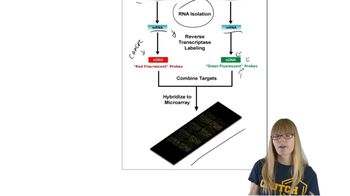
Functional Genomics

Phenotypic Analysis

Phenotypic analysis involves observing and measuring the physical and functional traits of an organism resulting from the interaction of its genotype with the environment. In this context, examining the phenotypes of yeast with different alleles will help determine how each gene contributes to the organism's ability to adapt to high-salt conditions, revealing insights into their biological roles.
Recommended video:
Guided course
02:48
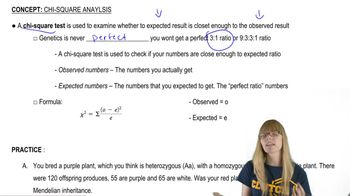
Chi Square Analysis

Experimental Design in Genetics

Experimental design in genetics refers to the structured approach used to test hypotheses about gene function. This includes creating controlled experiments to assess the effects of specific alleles on yeast growth and survival in high-salt conditions. Techniques such as gene knockout, overexpression, and phenotypic assays are essential for systematically evaluating the roles of the identified genes.
Recommended video:
Guided course
03:45
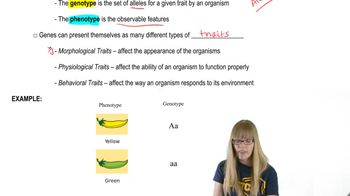
Descriptive Genetics
Related Practice
Textbook Question

You have isolated another cDNA clone of the CRABS CLAW gene from a cDNA library. The cDNA was directionally cloned using the EcoRI and XhoI sites. You sequence the recombinant plasmid using primers complementary to the T7 and T3 promoter sites flanking the MCS. The first 30 to 60 bases of sequence are usually discarded since they tend to contain errors.

Will the long stretch of T residues in the T3 sequence exist in the genomic sequence of the gene?

492
views
Textbook Question

You have isolated another cDNA clone of the CRABS CLAW gene from a cDNA library.. The cDNA was directionally cloned using the EcoRI and XhoI sites. You sequence the recombinant plasmid using primers complementary to the T7 and T3 promoter sites flanking the MCS. The first 30 to 60 bases of sequence are usually discarded since they tend to contain errors.

Can you identify which sequence portions are derived from the vector (specifically the MCS) and which are derived from the cDNA clone?

546
views
Textbook Question

You have isolated another cDNA clone of the CRABS CLAW gene from a cDNA library. The cDNA was directionally cloned using the EcoRI and XhoI sites. You sequence the recombinant plasmid using primers complementary to the T7 and T3 promoter sites flanking the MCS. The first 30 to 60 bases of sequence are usually discarded since they tend to contain errors.

Can you identify the start of the coding region in the end of the gene? What does the sequence preceding the start codon represent?

602
views
Textbook Question

You have identified five genes in S. cerevisiae that are induced when the yeast are grown in a high-salt (NaCl) medium. To study the potential roles of these genes in acclimation to growth in high-salt conditions, you wish to examine the phenotypes of loss- and gain-of-function alleles of each. How would your answer differ if you were working with tomato plants instead of yeast?

562
views
Textbook Question

You have generated three transgenic lines of maize that are resistant to the European corn borer, a significant pest in many regions of the world. The transgenic lines (T₁ in the accompanying table) were created using Agrobacterium-mediated transformation with a T-DNA having two genes, the first being a gene conferring resistance to the corn borer and the second being a gene conferring resistance to a herbicide that you used as a selectable marker to obtain your transgenic plants. You crossed each of the lines to a wild-type maize plant and also generated a T2 population by self-fertilization of the T1 plant. The following segregation results were observed (herbicide resistant : herbicide sensitive):

Explain these segregation ratios.

549
views
Textbook Question

Bacterial Pseudomonas species often possess plasmids encoding genes involved in the catabolism of organic compounds. You have discovered a strain that can metabolize crude oil and wish to identify the gene(s) responsible. Outline an experimental protocol to find the gene or genes required for crude oil metabolism.

513
views