Pearson+ LogoPearson+ Logo
Ch. 15 - Recombinant DNA Technology and Its Applications
Sanders - Genetic Analysis: An Integrated Approach 3rd Edition
Sanders3rd EditionGenetic Analysis: An Integrated ApproachISBN: 9780135564172Not the one you use?Change textbook
Chapter 15, Problem 21c

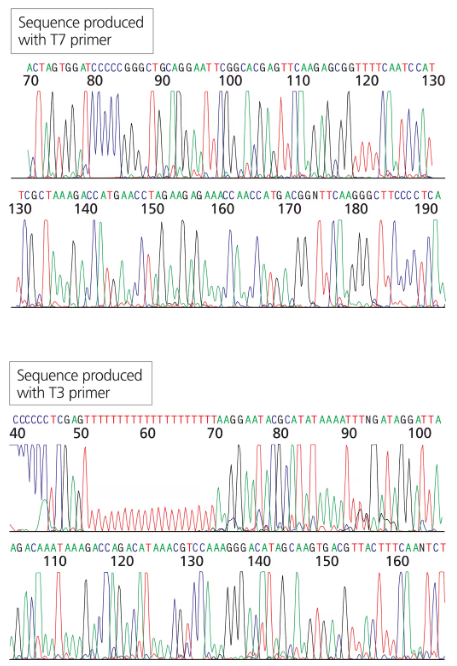
You have isolated another cDNA clone of the CRABS CLAW gene from a cDNA library.. The cDNA was directionally cloned using the EcoRI and XhoI sites. You sequence the recombinant plasmid using primers complementary to the T7 and T3 promoter sites flanking the MCS. The first 30 to 60 bases of sequence are usually discarded since they tend to contain errors.
Can you identify which sequence portions are derived from the vector (specifically the MCS) and which are derived from the cDNA clone?
DNA sequencing results showing T7 and T3 primer sequences, with peaks indicating nucleotide bases and potential vector contamination.

Verified step by step guidance
1
Step 1: Understand the concept of directional cloning. Directional cloning ensures that the cDNA is inserted into the vector in a specific orientation using restriction enzyme sites, in this case, EcoRI and XhoI. This allows the cDNA to be flanked by known sequences in the vector, such as the T7 and T3 promoter sites.
Step 2: Review the structure of the vector and the multiple cloning site (MCS). The MCS contains several restriction enzyme recognition sites, including EcoRI and XhoI, which are used for inserting the cDNA. The sequence of the MCS is known and can be compared to the sequence obtained from the recombinant plasmid.
Step 3: Analyze the sequencing data obtained using primers complementary to the T7 and T3 promoter sites. The sequencing will start from these promoter sites and proceed into the MCS and the inserted cDNA. Discard the first 30 to 60 bases of sequence due to potential errors, as mentioned in the problem.
Step 4: Compare the sequence obtained from the recombinant plasmid to the known sequence of the vector's MCS. Identify the portions of the sequence that match the MCS, as these are derived from the vector. The remaining sequence, which does not match the MCS, is derived from the cDNA clone.
Step 5: Confirm the orientation and boundaries of the cDNA insert by checking the presence of EcoRI and XhoI sites flanking the cDNA. This ensures that the cDNA was directionally cloned and helps distinguish vector-derived sequences from cDNA-derived sequences.

Verified video answer for a similar problem:

This video solution was recommended by our tutors as helpful for the problem above.
Video duration:
3m
Was this helpful?

Key Concepts

Here are the essential concepts you must grasp in order to answer the question correctly.

cDNA Cloning

cDNA cloning involves synthesizing complementary DNA (cDNA) from messenger RNA (mRNA) using the enzyme reverse transcriptase. This process allows researchers to create DNA copies of expressed genes, which can then be inserted into vectors for further study. Understanding cDNA cloning is essential for identifying gene sequences and analyzing gene expression.
Recommended video:
Guided course
07:39
Genetic Cloning

Restriction Enzymes and MCS

Restriction enzymes are proteins that cut DNA at specific sequences, allowing for the insertion of foreign DNA into plasmids. The Multiple Cloning Site (MCS) is a region within a vector that contains several unique restriction sites, facilitating the directional cloning of DNA fragments. Recognizing the MCS is crucial for distinguishing between vector-derived and insert-derived sequences in recombinant DNA.
Recommended video:
Guided course
07:11
Mapping with Markers

Sequencing and Error Management

DNA sequencing is the process of determining the precise order of nucleotides in a DNA molecule. In sequencing, the initial bases are often discarded due to potential errors introduced during amplification or sequencing. Understanding the importance of quality control in sequencing helps in accurately identifying which portions of the sequence correspond to the vector and which correspond to the cDNA insert.
Recommended video:
Guided course
08:41
Sequencing Difficulties
Related Practice
Textbook Question

You have isolated a genomic clone with an EcoRI fragment of 11 kb that encompasses the CRABS CLAW gene (see Problem 18). You digest the genomic clone with HindIII and note that the 11-kb EcoRI fragment is split into three fragments of 9 kb, 1.5 kb, and 0.5 kb.

Restriction enzyme sites within a cDNA clone are often also found in the genomic sequence. Can you think of a reason why occasionally this is not the case? What about the converse: Are restriction enzyme sites in a genomic clone always in a cDNA clone of the same gene?

553
views
Textbook Question

You have identified a 0.80-kb cDNA clone that contains the entire coding sequence of the Arabidopsis gene CRABS CLAW. In the construction of the cDNA library, linkers with EcoRI sites were added to each end of the cDNA, and the cDNA was inserted into the EcoRI site of the MCS of the vector shown in the accompanying figure. You perform digests on the CRABS CLAW cDNA clone with restriction enzymes and obtain the following results. Can you determine the orientation of the cDNA clone with respect to the restriction enzyme sites in the vector? The restriction enzyme sites listed in the dark blue region are found only in the MCS of the vector.

875
views
Textbook Question

You have isolated another cDNA clone of the CRABS CLAW gene from a cDNA library. The cDNA was directionally cloned using the EcoRI and XhoI sites. You sequence the recombinant plasmid using primers complementary to the T7 and T3 promoter sites flanking the MCS. The first 30 to 60 bases of sequence are usually discarded since they tend to contain errors.

Will the long stretch of T residues in the T3 sequence exist in the genomic sequence of the gene?

492
views
Textbook Question

You have isolated another cDNA clone of the CRABS CLAW gene from a cDNA library. The cDNA was directionally cloned using the EcoRI and XhoI sites. You sequence the recombinant plasmid using primers complementary to the T7 and T3 promoter sites flanking the MCS. The first 30 to 60 bases of sequence are usually discarded since they tend to contain errors.

Can you identify the start of the coding region in the end of the gene? What does the sequence preceding the start codon represent?

602
views
Textbook Question

You have identified five genes in S. cerevisiae that are induced when the yeast are grown in a high-salt (NaCl) medium. To study the potential roles of these genes in acclimation to growth in high-salt conditions, you wish to examine the phenotypes of loss- and gain-of-function alleles of each. How will you do this?

498
views
Textbook Question

You have identified five genes in S. cerevisiae that are induced when the yeast are grown in a high-salt (NaCl) medium. To study the potential roles of these genes in acclimation to growth in high-salt conditions, you wish to examine the phenotypes of loss- and gain-of-function alleles of each. How would your answer differ if you were working with tomato plants instead of yeast?

562
views