Pearson+ LogoPearson+ Logo
Ch. 15 - Recombinant DNA Technology and Its Applications
Sanders - Genetic Analysis: An Integrated Approach 3rd Edition
Sanders3rd EditionGenetic Analysis: An Integrated ApproachISBN: 9780135564172Not the one you use?Change textbook
Chapter 15, Problem 23

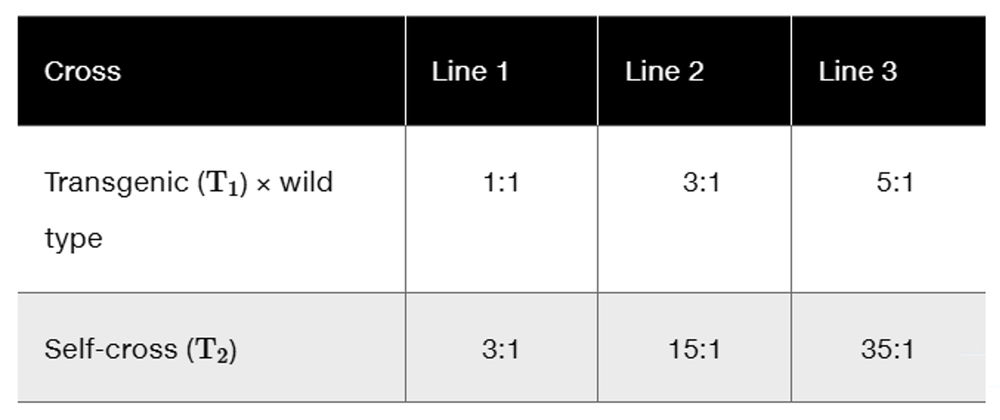
You have generated three transgenic lines of maize that are resistant to the European corn borer, a significant pest in many regions of the world. The transgenic lines (T₁ in the accompanying table) were created using Agrobacterium-mediated transformation with a T-DNA having two genes, the first being a gene conferring resistance to the corn borer and the second being a gene conferring resistance to a herbicide that you used as a selectable marker to obtain your transgenic plants. You crossed each of the lines to a wild-type maize plant and also generated a T2 population by self-fertilization of the T1 plant. The following segregation results were observed (herbicide resistant : herbicide sensitive):
Table displaying segregation ratios of transgenic maize lines crossed with wild-type and self-crossed populations.
Explain these segregation ratios.

Verified step by step guidance
1
Step 1: Understand the genetic basis of the problem. The T-DNA contains two genes: one conferring resistance to the corn borer and another conferring resistance to a herbicide. The herbicide resistance gene is used as a selectable marker, and its segregation ratios provide insight into the inheritance patterns of the transgenic lines.
Step 2: Analyze the segregation ratios for the T₁ × wild type crosses. A 1:1 ratio in Line 1 suggests that the transgene is heterozygous and segregates in a Mendelian fashion. A 3:1 ratio in Line 2 indicates that the transgene is homozygous dominant. A 5:1 ratio in Line 3 suggests a more complex inheritance pattern, possibly involving multiple copies of the transgene or linked loci.
Step 3: Examine the segregation ratios for the T₂ self-crosses. A 3:1 ratio in Line 1 is consistent with Mendelian inheritance for a single heterozygous gene. A 15:1 ratio in Line 2 suggests the presence of two independent homozygous dominant loci. A 35:1 ratio in Line 3 indicates a higher number of loci or gene copies contributing to herbicide resistance.
Step 4: Relate the observed ratios to the genetic mechanisms. For Line 1, the 1:1 and 3:1 ratios suggest simple Mendelian inheritance of a single gene. For Line 2, the 3:1 and 15:1 ratios imply two independent loci or gene copies. For Line 3, the 5:1 and 35:1 ratios suggest a more complex genetic arrangement, such as multiple linked loci or tandem gene copies.
Step 5: Conclude that the differences in segregation ratios across the lines are due to variations in the genetic architecture of the transgenic insertions. Line 1 likely has a single copy of the transgene, Line 2 has two independent copies, and Line 3 has multiple linked copies or tandem repeats, leading to the observed ratios.

Verified video answer for a similar problem:

This video solution was recommended by our tutors as helpful for the problem above.
Video duration:
3m
Was this helpful?

Key Concepts

Here are the essential concepts you must grasp in order to answer the question correctly.

Transgenic Plants

Transgenic plants are genetically modified organisms that contain a gene or genes which have been artificially inserted instead of the plant acquiring them through reproduction. In this case, maize lines have been engineered to express genes for resistance to the European corn borer and a herbicide, allowing researchers to study the inheritance of these traits.
Recommended video:
Guided course
02:56
Plant Gamete Terminology

Segregation Ratios

Segregation ratios refer to the expected proportions of different phenotypes in the offspring of a genetic cross, based on Mendelian inheritance. The observed ratios, such as 1:1, 3:1, and 5:1, indicate how traits segregate during gamete formation and can reveal the number of alleles involved and their dominance relationships.
Recommended video:
Guided course
05:13
Organelle Inheritance

Selectable Markers

Selectable markers are genes introduced into transgenic organisms that confer a trait allowing for the identification of successfully modified individuals. In this scenario, the herbicide resistance gene serves as a selectable marker, enabling researchers to distinguish transgenic plants from non-transgenic ones during the selection process.
Recommended video:
Guided course
07:11
Mapping with Markers
Related Practice
Textbook Question

You have isolated another cDNA clone of the CRABS CLAW gene from a cDNA library. The cDNA was directionally cloned using the EcoRI and XhoI sites. You sequence the recombinant plasmid using primers complementary to the T7 and T3 promoter sites flanking the MCS. The first 30 to 60 bases of sequence are usually discarded since they tend to contain errors.

Can you identify the start of the coding region in the end of the gene? What does the sequence preceding the start codon represent?

602
views
Textbook Question

You have identified five genes in S. cerevisiae that are induced when the yeast are grown in a high-salt (NaCl) medium. To study the potential roles of these genes in acclimation to growth in high-salt conditions, you wish to examine the phenotypes of loss- and gain-of-function alleles of each. How will you do this?

498
views
Textbook Question

You have identified five genes in S. cerevisiae that are induced when the yeast are grown in a high-salt (NaCl) medium. To study the potential roles of these genes in acclimation to growth in high-salt conditions, you wish to examine the phenotypes of loss- and gain-of-function alleles of each. How would your answer differ if you were working with tomato plants instead of yeast?

562
views
Textbook Question

Bacterial Pseudomonas species often possess plasmids encoding genes involved in the catabolism of organic compounds. You have discovered a strain that can metabolize crude oil and wish to identify the gene(s) responsible. Outline an experimental protocol to find the gene or genes required for crude oil metabolism.

513
views
Textbook Question

Two complaints about some transgenic plants presently in commercial use are that (1) the Bt toxin gene is constitutively expressed in them, leading to fears that selection pressures will cause insects to evolve resistance to the toxin, and (2) a selectable marker gene—for example, conferring kanamycin resistance—remains in the plant, leading to concerns about increased antibiotic resistance in organisms in the wild. How would you generate transgenic plants that produce Bt only in response to being fed upon by insects and without the selectable marker?

428
views
Textbook Question

In Drosophila, loss-of-function Ultrabithorax mutations result in the posterior thoracic segments differentiating into body parts with an identity normally found in the anterior thoracic segments. When the Ultrabithorax gene was cloned, it was shown to encode a transcription factor and to be expressed only in the posterior region of the thorax. Thus, Ultrabithorax acts to specify the identity of the posterior thoracic segments. Similar genes were soon discovered in other animals, including mice and humans. You have found that mice possess two closely related genes, Hoxa7 and Hoxb4, which are orthologs of Ultrabithorax. You wish to know whether the two mouse genes act to specify the identity of body segments in mice.

How will you determine where and when the mouse genes are expressed?

419
views