Pearson+ LogoPearson+ Logo
Ch. 15 - Recombinant DNA Technology and Its Applications
Sanders - Genetic Analysis: An Integrated Approach 3rd Edition
Sanders3rd EditionGenetic Analysis: An Integrated ApproachISBN: 9780135564172Not the one you use?Change textbook
Chapter 15, Problem 21b

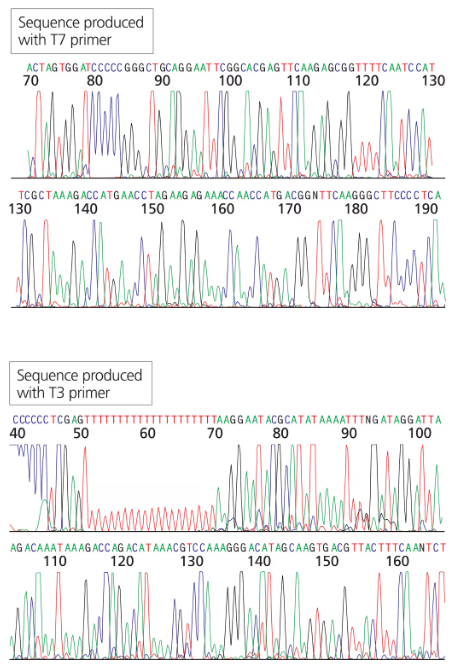
You have isolated another cDNA clone of the CRABS CLAW gene from a cDNA library. The cDNA was directionally cloned using the EcoRI and XhoI sites. You sequence the recombinant plasmid using primers complementary to the T7 and T3 promoter sites flanking the MCS. The first 30 to 60 bases of sequence are usually discarded since they tend to contain errors.
Will the long stretch of T residues in the T3 sequence exist in the genomic sequence of the gene?
DNA sequencing results showing T7 and T3 primer sequences with corresponding peak heights and base calls.

Verified step by step guidance
1
Understand the context: The cDNA clone of the CRABS CLAW gene was constructed using a cDNA library. cDNA is synthesized from mRNA, meaning it represents the expressed sequences of a gene (exons only) and does not include introns or regulatory sequences found in the genomic DNA.
Analyze the T3 promoter sequence: The T3 promoter is part of the vector used for cloning and sequencing. It is not derived from the genomic DNA or the cDNA of the gene itself. Instead, it is an artificial sequence included in the vector to facilitate transcription in vitro.
Determine the origin of the long stretch of T residues: The long stretch of T residues in the T3 promoter sequence is part of the vector design and does not originate from the genomic sequence of the CRABS CLAW gene. It is an engineered sequence used for experimental purposes.
Compare genomic DNA and cDNA: Genomic DNA contains both exons and introns, as well as regulatory regions. cDNA, on the other hand, is synthesized from mRNA and represents only the coding regions (exons). The T3 promoter sequence is unrelated to either genomic DNA or cDNA, as it is part of the vector.
Conclude: The long stretch of T residues in the T3 promoter sequence will not exist in the genomic sequence of the CRABS CLAW gene because it is an artificial sequence included in the vector and not part of the gene's natural genomic or cDNA sequence.

Verified video answer for a similar problem:

This video solution was recommended by our tutors as helpful for the problem above.
Video duration:
2m
Was this helpful?

Key Concepts

Here are the essential concepts you must grasp in order to answer the question correctly.

cDNA and Genomic DNA

cDNA (complementary DNA) is synthesized from mRNA through reverse transcription and represents only the expressed genes, lacking introns. In contrast, genomic DNA contains both coding (exons) and non-coding regions (introns) of the entire genome. Understanding the difference is crucial for determining whether sequences found in cDNA, like the T residues in the T3 promoter, will be present in the genomic DNA.
Recommended video:
Guided course
08:26
Functional Genomics

Promoter Sequences

Promoter sequences are regions of DNA that initiate transcription of a gene. They are typically located upstream of the coding region and are recognized by RNA polymerase and transcription factors. The T3 promoter, which contains a long stretch of T residues, is used in cloning and expression systems, but its presence in genomic DNA depends on the specific gene structure and regulatory elements.
Recommended video:
Guided course
08:41
Sequencing Difficulties

Sequencing and Error Correction

Sequencing involves determining the order of nucleotides in DNA. In this context, the first 30 to 60 bases of sequence are often discarded due to potential errors, which can arise from the sequencing process itself. This practice is important for ensuring the accuracy of the data, especially when analyzing sequences that may include repetitive elements like long stretches of T residues, which can complicate interpretation.
Recommended video:
Guided course
08:41
Sequencing Difficulties
Related Practice
Textbook Question

You have isolated a genomic clone with an EcoRI fragment of 11 kb that encompasses the CRABS CLAW gene. You digest the genomic clone with HindIII and note that the 11-kb EcoRI fragment is split into three fragments of 9 kb, 1.5 kb, and 0.5 kb.

Does this tell you anything about where the CRABS CLAW gene is located within the 11-kb genomic clone?

612
views
Textbook Question

You have isolated a genomic clone with an EcoRI fragment of 11 kb that encompasses the CRABS CLAW gene (see Problem 18). You digest the genomic clone with HindIII and note that the 11-kb EcoRI fragment is split into three fragments of 9 kb, 1.5 kb, and 0.5 kb.

Restriction enzyme sites within a cDNA clone are often also found in the genomic sequence. Can you think of a reason why occasionally this is not the case? What about the converse: Are restriction enzyme sites in a genomic clone always in a cDNA clone of the same gene?

553
views
Textbook Question

You have identified a 0.80-kb cDNA clone that contains the entire coding sequence of the Arabidopsis gene CRABS CLAW. In the construction of the cDNA library, linkers with EcoRI sites were added to each end of the cDNA, and the cDNA was inserted into the EcoRI site of the MCS of the vector shown in the accompanying figure. You perform digests on the CRABS CLAW cDNA clone with restriction enzymes and obtain the following results. Can you determine the orientation of the cDNA clone with respect to the restriction enzyme sites in the vector? The restriction enzyme sites listed in the dark blue region are found only in the MCS of the vector.

875
views
Textbook Question

You have isolated another cDNA clone of the CRABS CLAW gene from a cDNA library.. The cDNA was directionally cloned using the EcoRI and XhoI sites. You sequence the recombinant plasmid using primers complementary to the T7 and T3 promoter sites flanking the MCS. The first 30 to 60 bases of sequence are usually discarded since they tend to contain errors.

Can you identify which sequence portions are derived from the vector (specifically the MCS) and which are derived from the cDNA clone?

546
views
Textbook Question

You have isolated another cDNA clone of the CRABS CLAW gene from a cDNA library. The cDNA was directionally cloned using the EcoRI and XhoI sites. You sequence the recombinant plasmid using primers complementary to the T7 and T3 promoter sites flanking the MCS. The first 30 to 60 bases of sequence are usually discarded since they tend to contain errors.

Can you identify the start of the coding region in the end of the gene? What does the sequence preceding the start codon represent?

602
views
Textbook Question

You have identified five genes in S. cerevisiae that are induced when the yeast are grown in a high-salt (NaCl) medium. To study the potential roles of these genes in acclimation to growth in high-salt conditions, you wish to examine the phenotypes of loss- and gain-of-function alleles of each. How will you do this?

498
views