Pearson+ LogoPearson+ Logo
Ch. 16 - Genomics: Genetics from a Whole-Genome Perspective
Sanders - Genetic Analysis: An Integrated Approach 3rd Edition
Sanders3rd EditionGenetic Analysis: An Integrated ApproachISBN: 9780135564172Not the one you use?Change textbook
Chapter 16, Problem 2a

Repetitive DNA poses problems for genome sequencing. Why is this so?

Verified step by step guidance
1
Repetitive DNA sequences are regions in the genome where the same sequence of nucleotides is repeated multiple times. These can include tandem repeats (e.g., microsatellites) or interspersed repeats (e.g., transposable elements).
During genome sequencing, especially with short-read sequencing technologies, the reads generated are often much shorter than the length of the repetitive regions. This makes it difficult to determine the exact number of repeats or their precise location in the genome.
When sequencing reads are aligned to a reference genome or assembled de novo, repetitive sequences can lead to ambiguities. For example, multiple reads may map to the same repetitive region, making it challenging to resolve the correct sequence.
Repetitive DNA can also cause errors in assembly algorithms, as they may incorrectly join non-adjacent regions of the genome that share similar repetitive sequences, leading to misassemblies.
To address these challenges, researchers often use long-read sequencing technologies (e.g., PacBio or Oxford Nanopore) or specialized computational tools designed to handle repetitive regions more effectively.

Verified video answer for a similar problem:

This video solution was recommended by our tutors as helpful for the problem above.
Video duration:
1m
Was this helpful?

Key Concepts

Here are the essential concepts you must grasp in order to answer the question correctly.

Repetitive DNA

Repetitive DNA refers to sequences in the genome that are repeated multiple times. These can include simple repeats, such as microsatellites, and more complex structures like transposable elements. Their abundance can complicate genome assembly and alignment, as distinguishing between identical or nearly identical sequences becomes challenging.
Recommended video:
Guided course
01:45
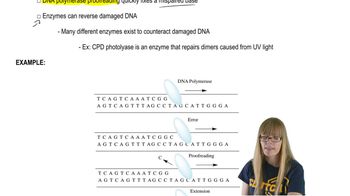
DNA Proofreading

Genome Sequencing

Genome sequencing is the process of determining the complete DNA sequence of an organism's genome. This involves reading the nucleotide sequences and assembling them into a coherent representation of the genome. The presence of repetitive DNA can lead to ambiguities in sequencing data, making it difficult to accurately reconstruct the genome.
Recommended video:
Guided course
08:41
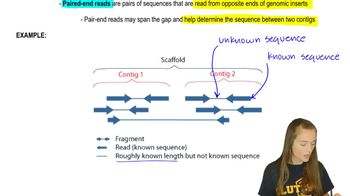
Sequencing Difficulties

Assembly Algorithms

Assembly algorithms are computational methods used to piece together short DNA sequences into longer contiguous sequences, or contigs. These algorithms often struggle with repetitive regions because they can produce multiple valid assemblies, leading to errors or gaps in the final genome representation. Effective handling of repetitive DNA is crucial for accurate genome assembly.
Recommended video:
Guided course
03:49
Ribosome Structure