Pearson+ LogoPearson+ Logo
Ch. 16 - Genomics: Genetics from a Whole-Genome Perspective
Sanders - Genetic Analysis: An Integrated Approach 3rd Edition
Sanders3rd EditionGenetic Analysis: An Integrated ApproachISBN: 9780135564172Not the one you use?Change textbook
Chapter 16, Problem 18

When the human genome is examined, the chromosomes appear to have undergone only minimal rearrangement in the 100 million years since the last common ancestor of eutherian mammals. However, when individual humans are examined or when the human genome is compared with that of chimpanzees, a large number of small indels and SNPs can be detected. How are these observations reconciled?

Verified step by step guidance
1
Understand the difference between large-scale chromosomal rearrangements and small-scale genetic variations. Large-scale rearrangements involve changes like inversions, translocations, or fusions of whole chromosome segments, while small-scale variations include single nucleotide polymorphisms (SNPs) and small insertions or deletions (indels).
Recognize that over long evolutionary timescales (e.g., 100 million years), the overall structure and number of chromosomes in eutherian mammals have remained relatively stable, indicating minimal large-scale rearrangements.
Acknowledge that within species or between closely related species (like humans and chimpanzees), genetic diversity is primarily due to numerous small-scale mutations such as SNPs and indels, which accumulate more rapidly and contribute to individual and species differences.
Explain that the stability of chromosome structure over millions of years does not contradict the presence of many small genetic changes; these small changes do not necessarily alter chromosome structure but can affect genetic sequences and traits.
Conclude that the observations are reconciled by understanding that chromosome structure is conserved over long evolutionary periods, while small-scale genetic variations accumulate more quickly and are responsible for differences observed within and between closely related species.

Verified video answer for a similar problem:

This video solution was recommended by our tutors as helpful for the problem above.
Video duration:
2m
Was this helpful?

Key Concepts

Here are the essential concepts you must grasp in order to answer the question correctly.

Chromosomal Rearrangements and Genome Stability

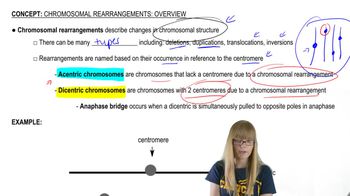
Chromosomal rearrangements involve large-scale changes like inversions, translocations, or fusions that alter chromosome structure. Over long evolutionary timescales, such as 100 million years, these events are relatively rare in eutherian mammals, leading to overall genome stability at the chromosomal level despite species divergence.
Recommended video:
Guided course
04:38
Rearrangement Overview

Small-scale Genetic Variations: SNPs and Indels

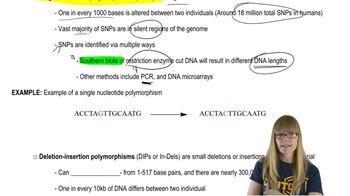
Single nucleotide polymorphisms (SNPs) and small insertions/deletions (indels) are minor genetic changes occurring frequently within populations and between closely related species. These variations contribute to genetic diversity and can accumulate rapidly without altering large chromosomal structures.
Recommended video:
Guided course
09:28
Genomic Variation

Evolutionary Timescales and Genetic Variation

Large chromosomal changes accumulate slowly over millions of years, while small-scale mutations like SNPs and indels arise more rapidly within populations and species. This explains why chromosomes appear stable over long periods, yet individual genomes show abundant small variations when compared within or between species.
Recommended video:
Guided course
09:28
Genomic Variation
Related Practice
Textbook Question

Consider the phylogenetic trees below pertaining to three related species (A, B, and C) that share a common ancestor (last common ancestor, or LCA). The lineage leading to species A diverges before the divergence of species B and C.

For gene Z, gene duplications have occurred in all species. Define orthology and paralogy relationships for the different Z genes.

379
views
Textbook Question

You have isolated a gene that is important for the production of milk and wish to study its regulation. You examine the genomes of human, mouse, dog, chicken, pufferfish, and yeast and note that all genomes except yeast have an orthologous gene.

What does the existence of orthologous genes in chicken and pufferfish tell you about the function of this gene?

437
views
Textbook Question

You have isolated a gene that is important for the production of milk and wish to study its regulation. You examine the genomes of human, mouse, dog, chicken, pufferfish, and yeast and note that all genomes except yeast have an orthologous gene.

How would you identify the regulatory elements important for the expression of your isolated gene in mammary glands?

532
views
Textbook Question

Symbiodinium minutum is a dinoflagellate with a genome size that encodes more than 40,000 protein-coding genes. In contrast, the genome of Plasmodium falciparum has only a little more than 5000 protein-coding genes. Both Symbiodinium and Plasmodium are members of the Alveolate lineage of eukaryotes. What might be the cause of such a wide variation in their genome sizes?

511
views
Textbook Question

Substantial fractions of the genomes of many plants consist of segmental duplications; for example, approximately 40% of genes in the Arabidopsis genome are duplicated. How might you approach the functional characterization of such genes using reverse genetics?

371
views
Textbook Question

A modification of the two-hybrid system, called the one-hybrid system, is used for identifying proteins that can bind specific DNA sequences. In this method, the DNA sequence to be tested, the bait, is fused to a TATA box to drive expression of a reporter gene. The reporter gene is often chosen to complement a mutant phenotype; for example, a HIS gene may be used in a his⁻ mutant yeast strain. A cDNA library is constructed with the cDNA sequences translationally fused to the GAL4 activation domain and transformed into this yeast strain. Diagram how trans-acting proteins that bind to cis-acting regulatory sequences can be identified using a one-hybrid screen.

548
views