Pearson+ LogoPearson+ Logo
Ch. 16 - Genomics: Genetics from a Whole-Genome Perspective
Sanders - Genetic Analysis: An Integrated Approach 3rd Edition
Sanders3rd EditionGenetic Analysis: An Integrated ApproachISBN: 9780135564172Not the one you use?Change textbook
Chapter 16, Problem 17a

You have isolated a gene that is important for the production of milk and wish to study its regulation. You examine the genomes of human, mouse, dog, chicken, pufferfish, and yeast and note that all genomes except yeast have an orthologous gene.
How would you identify the regulatory elements important for the expression of your isolated gene in mammary glands?

Verified step by step guidance
1
Compare the sequences of the orthologous genes across the genomes of human, mouse, dog, chicken, and pufferfish. Look for conserved non-coding regions near the gene, as these are likely to contain regulatory elements important for gene expression.
Focus on conserved regions that are specific to mammals (human, mouse, and dog) since mammary glands are a mammalian feature. These regions are more likely to be involved in mammary gland-specific regulation.
Use bioinformatics tools such as multiple sequence alignment (e.g., Clustal Omega or MUSCLE) to identify conserved sequences. Highlight regions upstream, downstream, or within introns of the gene that are conserved across the mammalian species.
Once candidate regulatory elements are identified, use experimental approaches such as reporter assays. Clone the conserved regions into a reporter construct (e.g., a luciferase or GFP reporter) and test their activity in mammary gland-derived cell lines to confirm their regulatory role.
Perform chromatin immunoprecipitation (ChIP) assays to identify transcription factors that bind to the conserved regulatory elements. This will help confirm the functional importance of these elements in regulating gene expression in mammary glands.

Verified video answer for a similar problem:

This video solution was recommended by our tutors as helpful for the problem above.
Video duration:
2m
Was this helpful?

Key Concepts

Here are the essential concepts you must grasp in order to answer the question correctly.

Orthologs

Orthologs are genes in different species that evolved from a common ancestral gene and typically retain the same function. Identifying orthologous genes across species, such as humans, mice, and dogs, can provide insights into gene function and regulation, as conserved sequences often indicate important regulatory elements.
Recommended video:

Regulatory Elements

Regulatory elements are sequences in the genome that control the expression of genes. These include promoters, enhancers, and silencers, which interact with transcription factors to modulate gene activity. Understanding these elements is crucial for studying how genes are expressed in specific tissues, such as mammary glands.
Recommended video:
Guided course
05:30
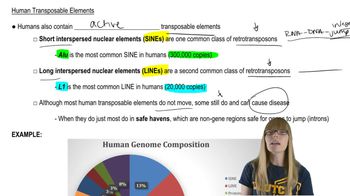
Human Transposable Elements

Gene Expression Analysis Techniques

Gene expression analysis techniques, such as reporter assays, chromatin immunoprecipitation (ChIP), and RNA sequencing, are essential for identifying and studying regulatory elements. These methods allow researchers to assess how different factors influence gene expression and to pinpoint the specific sequences that regulate the isolated gene's activity in mammary glands.
Recommended video:
Guided course
02:09
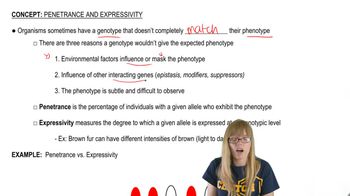
Penetrance and Expressivity
Related Practice
Textbook Question

Consider the phylogenetic trees below pertaining to three related species (A, B, and C) that share a common ancestor (last common ancestor, or LCA). The lineage leading to species A diverges before the divergence of species B and C.

For gene Y, a gene duplication occurred in the lineage leading to A after it diverged from that, leading to B and C. Are genes AY1 and AY2 orthologous or paralogous? Are genes AY1 and BY orthologous or paralogous? Are genes BY and CY orthologous or paralogous?

436
views
Textbook Question

Consider the phylogenetic trees below pertaining to three related species (A, B, and C) that share a common ancestor (last common ancestor, or LCA). The lineage leading to species A diverges before the divergence of species B and C.

For gene Z, gene duplications have occurred in all species. Define orthology and paralogy relationships for the different Z genes.

379
views
Textbook Question

You have isolated a gene that is important for the production of milk and wish to study its regulation. You examine the genomes of human, mouse, dog, chicken, pufferfish, and yeast and note that all genomes except yeast have an orthologous gene.

What does the existence of orthologous genes in chicken and pufferfish tell you about the function of this gene?

437
views
Textbook Question

When the human genome is examined, the chromosomes appear to have undergone only minimal rearrangement in the 100 million years since the last common ancestor of eutherian mammals. However, when individual humans are examined or when the human genome is compared with that of chimpanzees, a large number of small indels and SNPs can be detected. How are these observations reconciled?

441
views
Textbook Question

Symbiodinium minutum is a dinoflagellate with a genome size that encodes more than 40,000 protein-coding genes. In contrast, the genome of Plasmodium falciparum has only a little more than 5000 protein-coding genes. Both Symbiodinium and Plasmodium are members of the Alveolate lineage of eukaryotes. What might be the cause of such a wide variation in their genome sizes?

511
views
Textbook Question

Substantial fractions of the genomes of many plants consist of segmental duplications; for example, approximately 40% of genes in the Arabidopsis genome are duplicated. How might you approach the functional characterization of such genes using reverse genetics?

371
views