Pearson+ LogoPearson+ Logo
Ch. 16 - Genomics: Genetics from a Whole-Genome Perspective
Sanders - Genetic Analysis: An Integrated Approach 3rd Edition
Sanders3rd EditionGenetic Analysis: An Integrated ApproachISBN: 9780135564172Not the one you use?Change textbook
Chapter 16, Problem 3c

When the whole-genome shotgun sequence of the Drosophila genome was assembled, it comprised 134 scaffolds made up of 1636 contigs. How can physical gaps be closed?

Verified step by step guidance
1
Understand the concept of physical gaps: Physical gaps in genome assembly occur when there is missing sequence information between contigs that cannot be bridged by computational methods alone. These gaps need to be closed using experimental techniques.
Step 1: Use paired-end sequencing data. Paired-end reads provide information about the relative positions of sequences on the genome. If the paired reads span a gap, they can help identify the missing sequence and close the gap.
Step 2: Apply PCR amplification. Design primers flanking the gap regions based on the known sequences of adjacent contigs. Amplify the DNA in the gap using PCR and sequence the amplified product to fill the missing information.
Step 3: Utilize long-read sequencing technologies. Technologies like PacBio or Oxford Nanopore can generate longer reads that span gaps, providing direct sequence information for the missing regions.
Step 4: Perform chromosome walking or library screening. Use a genomic library to identify clones that contain sequences bridging the gap. Sequence these clones to close the physical gaps.

Verified video answer for a similar problem:

This video solution was recommended by our tutors as helpful for the problem above.
Video duration:
1m
Was this helpful?

Key Concepts

Here are the essential concepts you must grasp in order to answer the question correctly.

Whole-Genome Shotgun Sequencing

Whole-genome shotgun sequencing is a method used to sequence an entire genome by randomly breaking the DNA into small fragments, which are then sequenced and assembled into a complete sequence. This approach allows for the rapid generation of genomic data, but it often results in gaps due to the random nature of fragment selection, necessitating further techniques to close these gaps.
Recommended video:
Guided course
08:55
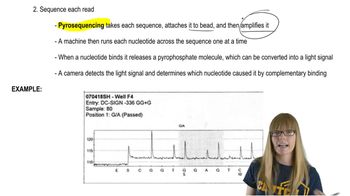
Sequencing Overview

Scaffolds and Contigs

In genome assembly, contigs are contiguous sequences of DNA that are formed by overlapping fragments, while scaffolds are larger structures that consist of multiple contigs linked together. Scaffolds provide a more complete representation of the genome, but gaps may still exist between contigs, which can be addressed through additional sequencing or mapping techniques to improve assembly accuracy.
Recommended video:
Guided course
04:17
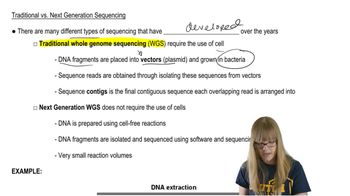
Traditional vs. Next-Gen

Gap Closure Techniques

Gap closure techniques involve various methods to fill in the physical gaps between contigs in a genome assembly. These methods can include targeted sequencing of the gap regions, using paired-end reads to bridge gaps, or employing long-read sequencing technologies that can span larger distances, thereby enhancing the completeness and accuracy of the genomic assembly.
Recommended video:
Guided course
11:19
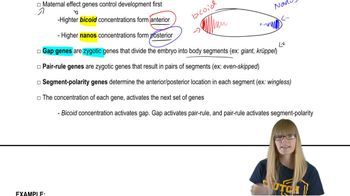
Segmentation Genes