Pearson+ LogoPearson+ Logo
Ch. 18 - Developmental Genetics
Sanders - Genetic Analysis: An Integrated Approach 3rd Edition
Sanders3rd EditionGenetic Analysis: An Integrated ApproachISBN: 9780135564172Not the one you use?Change textbook
Chapter 18, Problem 13b

The bicoid gene is a coordinate maternal–effect gene. A female that is homozygous for a loss-of-function bicoid allele is mated to a wild-type male. What are the phenotypes of their progeny?

Verified step by step guidance
1
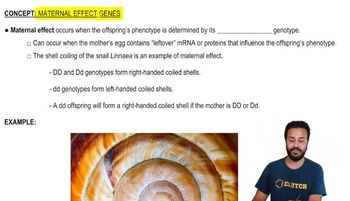
Understand the concept of a maternal-effect gene: Maternal-effect genes are genes whose products (mRNA or proteins) are deposited into the egg by the mother and are essential for early embryonic development. The phenotype of the offspring is determined by the genotype of the mother, not the offspring's own genotype.
Identify the genotype of the mother: The mother is homozygous for a loss-of-function bicoid allele. This means she cannot produce functional bicoid protein, which is critical for establishing the anterior-posterior axis in the embryo.
Identify the genotype of the father: The father is wild-type, meaning he has a functional bicoid allele. However, since bicoid is a maternal-effect gene, the father's genotype does not influence the phenotype of the progeny in this case.
Determine the phenotype of the progeny: Since the mother cannot produce functional bicoid protein, the embryos will lack the bicoid protein necessary for proper anterior development. As a result, the progeny will exhibit a phenotype where the anterior structures (e.g., head and thorax) fail to develop properly, regardless of their own genotype.
Conclude that the progeny’s phenotype is determined solely by the mother’s inability to provide functional bicoid protein, leading to defective anterior development in all offspring.

Verified video answer for a similar problem:

This video solution was recommended by our tutors as helpful for the problem above.
Video duration:
3m
Was this helpful?

Key Concepts

Here are the essential concepts you must grasp in order to answer the question correctly.

Maternal Effect Genes

Maternal effect genes are genes expressed in the mother that produce products (like mRNA or proteins) which are deposited into the egg. These products influence the development of the offspring, regardless of the offspring's own genotype. In the case of the bicoid gene, it plays a crucial role in establishing the anterior-posterior axis in the embryo.
Recommended video:
Guided course
03:38
Maternal Effect

Bicoid Gene Function

The bicoid gene is essential for proper embryonic development in Drosophila (fruit flies). It encodes a transcription factor that is crucial for the formation of the anterior structures of the embryo. A loss-of-function mutation in the bicoid gene results in embryos that lack head and thoracic structures, leading to severe developmental defects.
Recommended video:
Guided course
08:26
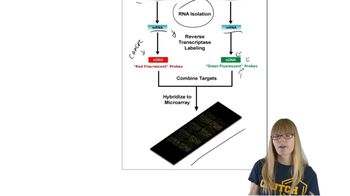
Functional Genomics

Homozygous Loss-of-Function Alleles

A homozygous loss-of-function allele means that both copies of a gene in an organism are non-functional due to mutations. In the context of the bicoid gene, a female that is homozygous for a loss-of-function allele will not produce functional bicoid protein, leading to progeny that are likely to exhibit severe developmental abnormalities, as they will not receive the necessary maternal bicoid products.
Recommended video:
Guided course
08:26
Functional Genomics
Related Practice
Textbook Question

In mammals, identical twins arise when an embryo derived from a single fertilized egg splits into two independent embryos, producing two genetically identical individuals.

What limits might there be, from a developmental genetic viewpoint, as to when this can occur?

408
views
Textbook Question

In mammals, identical twins arise when an embryo derived from a single fertilized egg splits into two independent embryos, producing two genetically identical individuals.

The converse phenotype, fusion of two genetically distinct embryos into a single individual, is also known. What are the genetic implications of such an event?

417
views
Textbook Question

The bicoid gene is a coordinate maternal-effect gene.

A female Drosophila heterozygous for a loss-of-function bicoid allele is mated to a male that is heterozygous for the same allele. What are the phenotypes of their progeny?

549
views
Textbook Question

The bicoid gene is a coordinate maternal–effect gene. If loss of bicoid function in the egg leads to lethality during embryogenesis, how are females homozygous for bicoid produced? What is the phenotype of a male homozygous for bicoid loss-of-function alleles?

397
views
Textbook Question

Given that maternal Bicoid activates the expression of hunchback, what would be the consequence of adding extra copies of the bicoid gene by transgenic means to a wild-type female with two copies, thus creating a female fly with three or four copies of the bicoid gene? How would the hunchback expression be altered? What about the expression of other gap genes and pair-rule genes?

660
views
Textbook Question
What phenotypes do you expect in flies homozygous for loss-of-function mutations in the following genes: Krüppel, odd-skipped, hedgehog, and Ultrabithorax?
494
views