
Textbook Question
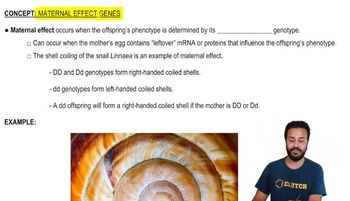
The bicoid gene is a coordinate maternal–effect gene. A female that is homozygous for a loss-of-function bicoid allele is mated to a wild-type male. What are the phenotypes of their progeny?
1071
views

 Verified step by step guidance
 08:26
08:26
 03:38
03:38 07:52
07:52The bicoid gene is a coordinate maternal–effect gene. A female that is homozygous for a loss-of-function bicoid allele is mated to a wild-type male. What are the phenotypes of their progeny?
In mammals, identical twins arise when an embryo derived from a single fertilized egg splits into two independent embryos, producing two genetically identical individuals.
The converse phenotype, fusion of two genetically distinct embryos into a single individual, is also known. What are the genetic implications of such an event?
In gain-of-function let-23 and let-60 C. elegans mutants, all of the vulval precursor cells differentiate with 1° or 2° fates. Do you expect adjacent cells to differentiate with 1° fates or with 2° fates? Explain.
The bicoid gene is a coordinate maternal–effect gene. If loss of bicoid function in the egg leads to lethality during embryogenesis, how are females homozygous for bicoid produced? What is the phenotype of a male homozygous for bicoid loss-of-function alleles?
Given that maternal Bicoid activates the expression of hunchback, what would be the consequence of adding extra copies of the bicoid gene by transgenic means to a wild-type female with two copies, thus creating a female fly with three or four copies of the bicoid gene? How would the hunchback expression be altered? What about the expression of other gap genes and pair-rule genes?
In mammals, identical twins arise when an embryo derived from a single fertilized egg splits into two independent embryos, producing two genetically identical individuals.
What limits might there be, from a developmental genetic viewpoint, as to when this can occur?