Pearson+ LogoPearson+ Logo
Ch. 19 - Genetic Analysis of Quantitative Traits
Sanders - Genetic Analysis: An Integrated Approach 3rd Edition
Sanders3rd EditionGenetic Analysis: An Integrated ApproachISBN: 9780135564172Not the one you use?Change textbook
Chapter 19, Problem 23b

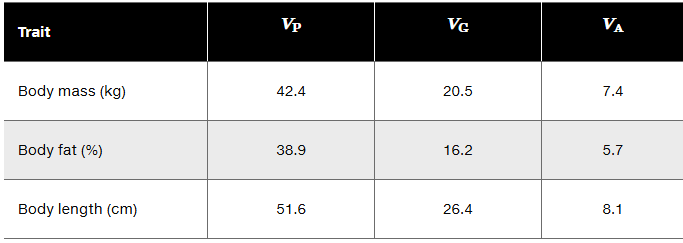
New Zealand lamb breeders measure the following variance values for their herd.
Table showing variance values for body mass, body fat, and body length in lambs with phenotypic, genetic, and additive variances.
How would you characterize the potential response to selection (R) for each trait?

Verified step by step guidance
1
Understand the components of variance given: VP is the phenotypic variance, VG is the genetic variance, and VA is the additive genetic variance. The additive genetic variance (VA) is most important for predicting response to selection because it represents the heritable portion of genetic variance.
Calculate the narrow-sense heritability (h²) for each trait using the formula: h2 = V_AV_P. This value indicates the proportion of phenotypic variance that is due to additive genetic variance.
Interpret the heritability values: higher h² means a greater potential response to selection because more of the trait variation is heritable and can be passed on to offspring.
Use the breeder's equation to understand the response to selection: R = h2 × S, where R is the response to selection and S is the selection differential. Although S is not given, knowing h² allows you to predict the relative potential for response among traits.
Compare the heritability values for body mass, body fat, and body length to characterize which trait is likely to respond most effectively to selection based on their additive genetic variance relative to phenotypic variance.

Verified video answer for a similar problem:

This video solution was recommended by our tutors as helpful for the problem above.
Video duration:
2m
Was this helpful?

Key Concepts

Here are the essential concepts you must grasp in order to answer the question correctly.

Phenotypic Variance (VP)

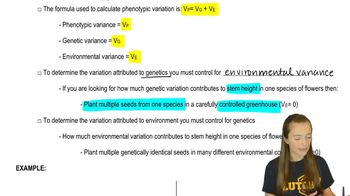
Phenotypic variance (VP) represents the total observed variation in a trait within a population, combining both genetic and environmental influences. It is the sum of genetic variance (VG) and environmental variance (VE). Understanding VP is essential to assess how much variation is available for selection.
Recommended video:
Guided course
08:34
Analyzing Trait Variance

Additive Genetic Variance (VA)

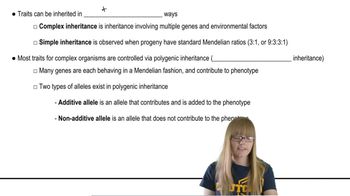
Additive genetic variance (VA) is the portion of genetic variance that contributes to the resemblance between parents and offspring. It reflects the cumulative effect of individual alleles and is crucial for predicting the response to selection, as only VA directly influences the trait's heritability and evolutionary change.
Recommended video:
Guided course
13:40
Traits and Variance

Response to Selection (R) and Heritability

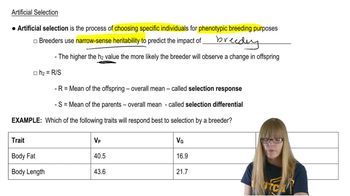
The response to selection (R) quantifies the expected change in a trait after selection and depends on the trait's heritability (h² = VA/VP) and the selection differential. Traits with higher heritability and additive genetic variance typically show greater potential for improvement through selective breeding.
Recommended video:
Guided course
04:15
Artificial Selection
Related Practice
Textbook Question

Suppose a polygenic system for producing color in kernels of a grain is controlled by three additive genes, G, M, and T. There are two alleles of each gene, G₁ and G₂, M₁ and M₂, and T₁ and T₂. The phenotypic effects of the three genotypes of the G gene are G₁G₁ = 6 units of color, G₁G₂ = 3 units of color, and G₂G₂ = 1 unit of color. The phenotypic effects for genes M and T are similar, giving the phenotype of a plant with the genotype G₁G₁M₁M₁T₁T₁ a total of 18 units of color and a plant with the genotype G₂G₂M₂M₂T₂T₂ a total of 3 units of color. Suppose that instead of an additive genetic system, kernel-color determination in this organism is a threshold system. The appearance of color in kernels requires nine or more units of color; otherwise, kernels have no color and appear white. In other words, plants whose phenotypes contain eight or fewer units of color are white. Based on the threshold model, what proportion of the F₂ progeny produced by the trihybrid cross in part (b) will be white?

Explain your answer.

787
views
Textbook Question

Suppose a polygenic system for producing color in kernels of a grain is controlled by three additive genes, G, M, and T. There are two alleles of each gene, G₁ and G₂, M₁ and M₂, and T₁ and T₂. The phenotypic effects of the three genotypes of the G gene are G₁G₁ = 6 units of color, G₁G₂ = 3 units of color, and G₂G₂ = 1 unit of color. The phenotypic effects for genes M and T are similar, giving the phenotype of a plant with the genotype G₁G₁M₁M₁T₁T₁ a total of 18 units of color and a plant with the genotype G₂G₂M₂M₂T₂T₂ a total of 3 units of color.

Assuming the threshold model applies to this kernel-color system, what proportion of the progeny of the cross G₁G₂M₁M₂T₂T₂xG₁G₂M₁M₂T₁T₂ do you expect to display colored kernels?

538
views
Textbook Question

New Zealand lamb breeders measure the following variance values for their herd.

Calculate the broad sense heritability (H²) and the narrow sense heritability (h²) for each trait in this lamb herd.

390
views
Textbook Question

Cattle breeders would like to improve the protein content and butterfat content of milk produced by a herd of cows. Narrow sense heritability values are 0.60 for protein content and 0.80 for butterfat content. The average percentages of these traits in the herd and the percentages of the traits in cows selected for breeding are as follows. Trait Herd Average Selected Cows Protein content 20.2% 22.7% Butterfat content  6.5%  7.4% Determine the selection differential (S) for each trait in this herd.

452
views
Textbook Question

Cattle breeders would like to improve the protein content and butterfat content of milk produced by a herd of cows. Narrow sense heritability values are 0.60 for protein content and 0.80 for butterfat content. The average percentages of these traits in the herd and the percentages of the traits in cows selected for breeding are as follows. Trait Herd Average Selected Cows Protein content 20.2% 22.7% Butterfat content  6.5%  7.4% Which trait is likely to be the most responsive to artificial selection applied by the cattle breeders through selection of cows for mating?

373
views
Textbook Question

In human gestational development, abnormalities of the closure of the lower part of the mid-face can result in cleft lip, if the lip alone is affected by the closure defect, or in cleft lip and palate (the roof of the mouth), if the closure defect is more extensive. Cleft lip and cleft lip with cleft palate are multifactorial disorders that are threshold traits. A family with a history of either condition has a significantly increased chance of a recurrence of mid-face cleft disorder in comparison with families without such a history. However, the recurrence risk of a mid-face cleft disorder is higher in families with a history of cleft lip with cleft palate than in families with a history of cleft lip alone. Suppose a friend of yours who has not taken genetics asks you to explain these observations. Construct a genetic explanation for the increased recurrence risk of mid-face clefting in families that have a history of cleft disorders versus families without a history of such disorders.

434
views