Answer the following in regard to multifactorial traits in human twins. If the trait is produced with little contribution from genetic variation, what would you expect to see if you compared the concordance rates of MZ twins versus DZ twins? Explain your reasoning.

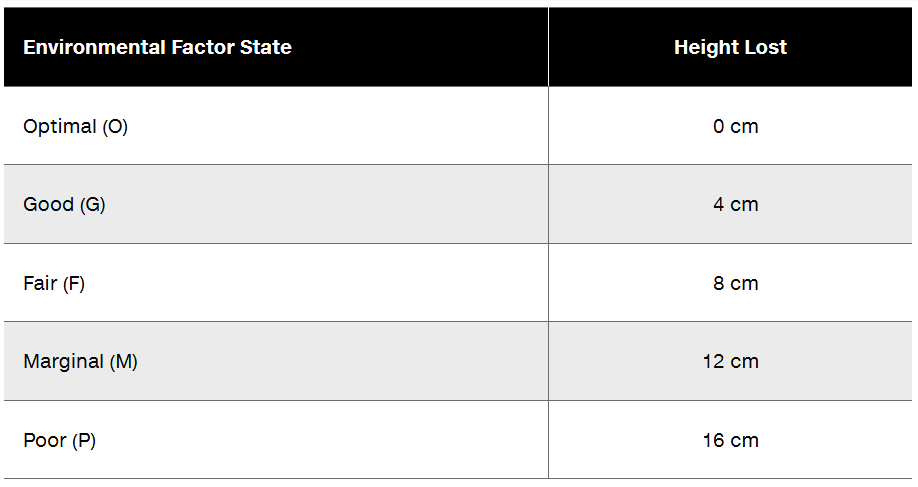
Suppose the mature height of a plant is a multifactorial trait under the control of five independently assorting genes, designated A, B, C, D, and E, and five environmental factors. There are two alleles of each gene (A₁, A₂, etc.). Each allele with a subscript 1 (i.e., A₁) contributes 5 cm to potential plant height, and each allele with a subscript 2 (i.e., A₂, etc.) contributes 10 cm to potential plant height. In other words, a genotype containing only 1 allele (A₁A₁B₁B₁C₁C₁D₁D₁E₁E₁) would have a potential height of [(10)(5)]=50 cm, and a genotype with only 2 alleles (A₂A₂B₂B₂C₂C₂D₂D₂E₂E₂) would have a potential height of [(10)(10)]=100 cm. The five environmental factors are (1) amount of water, (2) amount of sunlight, (3) soil drainage, (4) nutrient content of soil, and (5) temperature. Each environmental factor can vary from optimal to poor. If all factors are optimal, assume that full potential height is attained. However, if one or more of the environmental factors is less than optimal, then height is reduced. The state of each environmental factor has an effect on growth. In this exercise, we'll assume that the growth is affected according to the following scale:

Thus, for example, if one environmental factor is optimal, two are good, one is fair, and one is marginal, the loss of potential height is 0 + 4 + 4 + 8 + 12 = 28 cm. If the loss of height potential is greater than the height potential of the plant, the plant does not survive. Calculate the potential height, based on inherited alleles, and the attained height, based on growth in the environmental circumstances given, for the three plants (a, b, and c) in the accompanying table.
Verified step by step guidance
Verified video answer for a similar problem:
Key Concepts
Multifactorial Traits
Genotype and Phenotype
Environmental Impact on Growth
Suppose the mature height of a plant is a multifactorial trait under the control of five independently assorting genes, designated A, B, C, D, and E, and five environmental factors. There are two alleles of each gene (A₁, A₂, etc.). Each allele with a subscript 1 (i.e., A₁) contributes 5 cm to potential plant height, and each allele with a subscript 2 (i.e., A₂, etc.) contributes 10 cm to potential plant height. In other words, a genotype containing only 1 allele (A₁A₁B₁B₁C₁C₁D₁D₁E₁E₁) would have a potential height of [(10)(5)]=50 cm, and a genotype with only 2 alleles (A₂A₂B₂B₂C₂C₂D₂D₂E₂E₂) would have a potential height of [(10)(10)]=100 cm. The five environmental factors are (1) amount of water, (2) amount of sunlight, (3) soil drainage, (4) nutrient content of soil, and (5) temperature. Each environmental factor can vary from optimal to poor. If all factors are optimal, assume that full potential height is attained. However, if one or more of the environmental factors is less than optimal, then height is reduced. The state of each environmental factor has an effect on growth. In this exercise, we'll assume that the growth is affected according to the following scale:
Thus, for example, if one environmental factor is optimal, two are good, one is fair, and one is marginal, the loss of potential height is 0 + 4 + 4 + 8 + 12 = 28 cm. If the loss of height potential is greater than the height potential of the plant, the plant does not survive. If two plants that each have a height potential of 75 cm are crossed, what proportion of the progeny will have a height potential of 80 cm?.
A three-gene system of additive genes (A, B, and C) controls plant height. Each gene has two alleles (A and a, B and b, and C and c). There is dominance among the alleles of each gene, with alleles A, B, and C dominant over a, b, and c. Under this scheme, the dominant genotype for a gene contributes 10 cm to height potential, and the recessive genotype contributes 4 cm. What is the height potential of a plant that is homozygous for all three dominant alleles?