Pearson+ LogoPearson+ Logo
Ch. 19 - Genetic Analysis of Quantitative Traits
Sanders - Genetic Analysis: An Integrated Approach 3rd Edition
Sanders3rd EditionGenetic Analysis: An Integrated ApproachISBN: 9780135564172Not the one you use?Change textbook
Chapter 19, Problem 28d

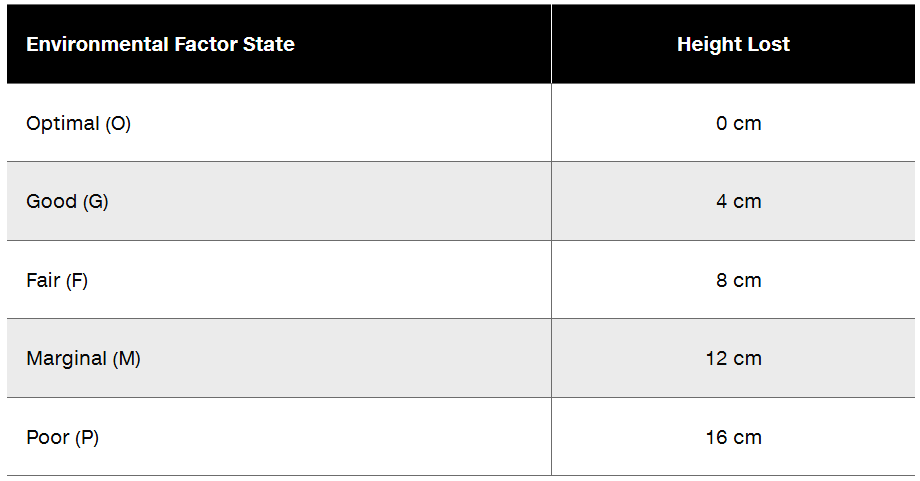
Suppose the mature height of a plant is a multifactorial trait under the control of five independently assorting genes, designated A, B, C, D, and E, and five environmental factors. There are two alleles of each gene (A₁, A₂, etc.). Each allele with a subscript 1 (i.e., A₁) contributes 5 cm to potential plant height, and each allele with a subscript 2 (i.e., A₂, etc.) contributes 10 cm to potential plant height. In other words, a genotype containing only 1 allele (A₁A₁B₁B₁C₁C₁D₁D₁E₁E₁) would have a potential height of [(10)(5)]=50 cm, and a genotype with only 2 alleles (A₂A₂B₂B₂C₂C₂D₂D₂E₂E₂) would have a potential height of [(10)(10)]=100 cm. The five environmental factors are (1) amount of water, (2) amount of sunlight, (3) soil drainage, (4) nutrient content of soil, and (5) temperature. Each environmental factor can vary from optimal to poor. If all factors are optimal, assume that full potential height is attained. However, if one or more of the environmental factors is less than optimal, then height is reduced. The state of each environmental factor has an effect on growth. In this exercise, we'll assume that the growth is affected according to the following scale:
Table showing environmental factor states and corresponding height loss for plants, with categories from optimal to poor.
Thus, for example, if one environmental factor is optimal, two are good, one is fair, and one is marginal, the loss of potential height is 0 + 4 + 4 + 8 + 12 = 28 cm. If the loss of height potential is greater than the height potential of the plant, the plant does not survive. If two plants that each have a height potential of 75 cm are crossed, what proportion of the progeny will have a height potential of 80 cm?.
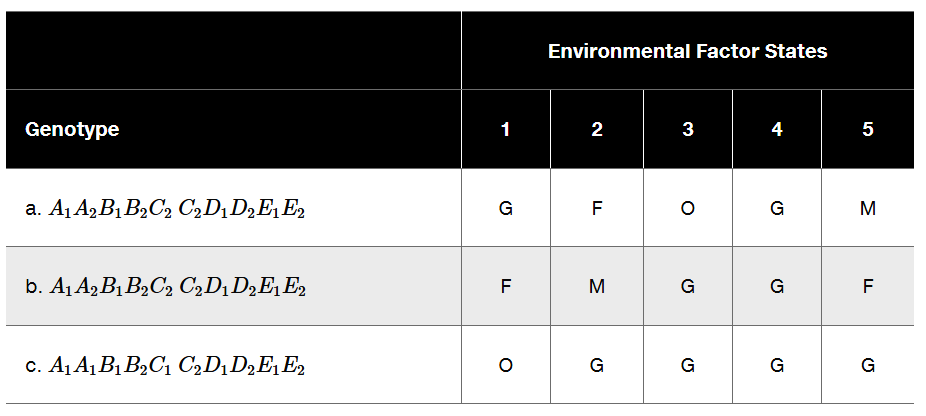
Table displaying genotypes and their corresponding environmental factor states affecting plant height potential.

Verified step by step guidance
1
Step 1: Understand the genetic contribution to height potential. Each gene (A, B, C, D, E) has two alleles, where A₁ contributes 5 cm and A₂ contributes 10 cm to the plant's potential height. Calculate the genetic height potential of the progeny by summing the contributions of all alleles in their genotype.
Step 2: Determine the possible genotypes of the progeny. Since both parents have a height potential of 75 cm, their genotypes must be heterozygous for all five genes (A₁A₂B₁B₂C₁C₂D₁D₂E₁E₂). Use a Punnett square or probability rules to calculate the proportion of progeny with a specific genotype that results in a height potential of 80 cm.
Step 3: Calculate the genetic height potential for each possible progeny genotype. For example, if a progeny inherits A₁A₂, B₁B₂, C₂C₂, D₁D₂, and E₁E₂, sum the contributions of each allele to determine the total genetic height potential.
Step 4: Consider the environmental factors. The problem specifies that environmental factors can reduce the height potential. However, since the question asks for the proportion of progeny with a genetic height potential of 80 cm, environmental factors do not need to be considered in this calculation.
Step 5: Sum the probabilities of all genotypes that result in a genetic height potential of 80 cm. Divide this sum by the total number of possible progeny genotypes to determine the proportion of progeny with a height potential of 80 cm.

Verified video answer for a similar problem:

This video solution was recommended by our tutors as helpful for the problem above.
Video duration:
2m
Was this helpful?

Key Concepts

Here are the essential concepts you must grasp in order to answer the question correctly.

Multifactorial Traits

Multifactorial traits are characteristics influenced by multiple genes and environmental factors. In this case, the mature height of the plant is determined by five genes, each with two alleles, and five environmental conditions. The interaction between these genetic and environmental components results in a range of phenotypes, making it essential to consider both when predicting traits.
Recommended video:
Guided course
13:40
Traits and Variance

Genotype and Phenotype

The genotype refers to the genetic makeup of an organism, while the phenotype is the observable expression of that genotype influenced by the environment. In the context of the question, the potential height of the plant is determined by its genotype (specific alleles) and modified by environmental factors, illustrating the relationship between genetics and physical traits.
Recommended video:
Guided course
07:52
Gamete Genotypes

Environmental Impact on Growth

Environmental factors significantly affect the growth and development of organisms. In this scenario, the height potential of the plants can be reduced based on the state of five environmental factors, each contributing to a specific height loss. Understanding how these factors interact with genetic potential is crucial for predicting the final height of the progeny.
Recommended video:
Guided course
08:34
Cancer Causes
Related Practice
Textbook Question
Suppose the mature height of a plant is a multifactorial trait under the control of five independently assorting genes, designated A, B, C, D, and E, and five environmental factors. There are two alleles of each gene (A₁, A₂, etc.). Each allele with a subscript 1 (i.e., A₁) contributes 5 cm to potential plant height, and each allele with a 2 subscript (i.e., A₂, etc.) contributes 10 cm to potential plant height. In other words, a genotype containing only 1 alleles (A₁A₁B₁B₁C₁C₁D₁D₁E₁E₁) would have a potential height of [(10)(5)]=50cm, and a genotype with only 2 alleles (A₂A₂B₂B₂C₂C₂D₂D₂E₂E₂) would have a potential height of [(10)(10)]=100cm.The five environmental factors are (1) amount of water, (2) amount of sunlight, (3) soil drainage, (4) nutrient content of soil, and (5) temperature. Each environmental factor can vary from optimal to poor. If all factors are optimal, assume that full potential height is attained. However, if one or more of the environmental factors is less than optimal, then height is reduced. The state of each environmental factor has an effect on growth. In this exercise, we'll assume that the growth is affected according to the following scale:Environmental Factor State Height LostOptimal (O) 0 cmGood (G) 4 cmFair (F) 8 cmMarginal (M) 12 cmPoor (P) 16 cmThus, for example, if one environmental factor is optimal, two are good, one is fair, and one is marginal, the loss of potential height is . If the loss of height potential is greater than the height potential of the plant, the plant does not survive.How many 1 and 2 alleles must be present to give a height potential of 80 cm?
403
views
Textbook Question
Suppose the mature height of a plant is a multifactorial trait under the control of five independently assorting genes, designated A, B, C, D, and E, and five environmental factors. There are two alleles of each gene (A₁, A₂, etc.). Each allele with a subscript 1 (i.e., A₁) contributes 5 cm to potential plant height, and each allele with a 2 subscript (i.e., A₂, etc.) contributes 10 cm to potential plant height. In other words, a genotype containing only 1 alleles (A₁A₁B₁B₁C₁C₁D₁D₁E₁E₁) would have a potential height of [(10)(5)]=50cm, and a genotype with only 2 alleles (A₂A₂B₂B₂C₂C₂D₂D₂E₂E₂) would have a potential height of [(10)(10)]=100cm.The five environmental factors are (1) amount of water, (2) amount of sunlight, (3) soil drainage, (4) nutrient content of soil, and (5) temperature. Each environmental factor can vary from optimal to poor. If all factors are optimal, assume that full potential height is attained. However, if one or more of the environmental factors is less than optimal, then height is reduced. The state of each environmental factor has an effect on growth. In this exercise, we'll assume that the growth is affected according to the following scale:Environmental Factor State Height LostOptimal (O) 0 cmGood (G) 4 cmFair (F) 8 cmMarginal (M) 12 cmPoor (P) 16 cmThus, for example, if one environmental factor is optimal, two are good, one is fair, and one is marginal, the loss of potential height is . If the loss of height potential is greater than the height potential of the plant, the plant does not survive.List two genotypes that have a height potential of 80 cm.
516
views
Textbook Question

Suppose the mature height of a plant is a multifactorial trait under the control of five independently assorting genes, designated A, B, C, D, and E, and five environmental factors. There are two alleles of each gene (A₁, A₂, etc.). Each allele with a subscript 1 (i.e., A₁) contributes 5 cm to potential plant height, and each allele with a subscript 2 (i.e., A₂, etc.) contributes 10 cm to potential plant height. In other words, a genotype containing only 1 allele (A₁A₁B₁B₁C₁C₁D₁D₁E₁E₁) would have a potential height of [(10)(5)]=50 cm, and a genotype with only 2 alleles (A₂A₂B₂B₂C₂C₂D₂D₂E₂E₂) would have a potential height of [(10)(10)]=100 cm. The five environmental factors are (1) amount of water, (2) amount of sunlight, (3) soil drainage, (4) nutrient content of soil, and (5) temperature. Each environmental factor can vary from optimal to poor. If all factors are optimal, assume that full potential height is attained. However, if one or more of the environmental factors is less than optimal, then height is reduced. The state of each environmental factor has an effect on growth. In this exercise, we'll assume that the growth is affected according to the following scale:

Thus, for example, if one environmental factor is optimal, two are good, one is fair, and one is marginal, the loss of potential height is 0 + 4 + 4 + 8 + 12 = 28 cm. If the loss of height potential is greater than the height potential of the plant, the plant does not survive. Calculate the potential height, based on inherited alleles, and the attained height, based on growth in the environmental circumstances given, for the three plants (a, b, and c) in the accompanying table.

606
views
Textbook Question
A three-gene system of additive genes (A, B, and C) controls plant height. Each gene has two alleles (A and a, B and b, and C and c). There is dominance among the alleles of each gene, with alleles A, B, and C dominant over a, b, and c. Under this scheme, the dominant genotype for a gene contributes 10 cm to height potential, and the recessive genotype contributes 4 cm.What is the height potential of a plant that is homozygous for all three recessive alleles?
632
views
Textbook Question

A three-gene system of additive genes (A, B, and C) controls plant height. Each gene has two alleles (A and a, B and b, and C and c). There is dominance among the alleles of each gene, with alleles A, B, and C dominant over a, b, and c. Under this scheme, the dominant genotype for a gene contributes 10 cm to height potential, and the recessive genotype contributes 4 cm. What is the height potential of a plant that is homozygous for all three dominant alleles?

837
views
Textbook Question

Congenital dislocation of the hip is a threshold condition in which the head of the femur (the femoral head) is out of its normal position relative to the bones that will form the socket of the hip (the acetabulum). This misplacement can lead to potentially serious orthopedic problems later in life if the condition is not treated in infancy. Numerous studies have shown that:

(a) Brothers and sisters of infants born with congenital hip dislocation are more likely to develop the condition than are the siblings of those without the condition. These studies also find that

(b) More female infants than male infants have the trait, and

(c) If the affected child is a girl, the risk to her siblings is lower than if the affected infant is a boy.

Explain the meaning of the three observations (a, b, and c) in the context of proposing a threshold model that explains these observations.

392
views