A man, J.B., has a sister with autosomal recessive galactosemia (OMIM 230400), and his partner, S.B., has a brother with galactosemia. Galactosemia is a serious condition caused by an enzyme deficiency that prevents the metabolism of the sugar galactose. Neither J.B. nor S.B. has galactosemia, but they are concerned about the risk that a future child of theirs will have the condition. What is the probability their first child will have galactosemia?
Ch. 2 - Transmission Genetics

Sanders3rd EditionGenetic Analysis: An Integrated ApproachISBN: 9780135564172Not the one you use?Change textbook
Chapter 2, Problem A.6
A 40-year-old woman whose father had Huntington disease currently shows no symptoms of the disease. She is newly pregnant with her first child and seeks your best estimate of the chance her child will inherit the disease. What is your estimate and how did you arrive at it? (Hint: See Figure 4.11)
Verified step by step guidance1
Understand that Huntington disease is an autosomal dominant disorder, meaning only one copy of the mutated gene is needed for the disease to manifest.
Since the woman's father had Huntington disease, he must have had one mutated allele (H) and one normal allele (h), so his genotype is likely Hh.
The woman currently shows no symptoms, but because Huntington disease has late onset and incomplete penetrance, she could still be a carrier with genotype Hh or be hh (normal). The chance she inherited the mutated allele from her affected father is 50%, or 1/2.
If the woman is Hh, the chance of passing the mutated allele to her child is 50%, or 1/2. If she is hh, the chance is 0%.
To find the overall chance her child will inherit the disease, multiply the probability the woman is a carrier (1/2) by the probability she passes the mutated allele (1/2), resulting in an overall probability of .

Verified video answer for a similar problem:
This video solution was recommended by our tutors as helpful for the problem above.
Video duration:
3mWas this helpful?
Key Concepts
Here are the essential concepts you must grasp in order to answer the question correctly.
Autosomal Dominant Inheritance
Huntington disease is inherited in an autosomal dominant pattern, meaning only one copy of the mutated gene from an affected parent is sufficient to cause the disease. Each child of an affected individual has a 50% chance of inheriting the mutation and developing the disorder.
Recommended video:
Guided course
Variations on Dominance
Penetrance and Age of Onset
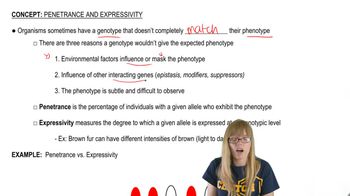
Huntington disease shows age-dependent penetrance, often manifesting symptoms in mid-adulthood. A person may carry the mutation without symptoms early in life, so an asymptomatic 40-year-old with an affected parent could still carry the gene and develop symptoms later.
Recommended video:
Guided course
Penetrance and Expressivity
Risk Estimation Using Family History and Genetic Testing
Estimating the child's risk involves assessing the mother's probability of carrying the mutation based on her affected father and her current symptom-free status. Genetic testing can confirm her status, but without it, the risk to the child is half the mother's risk of being a carrier.
Recommended video:
Guided course
History of Genetics
Related Practice
Textbook Question
693
views
Textbook Question
A woman, S.R., had a maternal grandfather with hemophilia A (OMIM 306700), an X-linked recessive condition that reduces blood clotting. S.R.'s maternal grandmother and paternal grandparents are free of the condition, as are her partner, his parents, and his grandparents. S.R. has no siblings. She wants to know the chance that a son of hers will have the condition. What is that probability?
549
views
Textbook Question
Compare and contrast the following terms:
Dominant and Recessive
652
views
Textbook Question
Compare and contrast the following terms:
Genotype and Phenotype
794
views
Textbook Question
Compare and contrast the following terms:
Homozygous and Heterozygous
525
views
