A woman, S.R., had a maternal grandfather with hemophilia A (OMIM 306700), an X-linked recessive condition that reduces blood clotting. S.R.'s maternal grandmother and paternal grandparents are free of the condition, as are her partner, his parents, and his grandparents. S.R. has no siblings. She wants to know the chance that a son of hers will have the condition. What is that probability?
Ch. 2 - Transmission Genetics

Sanders3rd EditionGenetic Analysis: An Integrated ApproachISBN: 9780135564172Not the one you use?Change textbook
Chapter 2, Problem 1b
Compare and contrast the following terms:
Genotype and Phenotype
Verified step by step guidance1
Understand that 'genotype' refers to the genetic makeup of an organism, specifically the alleles (versions of a gene) that an organism carries for a particular trait. For example, an organism might have the genotype 'Aa' for a gene where 'A' and 'a' are two alleles.
Recognize that 'phenotype' refers to the observable physical or physiological traits of an organism, which result from the interaction of the genotype with the environment. For example, the phenotype might be the color of a flower, such as purple or white.
Compare the two terms: Genotype is the underlying genetic code, while phenotype is the outward expression of that code. For instance, a plant with the genotype 'Aa' might have a purple flower phenotype if 'A' is dominant over 'a'.
Contrast the two terms: Genotype is not directly observable without genetic testing, while phenotype is typically visible or measurable. Additionally, the same genotype can produce different phenotypes under different environmental conditions.
Summarize the relationship: The genotype determines the potential for a phenotype, but the phenotype is the result of both the genotype and environmental influences. This distinction is key in understanding how traits are inherited and expressed.

Verified video answer for a similar problem:
This video solution was recommended by our tutors as helpful for the problem above.
Video duration:
1mWas this helpful?
Key Concepts
Here are the essential concepts you must grasp in order to answer the question correctly.
Genotype
The genotype refers to the genetic makeup of an organism, encompassing all the alleles inherited from its parents. It is the specific set of genes that an individual carries, which can influence various traits. Genotypes are often represented using letters, such as 'AA', 'Aa', or 'aa', indicating dominant and recessive alleles. Understanding genotype is crucial for predicting inheritance patterns and potential traits in offspring.
Recommended video:
Guided course
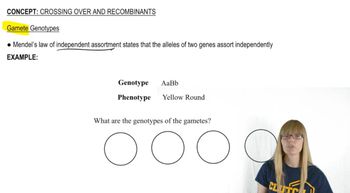
Gamete Genotypes
Phenotype
The phenotype is the observable physical and physiological traits of an organism, resulting from the interaction of its genotype with the environment. This includes characteristics such as height, eye color, and behavior. While the genotype provides the potential for certain traits, the phenotype is the actual expression of those traits, which can be influenced by environmental factors. Thus, two organisms with the same genotype may exhibit different phenotypes.
Recommended video:
Guided course
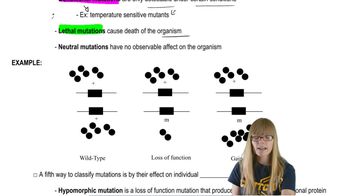
Mutations and Phenotypes
Relationship between Genotype and Phenotype
The relationship between genotype and phenotype is fundamental in genetics, as the genotype determines the potential traits an organism can express, while the phenotype is the manifestation of those traits. Environmental factors can modify how a genotype is expressed, leading to variations in phenotype. This interplay is essential for understanding concepts like natural selection and evolution, where certain phenotypes may be favored in specific environments, influencing reproductive success.
Recommended video:
Guided course
Gamete Genotypes
Related Practice
Textbook Question
549
views
Textbook Question
A 40-year-old woman whose father had Huntington disease currently shows no symptoms of the disease. She is newly pregnant with her first child and seeks your best estimate of the chance her child will inherit the disease. What is your estimate and how did you arrive at it? (Hint: See Figure 4.11)
484
views
Textbook Question
Compare and contrast the following terms:
Dominant and Recessive
652
views
Textbook Question
Compare and contrast the following terms:
Homozygous and Heterozygous
525
views
Textbook Question
Compare and contrast the following terms:
Monohybrid cross and Test cross
631
views
Textbook Question
Compare and contrast the following terms:
Dihybrid cross and Trihybrid cross
648
views