Ch. 2 - Transmission Genetics
Sanders - Genetic Analysis: An Integrated Approach 3rd Edition
Sanders3rd EditionGenetic Analysis: An Integrated ApproachISBN: 9780135564172Not the one you use?Change textbook
Chapter 2, Problem A.5

A woman, S.R., had a maternal grandfather with hemophilia A (OMIM 306700), an X-linked recessive condition that reduces blood clotting. S.R.'s maternal grandmother and paternal grandparents are free of the condition, as are her partner, his parents, and his grandparents. S.R. has no siblings. She wants to know the chance that a son of hers will have the condition. What is that probability?

Verified step by step guidance
1
Identify the inheritance pattern: Hemophilia A is an X-linked recessive disorder, meaning the gene causing the condition is located on the X chromosome, and males (XY) are affected if they inherit the affected X chromosome, while females (XX) are typically carriers if they have one affected X chromosome.
Determine the genotype of S.R.'s maternal grandfather: Since he had hemophilia A, he must have had the affected X chromosome (Xᴴ) and a Y chromosome (XᴴY), where Xᴴ represents the affected X chromosome.
Analyze S.R.'s mother’s genotype: Because S.R.'s maternal grandfather was affected and the maternal grandmother was unaffected, S.R.'s mother must be a carrier (XᴴX) — she inherited the affected X chromosome from her father and a normal X chromosome from her mother.
Calculate the probability that S.R. inherited the affected X chromosome from her mother: Since S.R.'s mother is a carrier (XᴴX), there is a 50% chance that S.R. inherited the affected X chromosome (Xᴴ) and a 50% chance she inherited the normal X chromosome (X).
Determine the probability that S.R.'s son will have hemophilia A: If S.R. is a carrier (XᴴX), each son has a 50% chance of inheriting the affected X chromosome (Xᴴ) and thus having hemophilia A. Multiply this by the probability that S.R. is a carrier (from step 4) to find the overall chance that her son will have the condition.

Verified video answer for a similar problem:

This video solution was recommended by our tutors as helpful for the problem above.
Video duration:
1m
Was this helpful?

Key Concepts

Here are the essential concepts you must grasp in order to answer the question correctly.

X-linked Recessive Inheritance

X-linked recessive disorders are caused by mutations on the X chromosome. Males, having one X chromosome, are affected if they inherit the mutated gene, while females, with two X chromosomes, are typically carriers unless both X chromosomes carry the mutation. This pattern explains why males are more frequently affected.
Recommended video:
Guided course
09:30
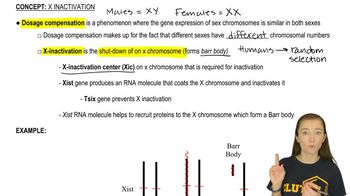
X-Inactivation

Carrier Status and Transmission Risk

A female carrier of an X-linked recessive mutation has a 50% chance of passing the mutated gene to her children. Sons who inherit the mutation will be affected, while daughters who inherit it become carriers. Determining carrier status is essential to estimate the risk of affected offspring.
Recommended video:
Guided course
06:59
RNA Interference

Pedigree Analysis and Probability Calculation

Analyzing family history helps identify carriers and affected individuals. In this case, the maternal grandfather had hemophilia, so the mother’s mother is likely a carrier. Using this information, one can calculate the probability that S.R. is a carrier and then the chance her son will inherit the condition.
Recommended video: