Pearson+ LogoPearson+ Logo
Ch. 2 - Transmission Genetics
Sanders - Genetic Analysis: An Integrated Approach 3rd Edition
Sanders3rd EditionGenetic Analysis: An Integrated ApproachISBN: 9780135564172Not the one you use?Change textbook
Chapter 2, Problem 43

A pure-breeding fruit fly with the recessive mutation cut wing, caused by the homozygous cc genotype, is crossed to a pure-breeding fly with normal wings, genotype CC. Their F1 progeny all have normal wings. F1 flies are crossed, and the F2 progeny have a 3:1 ratio of normal wing to cut wing. One male F2 fly with normal wings is selected at random and mated to an F2 female with normal wings. Using all possible genotypes of the F2 flies selected for this cross, list all possible crosses between the two flies involved in this mating, and determine the probability of each possible outcome.

Verified step by step guidance
1
Step 1: Understand the inheritance pattern. The cut wing mutation is recessive, meaning the phenotype appears only when the genotype is homozygous recessive (cc). Normal wings are dominant, so flies with genotypes CC or Cc will have normal wings.
Step 2: Analyze the F₂ generation. The F₁ flies are heterozygous (Cc) and produce F₂ progeny with a 3:1 phenotypic ratio of normal wings to cut wings. This ratio corresponds to genotypes CC, Cc, and cc in a 1:2:1 ratio.
Step 3: Identify the genotypes of the selected F₂ flies. Since both selected flies have normal wings, their genotypes could be either CC (homozygous dominant) or Cc (heterozygous). This gives four possible crosses: CC × CC, CC × Cc, Cc × CC, and Cc × Cc.
Step 4: Determine the offspring genotypes for each possible cross. Use a Punnett square for each combination: (1) CC × CC produces 100% CC offspring, (2) CC × Cc produces 50% CC and 50% Cc offspring, (3) Cc × CC produces 50% CC and 50% Cc offspring, and (4) Cc × Cc produces 25% CC, 50% Cc, and 25% cc offspring.
Step 5: Calculate the probabilities of each outcome. Since the F₂ flies are randomly selected, the probability of each genotype combination depends on the genotype frequencies in the F₂ generation (1/4 CC, 1/2 Cc, 1/4 cc). Multiply these probabilities to determine the likelihood of each cross and its resulting offspring distribution.

Verified video answer for a similar problem:

This video solution was recommended by our tutors as helpful for the problem above.
Video duration:
4m
Was this helpful?

Key Concepts

Here are the essential concepts you must grasp in order to answer the question correctly.

Mendelian Genetics

Mendelian genetics is the study of how traits are inherited through generations, based on the principles established by Gregor Mendel. It includes concepts such as dominant and recessive alleles, where dominant alleles mask the effects of recessive ones. In this scenario, the normal wing trait (C) is dominant over the cut wing trait (c), leading to the observed phenotypic ratios in the progeny.
Recommended video:
Guided course
03:45
Descriptive Genetics

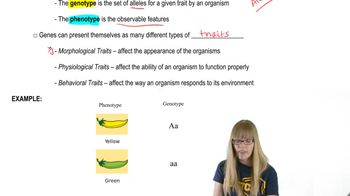
Genotype and Phenotype

The genotype refers to the genetic makeup of an organism, while the phenotype is the observable physical or biochemical characteristics. In this case, the genotypes CC and cc correspond to the phenotypes of normal wings and cut wings, respectively. Understanding the relationship between genotype and phenotype is crucial for predicting the outcomes of genetic crosses.
Recommended video:
Guided course
07:52
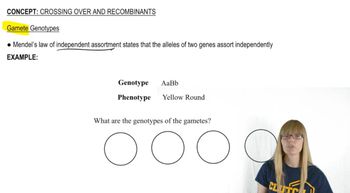
Gamete Genotypes

Punnett Square

A Punnett square is a diagram used to predict the genotypes of offspring from a genetic cross. It allows for the visualization of all possible combinations of alleles from the parents. In this question, constructing a Punnett square for the F₂ generation will help determine the probabilities of different wing types in the offspring resulting from the mating of two normal-winged flies.
Recommended video:
Guided course
18:27
Chi Square Analysis
Related Practice
Textbook Question

Humans vary in many ways from one another. Among many minor phenotypic differences are the following five independently assorting traits that (sort of) have a dominant and a recessive phenotype: (1) forearm hair (alleles F and f )—the presence of hair on the forearm is dominant to the absence of hair on the forearm; (2) earlobe form (alleles E and e)—unattached earlobes are dominant to attached earlobes; (3) widow's peak (alleles W and w)—a distinct 'V' shape to the hairline at the top of the forehead is dominant to a straight hairline; (4) hitchhiker's thumb (alleles H and h)—the ability to bend the thumb back beyond vertical is dominant and the inability to do so is recessive; and (5) freckling (alleles D and d)—the appearance of freckles is dominant to the absence of freckles. In reality, the genetics of these traits are more complicated than single gene variation, but assume for the purposes of this problem that the patterns in families match those of other single-gene variants.

If a couple with the genotypes Ff Ee Ww Hh Dd and Ff Ee Ww Hh Dd have children, what is the chance the children will inherit the following characteristics?


all recessive traits

504
views
Textbook Question

Humans vary in many ways from one another. Among many minor phenotypic differences are the following five independently assorting traits that (sort of) have a dominant and a recessive phenotype: (1) forearm hair (alleles F and f )—the presence of hair on the forearm is dominant to the absence of hair on the forearm; (2) earlobe form (alleles E and e)—unattached earlobes are dominant to attached earlobes; (3) widow's peak (alleles W and w)—a distinct 'V' shape to the hairline at the top of the forehead is dominant to a straight hairline; (4) hitchhiker's thumb (alleles H and h)—the ability to bend the thumb back beyond vertical is dominant and the inability to do so is recessive; and (5) freckling (alleles D and d)—the appearance of freckles is dominant to the absence of freckles. In reality, the genetics of these traits are more complicated than single gene variation, but assume for the purposes of this problem that the patterns in families match those of other single-gene variants.

If a couple with the genotypes Ff Ee Ww Hh Dd and Ff Ee Ww Hh Dd have children, what is the chance the children will inherit the following characteristics?


the genotype Ff EE Ww hh dd

457
views
Textbook Question

In chickens, the presence of feathers on the legs is due to a dominant allele (F), and the absence of leg feathers is due to a recessive allele (f). The comb on the top of the head can be either pea-shaped, a phenotype that is controlled by a dominant allele (P), or a single comb controlled by a recessive allele (p). The two genes assort independently. Assume that a pure-breeding rooster that has feathered legs and a single comb is crossed with a pure-breeding hen that has no leg feathers and a pea-shaped comb. The F₁ are crossed to produce the F₂. Among the resulting F₂, however, only birds with a single comb and feathered legs are allowed to mate. These chickens mate at random to produce F₃ progeny. What are the expected genotypic and phenotypic ratios among the resulting F₃ progeny?

1208
views
1
comments
Textbook Question

Situs inversus is a congenital condition in which the major visceral organs are reversed from their normal positions. Investigations into the genetics of this abnormality revealed that individuals with at least one dominant allele (SI) of an autosomal gene are normal but, surprisingly, of individuals that are homozygous for a recessive allele (si), 1/2 are situs inversus and 1/2 are normal.


What genotypes and phenotypes are expected in progeny from a cross of two si si individuals?

415
views
Textbook Question

Situs inversus is a congenital condition in which the major visceral organs are reversed from their normal positions. Investigations into the genetics of this abnormality revealed that individuals with at least one dominant allele (SI) of an autosomal gene are normal but, surprisingly, of individuals that are homozygous for a recessive allele (si), 1/2 are situs inversus and 1/2 are normal.


What genotypes and phenotypes are expected in progeny from a cross of two SI si individuals?

565
views
Textbook Question

Domestic dogs evolved from ancestral gray wolves. Wolves have coats of short, straight hair and lack 'furnishings,' a growth pattern marked by eyebrows and a mustache found in some domestic dogs. In domestic dogs, coat variation is controlled by allelic variation in three genes. Recessive mutant alleles in the FGF5 gene result in long hair, while dogs carrying the dominant ancestral allele have short hair. Likewise, recessive mutant alleles in the KRT71 gene result in curly hair, whereas dogs with an ancestral dominant allele have straight hair. Dominant mutant alleles in the RSPO2 gene cause the presence of furnishings, while dogs homozygous for the ancestral recessive allele have no furnishings. A pure-breeding curly- and long-haired poodle with furnishings was crossed to a pure-breeding short- and straight-haired border collie lacking furnishings


What are the genotypes and phenotypes of the puppies?

508
views