Pearson+ LogoPearson+ Logo
Ch. 2 - Transmission Genetics
Sanders - Genetic Analysis: An Integrated Approach 3rd Edition
Sanders3rd EditionGenetic Analysis: An Integrated ApproachISBN: 9780135564172Not the one you use?Change textbook
Chapter 2, Problem 28a

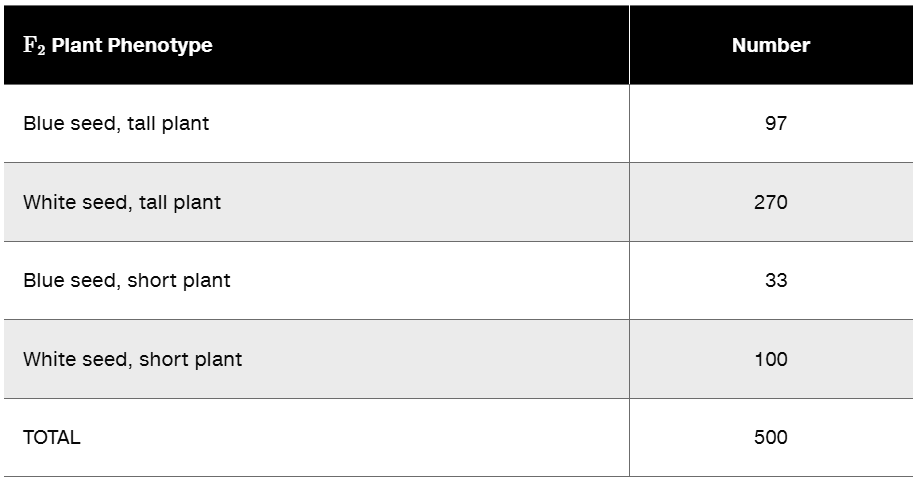
A variety of pea plant called Blue Persian produces a tall plant with blue seeds. A second variety of pea plant called Spanish Dwarf produces a short plant with white seed. The two varieties are crossed, and the resulting seeds are collected. All of the seeds are white; and when planted, they produce all tall plants. These tall F₁ plants are allowed to self-fertilize. The results for seed color and plant stature in the F₂ generation are as follows:
  F₂ plant phenotype data table showing counts for blue and white seeds, tall and short plants, totaling 500 plants.
Which phenotypes are dominant, and which are recessive? Why?

Verified step by step guidance
1
Step 1: Analyze the F₁ generation results. The F₁ generation plants all have white seeds and are tall. This indicates that the alleles for white seeds and tall stature are dominant, as these traits are expressed in the heterozygous F₁ plants.
Step 2: Examine the F₂ generation results. The F₂ generation shows a phenotypic ratio for seed color and plant stature. The phenotypes are distributed as follows: 97 blue seed, tall plant; 270 white seed, tall plant; 33 blue seed, short plant; and 100 white seed, short plant.
Step 3: Determine the inheritance pattern for seed color. The F₂ generation includes both white and blue seeds. Since white seeds appear more frequently (270 + 100 = 370) compared to blue seeds (97 + 33 = 130), white seed color is dominant, and blue seed color is recessive.
Step 4: Determine the inheritance pattern for plant stature. The F₂ generation includes both tall and short plants. Since tall plants appear more frequently (97 + 270 = 367) compared to short plants (33 + 100 = 133), tall stature is dominant, and short stature is recessive.
Step 5: Conclude the dominance relationships. White seed color and tall stature are dominant traits because they appear in the F₁ generation and are more frequent in the F₂ generation. Blue seed color and short stature are recessive traits because they are less frequent in the F₂ generation and do not appear in the F₁ generation.

Verified video answer for a similar problem:

This video solution was recommended by our tutors as helpful for the problem above.
Video duration:
3m
Was this helpful?

Key Concepts

Here are the essential concepts you must grasp in order to answer the question correctly.

Dominant and Recessive Traits

In genetics, dominant traits are those that are expressed in the phenotype even when only one copy of the allele is present, while recessive traits require two copies of the allele to be expressed. In this scenario, the tall plant phenotype and white seed color are dominant traits, as they appear in the F₁ generation and are more prevalent in the F₂ generation.
Recommended video:
Guided course
04:37
Variations on Dominance

Mendelian Inheritance

Mendelian inheritance refers to the patterns of inheritance first described by Gregor Mendel, which include the principles of segregation and independent assortment. These principles explain how alleles segregate during gamete formation and how different traits are inherited independently, allowing for the prediction of phenotypic ratios in offspring, as seen in the F₂ generation.
Recommended video:
Guided course
05:13
Organelle Inheritance

Phenotypic Ratios

Phenotypic ratios represent the relative frequencies of different phenotypes in the offspring of a genetic cross. In this case, the F₂ generation shows a phenotypic ratio of approximately 9:3:3:1 for tall and short plants with blue and white seeds, which helps to identify the dominant and recessive traits based on their frequencies in the offspring.
Recommended video:
Guided course
10:48
Mutations and Phenotypes
Related Practice
Textbook Question

In pea plants, plant height, seed shape, and seed color are governed by three independently assorting genes. The three genes have dominant and recessive alleles, with tall (T) dominant to short (t), round (R) dominant to wrinkled (r), and yellow (G) dominant to green (g).


If a true-breeding tall, wrinkled, yellow plant is crossed to a true-breeding short, round, green plant, what phenotypic ratios are expected in the F1 and F2?

1872
views
Textbook Question

In pea plants, plant height, seed shape, and seed color are governed by three independently assorting genes. The three genes have dominant and recessive alleles, with tall (T) dominant to short (t), round (R) dominant to wrinkled (r), and yellow (G) dominant to green (g).


What proportion of the F2 are expected to be tall, wrinkled, yellow? ttRRGg?

531
views
Textbook Question

In pea plants, plant height, seed shape, and seed color are governed by three independently assorting genes. The three genes have dominant and recessive alleles, with tall (T) dominant to short (t), round (R) dominant to wrinkled (r), and yellow (G) dominant to green (g).


What proportion of the that produce round, green seeds (regardless of the height of the plant) are expected to breed true?

554
views
Textbook Question

A variety of pea plant called Blue Persian produces a tall plant with blue seeds. A second variety of pea plant called Spanish Dwarf produces a short plant with white seed. The two varieties are crossed, and the resulting seeds are collected. All of the seeds are white; and when planted, they produce all tall plants. These tall F₁ plants are allowed to self-fertilize. The results for seed color and plant stature in the F₂ generation are as follows:

   F₂ Plant Phenotype    Number

   Blue seed, tall plant.     97

   White seed, tall plant   270

   Blue seed, short plant    33

   White seed, short plant  100

  TOTAL                500


What is the expected distribution of phenotypes in the F₂ generation?

516
views
Textbook Question

A variety of pea plant called Blue Persian produces a tall plant with blue seeds. A second variety of pea plant called Spanish Dwarf produces a short plant with white seed. The two varieties are crossed, and the resulting seeds are collected. All of the seeds are white; and when planted, they produce all tall plants. These tall F₁ plants are allowed to self-fertilize. The results for seed color and plant stature in the F₂ generation are as follows:

   F₂ Plant Phenotype    Number

   Blue seed, tall plant.     97

   White seed, tall plant    270

   Blue seed, short plant    33

   White seed, short plant  100

  TOTAL                500


State the hypothesis being tested in this experiment.

449
views
Textbook Question

A variety of pea plant called Blue Persian produces a tall plant with blue seeds. A second variety of pea plant called Spanish Dwarf produces a short plant with white seed. The two varieties are crossed, and the resulting seeds are collected. All of the seeds are white; and when planted, they produce all tall plants. These tall F₁ plants are allowed to self-fertilize. The results for seed color and plant stature in the F₂ generation are as follows:

   F₂ Plant Phenotype    Number

   Blue seed, tall plant.     97

   White seed, tall plant    270

   Blue seed, short plant    33

   White seed, short plant  100

  TOTAL                500


Examine the data in the table by the chi-square test and determine whether they conform to expectations of the hypothesis.

560
views