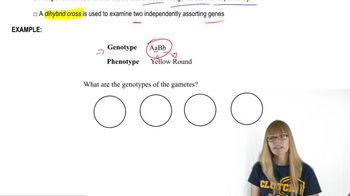
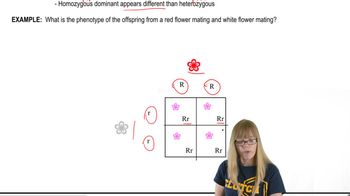
In the fruit fly Drosophila, a rudimentary wing called 'vestigial' and dark body color called 'ebony' are inherited as independently assorting genes and are recessive to their dominant counterparts full wing and gray body color. Dihybrid dominant-phenotype males and females are crossed, and 3200 progeny are produced. How many progeny flies are expected to be found in each phenotypic class?

In pea plants, plant height, seed shape, and seed color are governed by three independently assorting genes. The three genes have dominant and recessive alleles, with tall (T) dominant to short (t), round (R) dominant to wrinkled (r), and yellow (G) dominant to green (g).
What proportion of the that produce round, green seeds (regardless of the height of the plant) are expected to breed true?
Verified step by step guidance
Verified video answer for a similar problem:
Key Concepts
Independent Assortment
Dominant and Recessive Alleles
Breeding True
In pea plants, plant height, seed shape, and seed color are governed by three independently assorting genes. The three genes have dominant and recessive alleles, with tall (T) dominant to short (t), round (R) dominant to wrinkled (r), and yellow (G) dominant to green (g).
If a true-breeding tall, wrinkled, yellow plant is crossed to a true-breeding short, round, green plant, what phenotypic ratios are expected in the F1 and F2?
In pea plants, plant height, seed shape, and seed color are governed by three independently assorting genes. The three genes have dominant and recessive alleles, with tall (T) dominant to short (t), round (R) dominant to wrinkled (r), and yellow (G) dominant to green (g).
What proportion of the F2 are expected to be tall, wrinkled, yellow? ttRRGg?
A variety of pea plant called Blue Persian produces a tall plant with blue seeds. A second variety of pea plant called Spanish Dwarf produces a short plant with white seed. The two varieties are crossed, and the resulting seeds are collected. All of the seeds are white; and when planted, they produce all tall plants. These tall F₁ plants are allowed to self-fertilize. The results for seed color and plant stature in the F₂ generation are as follows:
Which phenotypes are dominant, and which are recessive? Why?
A variety of pea plant called Blue Persian produces a tall plant with blue seeds. A second variety of pea plant called Spanish Dwarf produces a short plant with white seed. The two varieties are crossed, and the resulting seeds are collected. All of the seeds are white; and when planted, they produce all tall plants. These tall F₁ plants are allowed to self-fertilize. The results for seed color and plant stature in the F₂ generation are as follows:
F₂ Plant Phenotype Number
Blue seed, tall plant. 97
White seed, tall plant 270
Blue seed, short plant 33
White seed, short plant 100
TOTAL 500
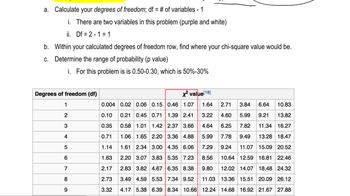
What is the expected distribution of phenotypes in the F₂ generation?
A variety of pea plant called Blue Persian produces a tall plant with blue seeds. A second variety of pea plant called Spanish Dwarf produces a short plant with white seed. The two varieties are crossed, and the resulting seeds are collected. All of the seeds are white; and when planted, they produce all tall plants. These tall F₁ plants are allowed to self-fertilize. The results for seed color and plant stature in the F₂ generation are as follows:
F₂ Plant Phenotype Number
Blue seed, tall plant. 97
White seed, tall plant 270
Blue seed, short plant 33
White seed, short plant 100
TOTAL 500
State the hypothesis being tested in this experiment.
