Pearson+ LogoPearson+ Logo
Ch. 2 - Transmission Genetics
Sanders - Genetic Analysis: An Integrated Approach 3rd Edition
Sanders3rd EditionGenetic Analysis: An Integrated ApproachISBN: 9780135564172Not the one you use?Change textbook
Chapter 2, Problem 40b

Alkaptonuria is an infrequent autosomal recessive condition. It is first noticed in newborns when the urine in their diapers turns black upon exposure to air. The condition is caused by the defective transport of the amino acid phenylalanine through the intestinal walls during digestion. About 4 people per 1000 are carriers of alkaptonuria.
Sara and James had never heard of alkaptonuria and were shocked to discover that their first child had the condition. Sara's sister Mary and her husband, Frank, are planning to have a family and are concerned about the possibility of alkaptonuria in one of their children.
The four adults (Sara, James, Mary, and Frank) seek information from a neighbor who is a retired physician. After discussing their family histories, the neighbor says, 'I never took genetics, but I know from my many years in practice that Sara and James are both carriers of this recessive condition. Since their first child had the condition, there is a very low chance that the next child will also have it, because the odds of having two children with a recessive condition are very low. Mary and Frank have no chance of having a child with alkaptonuria because Frank has no family history of the condition.' The two couples each have babies and both babies have alkaptonuria.


What was incorrect about the information given to Sara and James? What is incorrect about the information given to Mary and Frank?

Verified step by step guidance
1
Step 1: Understand the inheritance pattern of alkaptonuria. It is an autosomal recessive condition, meaning that an individual must inherit two copies of the defective gene (one from each parent) to express the condition. Carriers have one defective gene and one normal gene, and they do not exhibit symptoms.
Step 2: Analyze the genetic situation of Sara and James. Since their first child has alkaptonuria, both Sara and James must be carriers of the defective gene. The probability of their next child inheriting the condition is determined by a Punnett square, which shows a 25% chance of having a child with alkaptonuria for each pregnancy.
Step 3: Evaluate the statement given to Mary and Frank. The claim that Frank's lack of family history eliminates the possibility of their child having alkaptonuria is incorrect. Mary could still be a carrier, and if Frank is unknowingly a carrier (since carriers do not exhibit symptoms), there is a 25% chance of their child inheriting the condition. Family history alone cannot definitively rule out carrier status.
Step 4: Consider the genetic probabilities for both couples. For Sara and James, the neighbor's assertion that the odds of having two children with alkaptonuria are very low is misleading. Each pregnancy is an independent event, and the probability remains 25% for each child. For Mary and Frank, the neighbor incorrectly assumes that Frank's family history guarantees no risk, ignoring the possibility of unrecognized carrier status.
Step 5: Summarize the errors in the neighbor's advice. The neighbor misunderstood the principles of autosomal recessive inheritance, particularly the independence of genetic probabilities for each pregnancy and the limitations of using family history alone to assess genetic risk. Genetic testing or counseling would provide more accurate information for both couples.

Verified video answer for a similar problem:

This video solution was recommended by our tutors as helpful for the problem above.
Video duration:
1m
Was this helpful?

Key Concepts

Here are the essential concepts you must grasp in order to answer the question correctly.

Autosomal Recessive Inheritance

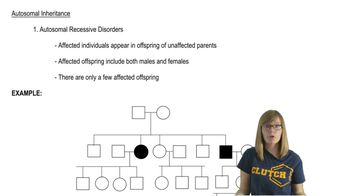
Autosomal recessive inheritance occurs when a child inherits two copies of a mutated gene, one from each parent, leading to the expression of a recessive trait. In the case of alkaptonuria, both parents must be carriers of the defective gene for their child to be affected. This means that even if a child is born with the condition, it does not guarantee that subsequent children will also inherit it, as the probability depends on the genetic status of the parents.
Recommended video:
Guided course
09:08
Autosomal Pedigrees

Carrier Status

Carriers are individuals who possess one copy of a mutated gene but do not exhibit symptoms of the associated condition. In the scenario, both Sara and James are carriers of the alkaptonuria gene, which means they can pass the gene to their offspring. The neighbor's assumption that the chance of having another affected child is low is misleading; the probability remains consistent for each pregnancy, as each child has a 25% chance of being affected if both parents are carriers.
Recommended video:
Guided course
10:56
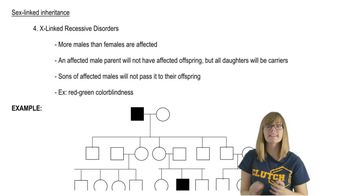
Sex-Linked Pedigrees

Family History and Genetic Risk

Family history plays a crucial role in assessing genetic risk for conditions like alkaptonuria. The neighbor incorrectly stated that Mary and Frank have no chance of having a child with the condition based solely on Frank's lack of family history. However, if Mary is a carrier, there is still a risk for their children to inherit the condition, as the presence of one carrier parent can lead to a 25% chance of having an affected child, regardless of the other parent's genetic background.
Recommended video:
Guided course
11:35
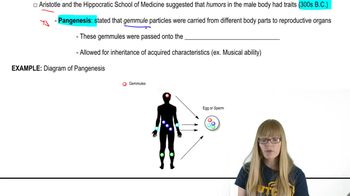
History of Genetics
Related Practice
Textbook Question

A cross between a spicy variety of Capsicum annum pepper and a sweet (nonspicy) variety produces F1 progeny plants that all have spicy peppers. The F1 are crossed, and among the F2 plants are 56 that produce spicy peppers and 20 that produce sweet peppers. Dr. Ara B. Dopsis, an expert on pepper plants, discovers a gene he designates Pun1 that he believes is responsible for spicy versus sweet flavor of peppers. Dr. Dopsis proposes that a dominant allele P produces spicy peppers and that a recessive mutant allele p results in sweet peppers.

Are the data on the parental cross and the F1 and F2 consistent with the proposal made by Dr. Dopsis? Explain why or why not, using P and p to indicate probable genotypes of pepper plants.

417
views
Textbook Question

A cross between a spicy variety of Capsicum annum pepper and a sweet (nonspicy) variety produces F1 progeny plants that all have spicy peppers. The F1 are crossed, and among the F2 plants are 56 that produce spicy peppers and 20 that produce sweet peppers. Dr. Ara B. Dopsis, an expert on pepper plants, discovers a gene he designates Pun1 that he believes is responsible for spicy versus sweet flavor of peppers. Dr. Dopsis proposes that a dominant allele P produces spicy peppers and that a recessive mutant allele p results in sweet peppers.

Assuming the proposal is correct, what proportion of the spicy F2 pepper plants do you expect will be pure-breeding? Explain your answer.

396
views
Textbook Question

Alkaptonuria is an infrequent autosomal recessive condition. It is first noticed in newborns when the urine in their diapers turns black upon exposure to air. The condition is caused by the defective transport of the amino acid phenylalanine through the intestinal walls during digestion. About 4 people per 1000 are carriers of alkaptonuria.

Sara and James had never heard of alkaptonuria and were shocked to discover that their first child had the condition. Sara's sister Mary and her husband, Frank, are planning to have a family and are concerned about the possibility of alkaptonuria in one of their children.

The four adults (Sara, James, Mary, and Frank) seek information from a neighbor who is a retired physician. After discussing their family histories, the neighbor says, "I never took genetics, but I know from my many years in practice that Sara and James are both carriers of this recessive condition. Since their first child had the condition, there is a very low chance that the next child will also have it, because the odds of having two children with a recessive condition are very low. Mary and Frank have no chance of having a child with alkaptonuria because Frank has no family history of the condition." The two couples each have babies and both babies have alkaptonuria.


What are the genotypes of the four adults?

701
views
Textbook Question

Alkaptonuria is an infrequent autosomal recessive condition. It is first noticed in newborns when the urine in their diapers turns black upon exposure to air. The condition is caused by the defective transport of the amino acid phenylalanine through the intestinal walls during digestion. About 4 people per 1000 are carriers of alkaptonuria.

Sara and James had never heard of alkaptonuria and were shocked to discover that their first child had the condition. Sara's sister Mary and her husband, Frank, are planning to have a family and are concerned about the possibility of alkaptonuria in one of their children.

The four adults (Sara, James, Mary, and Frank) seek information from a neighbor who is a retired physician. After discussing their family histories, the neighbor says, 'I never took genetics, but I know from my many years in practice that Sara and James are both carriers of this recessive condition. Since their first child had the condition, there is a very low chance that the next child will also have it, because the odds of having two children with a recessive condition are very low. Mary and Frank have no chance of having a child with alkaptonuria because Frank has no family history of the condition.' The two couples each have babies and both babies have alkaptonuria.


What is the probability that the second child of Mary and Frank will have alkaptonuria?

425
views
Textbook Question

Alkaptonuria is an infrequent autosomal recessive condition. It is first noticed in newborns when the urine in their diapers turns black upon exposure to air. The condition is caused by the defective transport of the amino acid phenylalanine through the intestinal walls during digestion. About 4 people per 1000 are carriers of alkaptonuria.

Sara and James had never heard of alkaptonuria and were shocked to discover that their first child had the condition. Sara's sister Mary and her husband, Frank, are planning to have a family and are concerned about the possibility of alkaptonuria in one of their children.

The four adults (Sara, James, Mary, and Frank) seek information from a neighbor who is a retired physician. After discussing their family histories, the neighbor says, 'I never took genetics, but I know from my many years in practice that Sara and James are both carriers of this recessive condition. Since their first child had the condition, there is a very low chance that the next child will also have it, because the odds of having two children with a recessive condition are very low. Mary and Frank have no chance of having a child with alkaptonuria because Frank has no family history of the condition.' The two couples each have babies and both babies have alkaptonuria.


What is the chance that the third child of Sara and James will be free of the condition?

559
views
Textbook Question

Alkaptonuria is an infrequent autosomal recessive condition. It is first noticed in newborns when the urine in their diapers turns black upon exposure to air. The condition is caused by the defective transport of the amino acid phenylalanine through the intestinal walls during digestion. About 4 people per 1000 are carriers of alkaptonuria.

Sara and James had never heard of alkaptonuria and were shocked to discover that their first child had the condition. Sara's sister Mary and her husband, Frank, are planning to have a family and are concerned about the possibility of alkaptonuria in one of their children.

The four adults (Sara, James, Mary, and Frank) seek information from a neighbor who is a retired physician. After discussing their family histories, the neighbor says, 'I never took genetics, but I know from my many years in practice that Sara and James are both carriers of this recessive condition. Since their first child had the condition, there is a very low chance that the next child will also have it, because the odds of having two children with a recessive condition are very low. Mary and Frank have no chance of having a child with alkaptonuria because Frank has no family history of the condition.' The two couples each have babies and both babies have alkaptonuria.


The couples are worried that one of their grandchildren will inherit alkaptonuria. How would you assess the risk that one of the offspring of a child with alkaptonuria will inherit the condition?

493
views