Pearson+ LogoPearson+ Logo
Ch. 2 - Transmission Genetics
Sanders - Genetic Analysis: An Integrated Approach 3rd Edition
Sanders3rd EditionGenetic Analysis: An Integrated ApproachISBN: 9780135564172Not the one you use?Change textbook
Chapter 2, Problem 40d

Alkaptonuria is an infrequent autosomal recessive condition. It is first noticed in newborns when the urine in their diapers turns black upon exposure to air. The condition is caused by the defective transport of the amino acid phenylalanine through the intestinal walls during digestion. About 4 people per 1000 are carriers of alkaptonuria.
Sara and James had never heard of alkaptonuria and were shocked to discover that their first child had the condition. Sara's sister Mary and her husband, Frank, are planning to have a family and are concerned about the possibility of alkaptonuria in one of their children.
The four adults (Sara, James, Mary, and Frank) seek information from a neighbor who is a retired physician. After discussing their family histories, the neighbor says, 'I never took genetics, but I know from my many years in practice that Sara and James are both carriers of this recessive condition. Since their first child had the condition, there is a very low chance that the next child will also have it, because the odds of having two children with a recessive condition are very low. Mary and Frank have no chance of having a child with alkaptonuria because Frank has no family history of the condition.' The two couples each have babies and both babies have alkaptonuria.


What is the chance that the third child of Sara and James will be free of the condition?

Verified step by step guidance
1
Step 1: Understand the inheritance pattern of alkaptonuria. It is an autosomal recessive condition, meaning a child must inherit two copies of the defective allele (one from each parent) to express the condition. Carriers have one defective allele and one normal allele, and they do not show symptoms.
Step 2: Determine the genotypes of Sara and James. Since their first child has alkaptonuria, both Sara and James must be carriers (heterozygous) for the condition. Their genotype is represented as Aa, where 'A' is the normal allele and 'a' is the defective allele.
Step 3: Use a Punnett square to calculate the probabilities of offspring genotypes. Cross the genotypes of Sara (Aa) and James (Aa). The possible combinations are: AA (normal, free of the condition), Aa (carrier, does not express the condition), Aa (carrier, does not express the condition), and aa (affected, has the condition).
Step 4: Analyze the results of the Punnett square. The probabilities for each genotype are: 25% chance of AA (normal), 50% chance of Aa (carrier), and 25% chance of aa (affected). Therefore, the chance of being free of the condition (AA) is 25%.
Step 5: Conclude that the probability of Sara and James's third child being free of alkaptonuria is 25%. This calculation assumes no other genetic or environmental factors influence the inheritance.

Verified video answer for a similar problem:

This video solution was recommended by our tutors as helpful for the problem above.
Video duration:
1m
Was this helpful?

Key Concepts

Here are the essential concepts you must grasp in order to answer the question correctly.

Autosomal Recessive Inheritance

Autosomal recessive inheritance occurs when a trait or condition is expressed only when an individual has two copies of the recessive allele, one inherited from each parent. In the case of alkaptonuria, both Sara and James are carriers, meaning they each have one normal allele and one mutated allele. Their child must inherit the mutated allele from both parents to express the condition, which significantly influences the probability of their future children inheriting the disorder.
Recommended video:
Guided course
09:08
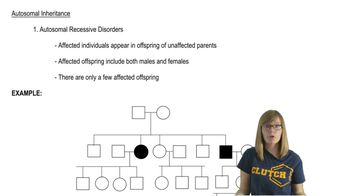
Autosomal Pedigrees

Punnett Square

A Punnett square is a diagram used to predict the genetic outcomes of a cross between two individuals. It helps visualize the possible combinations of alleles from the parents. For Sara and James, a Punnett square can illustrate the probabilities of their children being affected by alkaptonuria, showing a 25% chance of being affected, 50% chance of being carriers, and 25% chance of being unaffected.
Recommended video:
Guided course
18:27
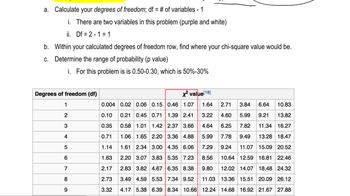
Chi Square Analysis

Carrier Probability

Carrier probability refers to the likelihood that an individual carries a recessive allele for a genetic condition without expressing it. In this scenario, since both Sara and James are carriers of the alkaptonuria allele, their children have a 25% chance of being affected, a 50% chance of being carriers, and a 25% chance of being completely free of the condition. Understanding carrier probability is crucial for assessing the risk for future offspring.
Recommended video:
Related Practice
Textbook Question

Alkaptonuria is an infrequent autosomal recessive condition. It is first noticed in newborns when the urine in their diapers turns black upon exposure to air. The condition is caused by the defective transport of the amino acid phenylalanine through the intestinal walls during digestion. About 4 people per 1000 are carriers of alkaptonuria.

Sara and James had never heard of alkaptonuria and were shocked to discover that their first child had the condition. Sara's sister Mary and her husband, Frank, are planning to have a family and are concerned about the possibility of alkaptonuria in one of their children.

The four adults (Sara, James, Mary, and Frank) seek information from a neighbor who is a retired physician. After discussing their family histories, the neighbor says, "I never took genetics, but I know from my many years in practice that Sara and James are both carriers of this recessive condition. Since their first child had the condition, there is a very low chance that the next child will also have it, because the odds of having two children with a recessive condition are very low. Mary and Frank have no chance of having a child with alkaptonuria because Frank has no family history of the condition." The two couples each have babies and both babies have alkaptonuria.


What are the genotypes of the four adults?

701
views
Textbook Question

Alkaptonuria is an infrequent autosomal recessive condition. It is first noticed in newborns when the urine in their diapers turns black upon exposure to air. The condition is caused by the defective transport of the amino acid phenylalanine through the intestinal walls during digestion. About 4 people per 1000 are carriers of alkaptonuria.

Sara and James had never heard of alkaptonuria and were shocked to discover that their first child had the condition. Sara's sister Mary and her husband, Frank, are planning to have a family and are concerned about the possibility of alkaptonuria in one of their children.

The four adults (Sara, James, Mary, and Frank) seek information from a neighbor who is a retired physician. After discussing their family histories, the neighbor says, 'I never took genetics, but I know from my many years in practice that Sara and James are both carriers of this recessive condition. Since their first child had the condition, there is a very low chance that the next child will also have it, because the odds of having two children with a recessive condition are very low. Mary and Frank have no chance of having a child with alkaptonuria because Frank has no family history of the condition.' The two couples each have babies and both babies have alkaptonuria.


What was incorrect about the information given to Sara and James? What is incorrect about the information given to Mary and Frank?

541
views
Textbook Question

Alkaptonuria is an infrequent autosomal recessive condition. It is first noticed in newborns when the urine in their diapers turns black upon exposure to air. The condition is caused by the defective transport of the amino acid phenylalanine through the intestinal walls during digestion. About 4 people per 1000 are carriers of alkaptonuria.

Sara and James had never heard of alkaptonuria and were shocked to discover that their first child had the condition. Sara's sister Mary and her husband, Frank, are planning to have a family and are concerned about the possibility of alkaptonuria in one of their children.

The four adults (Sara, James, Mary, and Frank) seek information from a neighbor who is a retired physician. After discussing their family histories, the neighbor says, 'I never took genetics, but I know from my many years in practice that Sara and James are both carriers of this recessive condition. Since their first child had the condition, there is a very low chance that the next child will also have it, because the odds of having two children with a recessive condition are very low. Mary and Frank have no chance of having a child with alkaptonuria because Frank has no family history of the condition.' The two couples each have babies and both babies have alkaptonuria.


What is the probability that the second child of Mary and Frank will have alkaptonuria?

425
views
Textbook Question

Alkaptonuria is an infrequent autosomal recessive condition. It is first noticed in newborns when the urine in their diapers turns black upon exposure to air. The condition is caused by the defective transport of the amino acid phenylalanine through the intestinal walls during digestion. About 4 people per 1000 are carriers of alkaptonuria.

Sara and James had never heard of alkaptonuria and were shocked to discover that their first child had the condition. Sara's sister Mary and her husband, Frank, are planning to have a family and are concerned about the possibility of alkaptonuria in one of their children.

The four adults (Sara, James, Mary, and Frank) seek information from a neighbor who is a retired physician. After discussing their family histories, the neighbor says, 'I never took genetics, but I know from my many years in practice that Sara and James are both carriers of this recessive condition. Since their first child had the condition, there is a very low chance that the next child will also have it, because the odds of having two children with a recessive condition are very low. Mary and Frank have no chance of having a child with alkaptonuria because Frank has no family history of the condition.' The two couples each have babies and both babies have alkaptonuria.


The couples are worried that one of their grandchildren will inherit alkaptonuria. How would you assess the risk that one of the offspring of a child with alkaptonuria will inherit the condition?

493
views
Textbook Question

Humans vary in many ways from one another. Among many minor phenotypic differences are the following five independently assorting traits that (sort of) have a dominant and a recessive phenotype: (1) forearm hair (alleles F and f )—the presence of hair on the forearm is dominant to the absence of hair on the forearm; (2) earlobe form (alleles E and e)—unattached earlobes are dominant to attached earlobes; (3) widow's peak (alleles W and w)—a distinct 'V' shape to the hairline at the top of the forehead is dominant to a straight hairline; (4) hitchhiker's thumb (alleles H and h)—the ability to bend the thumb back beyond vertical is dominant and the inability to do so is recessive; and (5) freckling (alleles D and d)—the appearance of freckles is dominant to the absence of freckles. In reality, the genetics of these traits are more complicated than single gene variation, but assume for the purposes of this problem that the patterns in families match those of other single-gene variants.

If a couple with the genotypes Ff Ee Ww Hh Dd and Ff Ee Ww Hh Dd have children, what is the chance the children will inherit the following characteristics?


the same phenotype as the parents

406
views
Textbook Question

Humans vary in many ways from one another. Among many minor phenotypic differences are the following five independently assorting traits that (sort of) have a dominant and a recessive phenotype: (1) forearm hair (alleles F and f )—the presence of hair on the forearm is dominant to the absence of hair on the forearm; (2) earlobe form (alleles E and e)—unattached earlobes are dominant to attached earlobes; (3) widow's peak (alleles W and w)—a distinct 'V' shape to the hairline at the top of the forehead is dominant to a straight hairline; (4) hitchhiker's thumb (alleles H and h)—the ability to bend the thumb back beyond vertical is dominant and the inability to do so is recessive; and (5) freckling (alleles D and d)—the appearance of freckles is dominant to the absence of freckles. In reality, the genetics of these traits are more complicated than single gene variation, but assume for the purposes of this problem that the patterns in families match those of other single-gene variants.

If a couple with the genotypes Ff Ee Ww Hh Dd and Ff Ee Ww Hh Dd have children, what is the chance the children will inherit the following characteristics?


four dominant traits and one recessive trait

410
views