Pearson+ LogoPearson+ Logo
Ch. 2 - Transmission Genetics
Sanders - Genetic Analysis: An Integrated Approach 3rd Edition
Sanders3rd EditionGenetic Analysis: An Integrated ApproachISBN: 9780135564172Not the one you use?Change textbook
Chapter 2, Problem 14a

An experienced goldfish breeder receives two unusual male goldfish. One is black rather than gold, and the other has a single tail fin rather than a split tail fin. The breeder crosses the black male with a female that is gold. All the F₁ are gold. She also crosses the single-finned male to a female with a split tail fin. All the F₁ have a split tail fin. She then crosses the black male to F₁ gold females and, separately, crosses the single-finned male to F₁ split-finned females. The results of the crosses are shown below.


  Black male x F₁ gold female:
    Gold        32
    Black       34
  Single-finned male x F₁ split-finned female:
    Split fin       41
    Single fin    39
What do the results of these crosses suggest about the inheritance of color and tail fin shape in goldfish?

Verified step by step guidance
1
Step 1: Analyze the initial crosses to determine the dominance relationships. The black male crossed with a gold female produces all gold F₁ offspring, indicating that gold color is dominant over black color. Similarly, the single-finned male crossed with a split-finned female produces all split-finned F₁ offspring, indicating that split fin is dominant over single fin.
Step 2: Consider the genotypes of the F₁ generation based on the initial crosses. Since all F₁ offspring show the dominant phenotype (gold color and split fin), they are likely heterozygous for the traits, carrying one dominant and one recessive allele.
Step 3: Examine the results of the backcrosses where the black male is crossed with F₁ gold females, and the single-finned male is crossed with F₁ split-finned females. The approximately 1:1 ratio of phenotypes (gold:black and split fin:single fin) suggests that the F₁ females are heterozygous and the black male and single-finned male are homozygous recessive for their respective traits.
Step 4: Use the Punnett square approach to model the backcrosses. For color, cross a heterozygous gold (Gg) female with a homozygous black (gg) male. For fin shape, cross a heterozygous split fin (Ss) female with a homozygous single fin (ss) male. This will predict a 1:1 phenotypic ratio, matching the observed data.
Step 5: Conclude that both gold color and split tail fin are inherited as simple Mendelian traits with dominant and recessive alleles, where gold and split fin are dominant, and black and single fin are recessive.

Verified video answer for a similar problem:

This video solution was recommended by our tutors as helpful for the problem above.
Video duration:
2m
Was this helpful?

Key Concepts

Here are the essential concepts you must grasp in order to answer the question correctly.

Mendelian Inheritance and Dominance

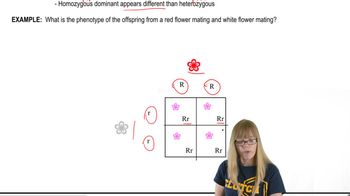
Mendelian inheritance describes how traits are passed from parents to offspring through dominant and recessive alleles. A dominant allele masks the effect of a recessive allele in heterozygotes, resulting in the dominant phenotype. In this question, the gold color and split tail fin appear dominant since all F₁ offspring show these traits when crossed with unusual males.
Recommended video:
Guided course
04:37
Variations on Dominance

Genotype and Phenotype Ratios in Test Crosses

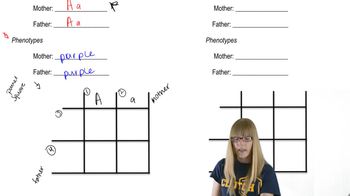
Test crosses involve breeding an individual with a homozygous recessive to reveal the genotype of the unknown parent. The approximately 1:1 phenotypic ratios in the backcrosses (black vs. gold and single fin vs. split fin) suggest the unusual males are heterozygous for these traits, confirming simple Mendelian inheritance with one gene controlling each trait.
Recommended video:
Guided course
06:28
Branch Diagram

Monohybrid Cross and Segregation of Alleles

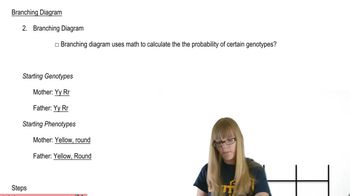
A monohybrid cross examines inheritance of a single trait with two alleles. The segregation principle states that alleles separate during gamete formation, resulting in offspring with predictable genotype ratios. The observed 1:1 phenotypic ratios in the backcrosses indicate that each trait is controlled by a single gene with two alleles segregating independently.
Recommended video:
Guided course
10:20
Monohybrid Cross
Related Practice
Textbook Question

A male mouse with brown fur color is mated to two different female mice with black fur. Black female 1 produces a litter of 9 black and 7 brown pups. Black female 2 produces 14 black pups.

What is the mode of inheritance of black and brown fur color in mice?

525
views
Textbook Question

A male mouse with brown fur color is mated to two different female mice with black fur. Black female 1 produces a litter of 9 black and 7 brown pups. Black female 2 produces 14 black pups.

Choose symbols for each allele, and identify the genotypes of the brown male and the two black females.

372
views
Textbook Question

The following figure shows the results of Mendel's test-cross analysis of independent assortment. In this experiment, he first crossed pure-breeding round, yellow plants to pure-breeding wrinkled, green plants. The round yellow are crossed to pure-breeding wrinkled, green plants. Use chi-square analysis to show that Mendel's results do not differ significantly from those expected.

821
views
Textbook Question

An experienced goldfish breeder receives two unusual male goldfish. One is black rather than gold, and the other has a single tail fin rather than a split tail fin. The breeder crosses the black male to a female that is gold. All the F₁ are gold. She also crosses the single-finned male to a female with a split tail fin. All the F₁ have a split tail fin. She then crosses the black male to F₁ gold females and, separately, crosses the single-finned male to F₁ split-finned females. The results of the crosses are shown below.

Is black color dominant or recessive? Explain. Is single tail dominant or recessive? Explain.

401
views
Textbook Question

An experienced goldfish breeder receives two unusual male goldfish. One is black rather than gold, and the other has a single tail fin rather than a split tail fin. The breeder crosses the black male to a female that is gold. All the F₁ are gold. She also crosses the single-finned male to a female with a split tail fin. All the F₁ have a split tail fin. She then crosses the black male to F₁ gold females and, separately, crosses the single-finned male to F₁ split-finned females. The results of the crosses are shown below.

  Black male x F₁ gold female:

    Gold         32

    Black        34

  Single-finned male x F₁ split-finned female:

    Split fin        41

    Single fin     39

Use chi-square analysis to test your hereditary hypothesis for each trait.

421
views
Textbook Question

The accompanying pedigree shows the transmission of albinism (absence of skin pigment) in a human family.

What is the most likely mode of transmission of albinism in this family? 

633
views