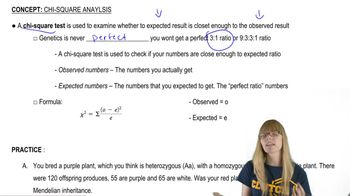
The following figure shows the results of Mendel's test-cross analysis of independent assortment. In this experiment, he first crossed pure-breeding round, yellow plants to pure-breeding wrinkled, green plants. The round yellow are crossed to pure-breeding wrinkled, green plants. Use chi-square analysis to show that Mendel's results do not differ significantly from those expected.

An experienced goldfish breeder receives two unusual male goldfish. One is black rather than gold, and the other has a single tail fin rather than a split tail fin. The breeder crosses the black male to a female that is gold. All the F₁ are gold. She also crosses the single-finned male to a female with a split tail fin. All the F₁ have a split tail fin. She then crosses the black male to F₁ gold females and, separately, crosses the single-finned male to F₁ split-finned females. The results of the crosses are shown below.
Black male x F₁ gold female:
Gold 32
Black 34
Single-finned male x F₁ split-finned female:
Split fin 41
Single fin 39
Use chi-square analysis to test your hereditary hypothesis for each trait.
Verified step by step guidance
Verified video answer for a similar problem:
Key Concepts
Mendelian Inheritance
Chi-Square Analysis
Phenotypic Ratios
An experienced goldfish breeder receives two unusual male goldfish. One is black rather than gold, and the other has a single tail fin rather than a split tail fin. The breeder crosses the black male with a female that is gold. All the F₁ are gold. She also crosses the single-finned male to a female with a split tail fin. All the F₁ have a split tail fin. She then crosses the black male to F₁ gold females and, separately, crosses the single-finned male to F₁ split-finned females. The results of the crosses are shown below.
Black male x F₁ gold female:
Gold 32
Black 34
Single-finned male x F₁ split-finned female:
Split fin 41
Single fin 39
What do the results of these crosses suggest about the inheritance of color and tail fin shape in goldfish?
An experienced goldfish breeder receives two unusual male goldfish. One is black rather than gold, and the other has a single tail fin rather than a split tail fin. The breeder crosses the black male to a female that is gold. All the F₁ are gold. She also crosses the single-finned male to a female with a split tail fin. All the F₁ have a split tail fin. She then crosses the black male to F₁ gold females and, separately, crosses the single-finned male to F₁ split-finned females. The results of the crosses are shown below.
Is black color dominant or recessive? Explain. Is single tail dominant or recessive? Explain.
The accompanying pedigree shows the transmission of albinism (absence of skin pigment) in a human family.
What is the most likely mode of transmission of albinism in this family?
The accompanying pedigree shows the transmission of albinism (absence of skin pigment) in a human family.
Using allelic symbols of your choice, identify the genotypes of the male and his two mates in generation I.
The accompanying pedigree shows the transmission of albinism (absence of skin pigment) in a human family.
The female I-1 and her mate, male I-2, had four children, one of whom has albinism. What is the probability that they could have had a total of four children with any other outcome except one child with albinism and three with normal pigmentation?
