Pearson+ LogoPearson+ Logo
Ch. 2 - Transmission Genetics
Sanders - Genetic Analysis: An Integrated Approach 3rd Edition
Sanders3rd EditionGenetic Analysis: An Integrated ApproachISBN: 9780135564172Not the one you use?Change textbook
Chapter 2, Problem 13

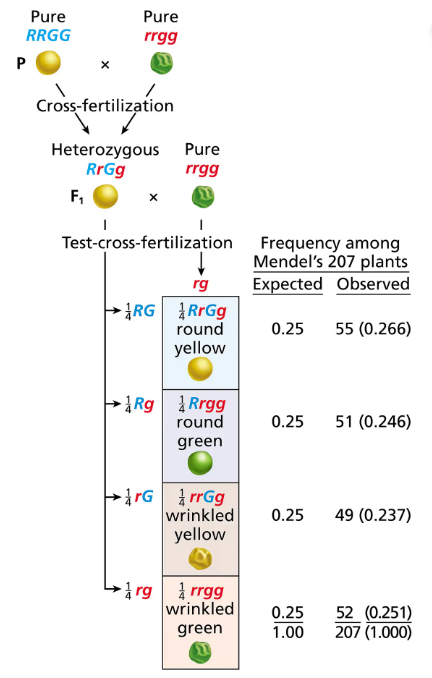
The following figure shows the results of Mendel's test-cross analysis of independent assortment. In this experiment, he first crossed pure-breeding round, yellow plants to pure-breeding wrinkled, green plants. The round yellow are crossed to pure-breeding wrinkled, green plants. Use chi-square analysis to show that Mendel's results do not differ significantly from those expected.
Mendel's test-cross results showing expected vs. observed frequencies of plant traits in his inheritance experiments.

Verified step by step guidance
1
Understand the problem: Mendel performed a test cross to analyze independent assortment. The parental generation consisted of pure-breeding round, yellow plants (RRYY) crossed with pure-breeding wrinkled, green plants (rryy). The F1 generation (RrYy) was then test-crossed with wrinkled, green plants (rryy). The goal is to use chi-square analysis to determine if the observed results align with the expected results based on Mendel's laws.
Determine the expected phenotypic ratio: According to Mendel's law of independent assortment, the two traits (seed shape and seed color) segregate independently. This means the expected phenotypic ratio for the offspring of the test cross (RrYy × rryy) is 1:1:1:1 for the four phenotypes: round yellow, round green, wrinkled yellow, and wrinkled green.
Calculate the expected values: Multiply the total number of offspring by the expected ratio for each phenotype. For example, if the total number of offspring is N, the expected number for each phenotype is N/4. Represent this mathematically as: N4.
Perform the chi-square calculation: Use the formula χ2 = in(O-E)2E, where O represents the observed number of offspring for each phenotype, E represents the expected number, and the summation is over all phenotypic categories. Calculate the chi-square value by summing the contributions from all four phenotypes.
Compare the chi-square value to the critical value: Determine the degrees of freedom (df), which is the number of phenotypic categories minus 1. In this case, df = 4 - 1 = 3. Use a chi-square table to find the critical value at the desired significance level (e.g., 0.05). If the calculated chi-square value is less than the critical value, the observed results do not differ significantly from the expected results, supporting Mendel's hypothesis of independent assortment.

Verified video answer for a similar problem:

This video solution was recommended by our tutors as helpful for the problem above.
Video duration:
1m
Was this helpful?

Key Concepts

Here are the essential concepts you must grasp in order to answer the question correctly.

Mendelian Genetics

Mendelian genetics is the study of how traits are inherited through generations, based on the principles established by Gregor Mendel. His experiments with pea plants led to the formulation of key concepts such as dominant and recessive traits, as well as the laws of segregation and independent assortment, which describe how alleles segregate during gamete formation.
Recommended video:
Guided course
03:45
Descriptive Genetics

Chi-Square Analysis

Chi-square analysis is a statistical method used to determine whether there is a significant difference between observed and expected frequencies in categorical data. In the context of Mendel's experiments, it helps assess whether the ratio of phenotypes observed in offspring aligns with the expected Mendelian ratios, thus validating or refuting the hypothesis of independent assortment.
Recommended video:
Guided course
02:48
Chi Square Analysis

Independent Assortment

The principle of independent assortment states that alleles for different traits segregate independently of one another during gamete formation. This means that the inheritance of one trait does not influence the inheritance of another, leading to a variety of genetic combinations in the offspring, which Mendel demonstrated through his dihybrid crosses.
Recommended video:
Guided course
04:58
Gamete Genetics and Independent Assortment
Related Practice
Textbook Question

Black skin color is dominant to pink skin color in pigs. Two heterozygous black pigs are crossed.

If these pigs produce a total of three piglets, what is the probability that two will be pink and one will be black?

595
views
Textbook Question

A male mouse with brown fur color is mated to two different female mice with black fur. Black female 1 produces a litter of 9 black and 7 brown pups. Black female 2 produces 14 black pups.

What is the mode of inheritance of black and brown fur color in mice?

525
views
Textbook Question

A male mouse with brown fur color is mated to two different female mice with black fur. Black female 1 produces a litter of 9 black and 7 brown pups. Black female 2 produces 14 black pups.

Choose symbols for each allele, and identify the genotypes of the brown male and the two black females.

372
views
Textbook Question

An experienced goldfish breeder receives two unusual male goldfish. One is black rather than gold, and the other has a single tail fin rather than a split tail fin. The breeder crosses the black male with a female that is gold. All the F₁ are gold. She also crosses the single-finned male to a female with a split tail fin. All the F₁ have a split tail fin. She then crosses the black male to F₁ gold females and, separately, crosses the single-finned male to F₁ split-finned females. The results of the crosses are shown below.


  Black male x F₁ gold female:

    Gold        32

    Black       34

  Single-finned male x F₁ split-finned female:

    Split fin       41

    Single fin    39

What do the results of these crosses suggest about the inheritance of color and tail fin shape in goldfish?

503
views
Textbook Question

An experienced goldfish breeder receives two unusual male goldfish. One is black rather than gold, and the other has a single tail fin rather than a split tail fin. The breeder crosses the black male to a female that is gold. All the F₁ are gold. She also crosses the single-finned male to a female with a split tail fin. All the F₁ have a split tail fin. She then crosses the black male to F₁ gold females and, separately, crosses the single-finned male to F₁ split-finned females. The results of the crosses are shown below.

Is black color dominant or recessive? Explain. Is single tail dominant or recessive? Explain.

401
views
Textbook Question

An experienced goldfish breeder receives two unusual male goldfish. One is black rather than gold, and the other has a single tail fin rather than a split tail fin. The breeder crosses the black male to a female that is gold. All the F₁ are gold. She also crosses the single-finned male to a female with a split tail fin. All the F₁ have a split tail fin. She then crosses the black male to F₁ gold females and, separately, crosses the single-finned male to F₁ split-finned females. The results of the crosses are shown below.

  Black male x F₁ gold female:

    Gold         32

    Black        34

  Single-finned male x F₁ split-finned female:

    Split fin        41

    Single fin     39

Use chi-square analysis to test your hereditary hypothesis for each trait.

421
views