Pearson+ LogoPearson+ Logo
Ch. 2 - Transmission Genetics
Sanders - Genetic Analysis: An Integrated Approach 3rd Edition
Sanders3rd EditionGenetic Analysis: An Integrated ApproachISBN: 9780135564172Not the one you use?Change textbook
Chapter 2, Problem 33a

An organism having the genotype AaBbCcDdEe is self-fertilized. Assuming the five genes assort independently, determine the following proportions:


Gametes that are expected to carry only dominant alleles.

Verified step by step guidance
1
Identify the genotype of the organism: AaBbCcDdEe. Each gene has two alleles, one dominant (A, B, C, D, E) and one recessive (a, b, c, d, e).
Understand that the organism is self-fertilized, meaning it produces gametes through meiosis. During meiosis, each gene segregates independently, and only one allele from each gene is passed to a gamete.
Determine the probability of a gamete carrying only dominant alleles. For each gene, the probability of passing the dominant allele (e.g., A instead of a) is 1/2, since the organism is heterozygous (Aa, Bb, etc.).
Calculate the combined probability of a gamete carrying dominant alleles for all five genes. Since the genes assort independently, the probabilities multiply: \( P = \frac{1}{2} \times \frac{1}{2} \times \frac{1}{2} \times \frac{1}{2} \times \frac{1}{2} \).
Express the final proportion of gametes carrying only dominant alleles as the result of the above multiplication. This represents the fraction of gametes with the desired genotype.

Verified video answer for a similar problem:

This video solution was recommended by our tutors as helpful for the problem above.
Video duration:
4m
Was this helpful?

Key Concepts

Here are the essential concepts you must grasp in order to answer the question correctly.

Independent Assortment

Independent assortment is a fundamental principle of genetics stating that alleles for different genes segregate independently of one another during gamete formation. This means that the inheritance of one trait will not affect the inheritance of another, allowing for a variety of combinations in the offspring. In the context of the question, it implies that the alleles for the five genes (A, B, C, D, E) can combine in multiple ways when gametes are formed.
Recommended video:
Guided course
04:58
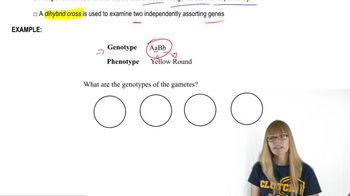
Gamete Genetics and Independent Assortment

Gamete Formation

Gamete formation involves the process of meiosis, where diploid cells divide to produce haploid gametes. Each gamete receives one allele from each gene, resulting in a combination of alleles that can be passed to the next generation. For the genotype AaBbCcDdEe, the number of different gametes produced can be calculated using the formula 2^n, where n is the number of heterozygous gene pairs.
Recommended video:
Guided course
04:06
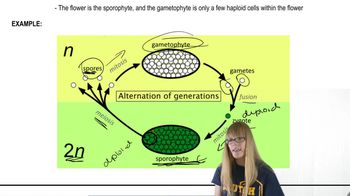
Formation of Plant Gametes

Dominant and Recessive Alleles

In genetics, alleles can be classified as dominant or recessive. A dominant allele is expressed in the phenotype even when only one copy is present, while a recessive allele is only expressed when two copies are present. In the given genotype, the dominant alleles are represented by uppercase letters (A, B, C, D, E), and the question asks for the proportion of gametes that carry only these dominant alleles, which requires understanding how these alleles combine during gamete formation.
Recommended video:
Guided course
04:37
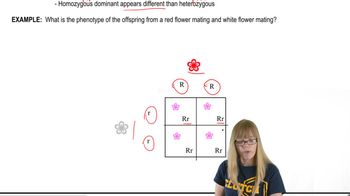
Variations on Dominance