Pearson+ LogoPearson+ Logo
Ch. 2 - Transmission Genetics
Sanders - Genetic Analysis: An Integrated Approach 3rd Edition
Sanders3rd EditionGenetic Analysis: An Integrated ApproachISBN: 9780135564172Not the one you use?Change textbook
Chapter 2, Problem 33c

An organism having the genotype AaBbCcDdEe is self-fertilized. Assuming the five genes assort independently, determine the following proportions:


Progeny that are expected to have a phenotype identical to that of the parent.

Verified step by step guidance
1
Identify the genotype of the parent organism: AaBbCcDdEe. Each gene pair represents a heterozygous condition, meaning the parent has one dominant allele and one recessive allele for each gene.
Determine the phenotype of the parent. Since the problem does not specify whether the dominant or recessive allele determines the phenotype, assume that the dominant allele contributes to the phenotype for each gene. Thus, the parent’s phenotype is determined by the dominant alleles: A, B, C, D, and E.
For the progeny to have a phenotype identical to the parent, they must inherit at least one dominant allele for each gene (A, B, C, D, and E). This means the progeny must have at least one dominant allele (A or aA, B or bB, etc.) for all five genes.
Calculate the probability of inheriting at least one dominant allele for each gene. For a heterozygous parent (e.g., Aa), the probability of passing on a dominant allele (A) is 3/4 when self-fertilized. This is because the possible genotypes for each gene in the progeny are 1/4 AA, 1/2 Aa, and 1/4 aa, and the first two contribute to the dominant phenotype.
Multiply the probabilities for all five genes to determine the overall proportion of progeny with the same phenotype as the parent. Since the genes assort independently, the combined probability is the product of the individual probabilities: (3/4) × (3/4) × (3/4) × (3/4) × (3/4).

Verified video answer for a similar problem:

This video solution was recommended by our tutors as helpful for the problem above.
Video duration:
3m
Was this helpful?

Key Concepts

Here are the essential concepts you must grasp in order to answer the question correctly.

Independent Assortment

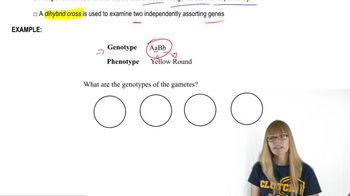
Independent assortment is a fundamental principle of genetics stating that alleles for different genes segregate independently of one another during gamete formation. This means that the inheritance of one trait will not affect the inheritance of another, allowing for a variety of combinations in the offspring's genotype.
Recommended video:
Guided course
04:58
Gamete Genetics and Independent Assortment

Genotype and Phenotype

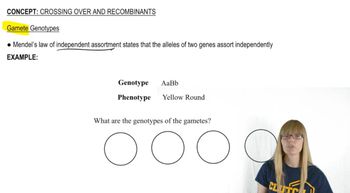
The genotype refers to the genetic makeup of an organism, represented by the alleles it possesses, while the phenotype is the observable expression of those genes, influenced by both genotype and environmental factors. In this case, the phenotype of the progeny will depend on the combinations of alleles inherited from the self-fertilized parent.
Recommended video:
Guided course
07:52
Gamete Genotypes

Punnett Square

A Punnett square is a diagram used to predict the genotypes and phenotypes of offspring from a genetic cross. By laying out the possible gametes from each parent, it allows for the visualization of the probability of each genotype occurring in the progeny, which is essential for determining the expected proportions of phenotypes in this self-fertilization scenario.
Recommended video:
Guided course
18:27
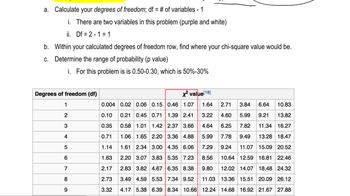
Chi Square Analysis
Related Practice
Textbook Question

Two parents who are each known to be carriers of an autosomal recessive allele have four children. None of the children has the recessive condition. What is the probability that one or more of the children is a carrier of the recessive allele?

474
views
Textbook Question

An organism having the genotype AaBbCcDdEe is self-fertilized. Assuming the five genes assort independently, determine the following proportions:


Gametes that are expected to carry only dominant alleles.

475
views
Textbook Question

An organism having the genotype AaBbCcDdEe is self-fertilized. Assuming the five genes assort independently, determine the following proportions:


Progeny that are expected to have a genotype identical to that of the parent.

905
views
Textbook Question

An organism having the genotype AaBbCcDdEe is self-fertilized. Assuming the five genes assort independently, determine the following proportions:


Gametes that are expected to be ABcde.

739
views
Textbook Question

An organism having the genotype AaBbCcDdEe is self-fertilized. Assuming the five genes assort independently, determine the following proportions:


Progeny that are expected to have the genotype AabbCcDdE–

496
views
Textbook Question

A man and a woman are each heterozygous carriers of an autosomal recessive mutation of a disorder that is fatal in infancy. They both want to have multiple children, but they are concerned about the risk of the disorder appearing in one or more of their children. In separate calculations, determine the probabilities of the couple having five children with 0, 1, 2, 3, 4, and all 5 children being affected by the disorder.

601
views