Pearson+ LogoPearson+ Logo
Ch. 2 - Transmission Genetics
Sanders - Genetic Analysis: An Integrated Approach 3rd Edition
Sanders3rd EditionGenetic Analysis: An Integrated ApproachISBN: 9780135564172Not the one you use?Change textbook
Chapter 2, Problem 1e

Compare and contrast the following terms:
Dihybrid cross and Trihybrid cross

Verified step by step guidance
1
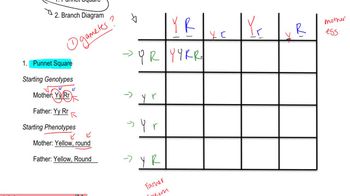
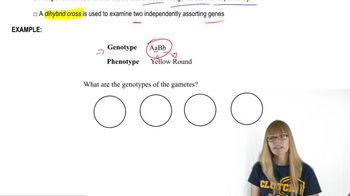
Define a dihybrid cross: A dihybrid cross involves the study of inheritance patterns for two traits, each controlled by different genes. For example, crossing two heterozygous individuals (AaBb) for two traits results in a 4x4 Punnett square with 16 possible genotype combinations.
Define a trihybrid cross: A trihybrid cross involves the study of inheritance patterns for three traits, each controlled by different genes. For example, crossing two heterozygous individuals (AaBbCc) for three traits results in an 8x8 Punnett square with 64 possible genotype combinations.
Compare the complexity: A dihybrid cross is simpler than a trihybrid cross because it involves fewer traits and fewer possible combinations. The Punnett square for a dihybrid cross is smaller (4x4) compared to the larger (8x8) Punnett square for a trihybrid cross.
Contrast the phenotypic ratios: In a dihybrid cross, the phenotypic ratio for two heterozygous parents (AaBb x AaBb) is typically 9:3:3:1 for the four possible phenotypes. In a trihybrid cross, the phenotypic ratio for three heterozygous parents (AaBbCc x AaBbCc) is 27:9:9:9:3:3:3:1 for the eight possible phenotypes.
Explain the genetic principles involved: Both dihybrid and trihybrid crosses rely on Mendel's laws of inheritance, specifically the Law of Independent Assortment, which states that alleles for different genes assort independently of one another during gamete formation. However, the number of traits being studied increases the complexity of the analysis in a trihybrid cross compared to a dihybrid cross.

Verified video answer for a similar problem:

This video solution was recommended by our tutors as helpful for the problem above.
Video duration:
3m
Was this helpful?

Key Concepts

Here are the essential concepts you must grasp in order to answer the question correctly.

Dihybrid Cross

A dihybrid cross is a genetic cross that examines the inheritance of two different traits, each represented by two alleles. For example, when crossing pea plants that differ in seed shape and color, the resulting offspring can exhibit various combinations of these traits. The phenotypic ratio typically observed in the F2 generation of a dihybrid cross is 9:3:3:1, reflecting the independent assortment of alleles.
Recommended video:
Guided course
15:24
Punnet Square

Trihybrid Cross

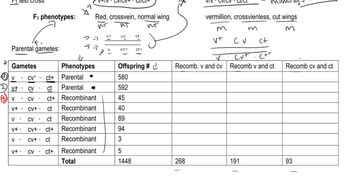
A trihybrid cross involves the study of three different traits, each with two alleles, in a genetic cross. This type of cross expands the complexity of inheritance patterns, as it considers the interactions among three pairs of alleles. The expected phenotypic ratio in the F2 generation of a trihybrid cross is 27:9:9:9:3:3:3:1, illustrating the principle of independent assortment across multiple traits.
Recommended video:
Guided course
26:08
Trihybrid Cross

Independent Assortment

Independent assortment is a fundamental principle of genetics that states that alleles for different traits segregate independently of one another during gamete formation. This means that the inheritance of one trait does not influence the inheritance of another trait. This principle is crucial for understanding the outcomes of both dihybrid and trihybrid crosses, as it allows for the combination of various traits in the offspring.
Recommended video:
Guided course
04:58
Gamete Genetics and Independent Assortment