Pearson+ LogoPearson+ Logo
Ch. 2 - Transmission Genetics
Sanders - Genetic Analysis: An Integrated Approach 3rd Edition
Sanders3rd EditionGenetic Analysis: An Integrated ApproachISBN: 9780135564172Not the one you use?Change textbook
Chapter 2, Problem 3

For the cross Aabb × aaBb, what is the expected genotype ratio? What is the expected phenotype ratio?

Verified step by step guidance
1
Identify the genotypes of the parents: Parent 1 is Aabb and Parent 2 is aaBb. Each parent can produce gametes based on the alleles they carry for each gene.
Determine the possible gametes from each parent. For Aabb, the possible gametes are A b (since the genotype is A b b, the alleles for the two genes are A or a and b or B). For aaBb, the possible gametes are a B and a b.
Set up a Punnett square using the gametes from each parent. The rows represent the gametes from Parent 1 (A b), and the columns represent the gametes from Parent 2 (a B and a b). Fill in the squares by combining the alleles from each gamete.
Write out the genotypes from the Punnett square and count the frequency of each genotype to determine the genotype ratio. Remember that each genotype consists of two alleles for each gene, for example, AaBb, Aabb, aaBb, or aabb.
Determine the phenotype ratio by considering the dominance relationships of the alleles. Typically, uppercase letters represent dominant alleles and lowercase letters represent recessive alleles. Identify which genotypes correspond to which phenotypes based on dominance, then count the frequency of each phenotype.

Verified video answer for a similar problem:

This video solution was recommended by our tutors as helpful for the problem above.
Video duration:
4m
Was this helpful?

Key Concepts

Here are the essential concepts you must grasp in order to answer the question correctly.

Dihybrid Cross and Genotype Combinations

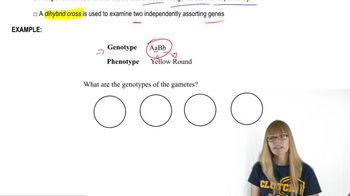
A dihybrid cross involves two genes, each with two alleles. To find genotype ratios, list all possible allele combinations from each parent and determine offspring genotypes by combining these alleles. This helps predict the frequency of each genotype in the progeny.
Recommended video:
Guided course
07:52
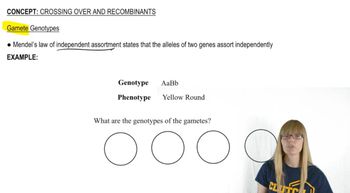
Gamete Genotypes

Mendelian Inheritance and Independent Assortment

Mendel's law of independent assortment states that alleles of different genes segregate independently during gamete formation. This principle allows the prediction of genotype and phenotype ratios by treating each gene's inheritance separately and then combining the results.
Recommended video:
Guided course
04:58
Gamete Genetics and Independent Assortment

Phenotype Determination from Genotype

Phenotypes depend on dominant and recessive allele interactions. Dominant alleles mask recessive ones, so the phenotype ratio is derived by grouping genotypes based on dominant or recessive trait expression, enabling prediction of observable traits in offspring.
Recommended video:
Guided course
07:52
Gamete Genotypes