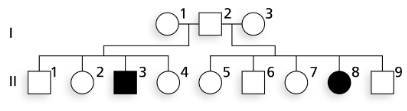
The accompanying pedigree shows the transmission of albinism (absence of skin pigment) in a human family.
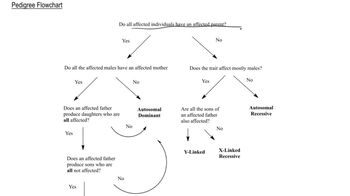
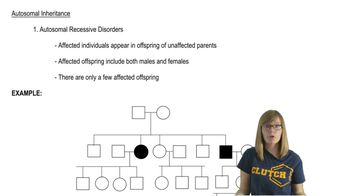
What is the most likely mode of transmission of albinism in this family?

Verified step by step guidance
The accompanying pedigree shows the transmission of albinism (absence of skin pigment) in a human family.
What is the most likely mode of transmission of albinism in this family?
The accompanying pedigree shows the transmission of albinism (absence of skin pigment) in a human family.
Using allelic symbols of your choice, identify the genotypes of the male and his two mates in generation I.
The accompanying pedigree shows the transmission of albinism (absence of skin pigment) in a human family.
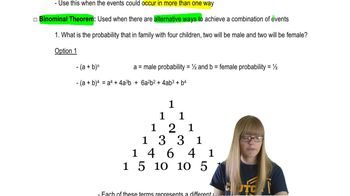
The female I-1 and her mate, male I-2, had four children, one of whom has albinism. What is the probability that they could have had a total of four children with any other outcome except one child with albinism and three with normal pigmentation?
The accompanying pedigree shows the transmission of albinism (absence of skin pigment) in a human family.
One child of female I-3 has albinism. What is the probability that any of the other four children are carriers of the allele for albinism?
A geneticist crosses a pure-breeding strain of peas producing yellow, wrinkled seeds with one that is pure-breeding for green, round seeds.
Use a Punnett square to predict the F₂ progeny that would be expected if the F₁ are allowed to self-fertilize.
A geneticist crosses a pure-breeding strain of peas producing yellow, wrinkled seeds with one that is pure-breeding for green, round seeds.
What proportion of the F₂ progeny are expected to have yellow seeds? Wrinkled seeds? Green seeds? Round seeds?