Pearson+ LogoPearson+ Logo
Ch. 2 - Transmission Genetics
Sanders - Genetic Analysis: An Integrated Approach 3rd Edition
Sanders3rd EditionGenetic Analysis: An Integrated ApproachISBN: 9780135564172Not the one you use?Change textbook
Chapter 2, Problem 15b

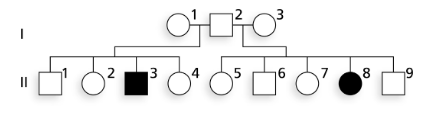
The accompanying pedigree shows the transmission of albinism (absence of skin pigment) in a human family.
Pedigree chart illustrating the inheritance of albinism in a human family across two generations.
Using allelic symbols of your choice, identify the genotypes of the male and his two mates in generation I. 

Verified step by step guidance
1
Examine the pedigree to determine the inheritance pattern of albinism. Albinism is typically inherited in an autosomal recessive manner, meaning individuals must inherit two recessive alleles to express the trait.
Choose allelic symbols to represent the trait. For example, use 'A' for the dominant allele (normal pigmentation) and 'a' for the recessive allele (albinism).
Identify the genotype of the male in generation I. If he has offspring with albinism, he must carry at least one recessive allele ('a'). If he does not express albinism himself, his genotype is heterozygous ('Aa').
Determine the genotype of the first mate in generation I. If their offspring express albinism, the mate must also carry at least one recessive allele ('a'). If the mate does not express albinism, their genotype is likely heterozygous ('Aa').
Analyze the genotype of the second mate in generation I. Follow the same logic as above, considering whether their offspring express albinism and whether the mate expresses the trait themselves. If offspring express albinism, the mate must carry at least one recessive allele ('a').

Verified video answer for a similar problem:

This video solution was recommended by our tutors as helpful for the problem above.
Video duration:
4m
Was this helpful?

Key Concepts

Here are the essential concepts you must grasp in order to answer the question correctly.

Pedigree Analysis

Pedigree analysis is a diagrammatic method used to trace the inheritance patterns of traits through generations in a family. It helps identify how traits, such as albinism, are passed down, revealing whether they are dominant or recessive. Understanding the symbols and structure of a pedigree is crucial for determining genotypes based on observed phenotypes.
Recommended video:
Guided course
01:59
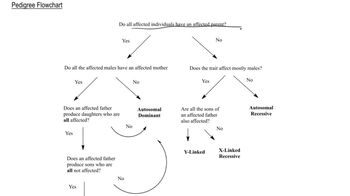
Pedigree Flowchart

Genotype vs. Phenotype

The genotype refers to the genetic makeup of an individual, while the phenotype is the observable expression of that genotype, influenced by environmental factors. In the context of albinism, individuals with the genotype 'aa' exhibit the phenotype of albinism, whereas those with 'AA' or 'Aa' do not. Distinguishing between these concepts is essential for accurately identifying genotypes in a pedigree.
Recommended video:
Guided course
07:52
Gamete Genotypes

Dominant and Recessive Alleles

Alleles are different forms of a gene that can exist at a specific locus on a chromosome. In the case of albinism, if the trait is recessive, it requires two copies of the recessive allele (e.g., 'a') for the phenotype to be expressed. Conversely, a dominant allele (e.g., 'A') can mask the presence of a recessive allele, making it vital to understand these relationships when determining genotypes from a pedigree.
Recommended video:
Guided course
04:37
Variations on Dominance
Related Practice
Textbook Question

An experienced goldfish breeder receives two unusual male goldfish. One is black rather than gold, and the other has a single tail fin rather than a split tail fin. The breeder crosses the black male to a female that is gold. All the F₁ are gold. She also crosses the single-finned male to a female with a split tail fin. All the F₁ have a split tail fin. She then crosses the black male to F₁ gold females and, separately, crosses the single-finned male to F₁ split-finned females. The results of the crosses are shown below.

Is black color dominant or recessive? Explain. Is single tail dominant or recessive? Explain.

401
views
Textbook Question

An experienced goldfish breeder receives two unusual male goldfish. One is black rather than gold, and the other has a single tail fin rather than a split tail fin. The breeder crosses the black male to a female that is gold. All the F₁ are gold. She also crosses the single-finned male to a female with a split tail fin. All the F₁ have a split tail fin. She then crosses the black male to F₁ gold females and, separately, crosses the single-finned male to F₁ split-finned females. The results of the crosses are shown below.

  Black male x F₁ gold female:

    Gold         32

    Black        34

  Single-finned male x F₁ split-finned female:

    Split fin        41

    Single fin     39

Use chi-square analysis to test your hereditary hypothesis for each trait.

421
views
Textbook Question

The accompanying pedigree shows the transmission of albinism (absence of skin pigment) in a human family.

What is the most likely mode of transmission of albinism in this family? 

633
views
Textbook Question

The accompanying pedigree shows the transmission of albinism (absence of skin pigment) in a human family.

The female I-1 and her mate, male I-2, had four children, one of whom has albinism. What is the probability that they could have had a total of four children with any other outcome except one child with albinism and three with normal pigmentation? 

677
views
Textbook Question

The accompanying pedigree shows the transmission of albinism (absence of skin pigment) in a human family.

What is the probability that female I-3 is a heterozygous carrier of the allele for albinism? 

868
views
Textbook Question

The accompanying pedigree shows the transmission of albinism (absence of skin pigment) in a human family.

One child of female I-3 has albinism. What is the probability that any of the other four children are carriers of the allele for albinism? 

894
views