Pearson+ LogoPearson+ Logo
Ch. 2 - Transmission Genetics
Sanders - Genetic Analysis: An Integrated Approach 3rd Edition
Sanders3rd EditionGenetic Analysis: An Integrated ApproachISBN: 9780135564172Not the one you use?Change textbook
Chapter 2, Problem 15c

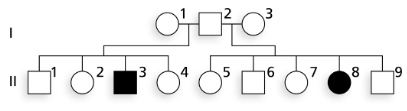
The accompanying pedigree shows the transmission of albinism (absence of skin pigment) in a human family.
Pedigree chart illustrating albinism inheritance in a family, showing one affected child among four siblings.
The female I-1 and her mate, male I-2, had four children, one of whom has albinism. What is the probability that they could have had a total of four children with any other outcome except one child with albinism and three with normal pigmentation? 

Verified step by step guidance
1
Step 1: Understand the inheritance pattern of albinism. Albinism is typically inherited as an autosomal recessive trait, meaning that an individual must inherit two copies of the recessive allele (one from each parent) to express the condition. Individuals with one dominant allele and one recessive allele are carriers but do not express albinism.
Step 2: Determine the genotypes of the parents (I-1 and I-2). Since one of their children has albinism, both parents must be carriers of the recessive allele (heterozygous, Aa). This is because a child with albinism (aa) can only inherit a recessive allele from each parent.
Step 3: Use a Punnett square to calculate the probabilities of offspring genotypes. Cross the genotypes of the parents (Aa x Aa). The possible genotypes for their children are: AA (normal pigmentation, not a carrier), Aa (normal pigmentation, carrier), and aa (albinism). The probabilities are: 25% AA, 50% Aa, and 25% aa.
Step 4: Calculate the probability of having one child with albinism and three with normal pigmentation. This involves using the binomial probability formula: \( P = \binom{n}{k} \cdot p^k \cdot (1-p)^{n-k} \), where \( n \) is the total number of children, \( k \) is the number of children with albinism, \( p \) is the probability of albinism (0.25), and \( 1-p \) is the probability of normal pigmentation (0.75).
Step 5: Subtract the probability calculated in Step 4 from 1 to find the probability of any other outcome except one child with albinism and three with normal pigmentation. This accounts for all other combinations of children with albinism and normal pigmentation.

Verified video answer for a similar problem:

This video solution was recommended by our tutors as helpful for the problem above.
Video duration:
3m
Was this helpful?

Key Concepts

Here are the essential concepts you must grasp in order to answer the question correctly.

Inheritance Patterns

Understanding inheritance patterns, particularly autosomal recessive traits like albinism, is crucial. Albinism typically requires two copies of the recessive allele for an individual to express the trait. Therefore, knowing the genotypes of the parents and how traits are passed down through generations helps in predicting the likelihood of offspring exhibiting specific traits.
Recommended video:
Guided course
05:13
Organelle Inheritance

Probability in Genetics

Probability in genetics involves calculating the likelihood of certain genetic outcomes based on parental genotypes. For example, if both parents are carriers of the albinism allele, the probability of having a child with albinism can be determined using a Punnett square, which visually represents the potential genetic combinations of the offspring.
Recommended video:

Pedigree Analysis

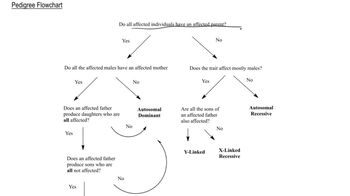
Pedigree analysis is a tool used to trace the inheritance of traits through generations in a family. By examining a pedigree chart, one can identify patterns of inheritance, determine carrier status, and assess the probability of future offspring inheriting specific traits, such as albinism, based on the family history.
Recommended video:
Guided course
01:59
Pedigree Flowchart
Related Practice
Textbook Question

An experienced goldfish breeder receives two unusual male goldfish. One is black rather than gold, and the other has a single tail fin rather than a split tail fin. The breeder crosses the black male to a female that is gold. All the F₁ are gold. She also crosses the single-finned male to a female with a split tail fin. All the F₁ have a split tail fin. She then crosses the black male to F₁ gold females and, separately, crosses the single-finned male to F₁ split-finned females. The results of the crosses are shown below.

  Black male x F₁ gold female:

    Gold         32

    Black        34

  Single-finned male x F₁ split-finned female:

    Split fin        41

    Single fin     39

Use chi-square analysis to test your hereditary hypothesis for each trait.

421
views
Textbook Question

The accompanying pedigree shows the transmission of albinism (absence of skin pigment) in a human family.

What is the most likely mode of transmission of albinism in this family? 

633
views
Textbook Question

The accompanying pedigree shows the transmission of albinism (absence of skin pigment) in a human family.

Using allelic symbols of your choice, identify the genotypes of the male and his two mates in generation I. 

658
views
Textbook Question

The accompanying pedigree shows the transmission of albinism (absence of skin pigment) in a human family.

What is the probability that female I-3 is a heterozygous carrier of the allele for albinism? 

868
views
Textbook Question

The accompanying pedigree shows the transmission of albinism (absence of skin pigment) in a human family.

One child of female I-3 has albinism. What is the probability that any of the other four children are carriers of the allele for albinism? 

894
views
Textbook Question

A geneticist crosses a pure-breeding strain of peas producing yellow, wrinkled seeds with one that is pure-breeding for green, round seeds.

Use a Punnett square to predict the F₂ progeny that would be expected if the F₁ are allowed to self-fertilize.

563
views