Pearson+ LogoPearson+ Logo
Ch. 2 - Transmission Genetics
Sanders - Genetic Analysis: An Integrated Approach 3rd Edition
Sanders3rd EditionGenetic Analysis: An Integrated ApproachISBN: 9780135564172Not the one you use?Change textbook
Chapter 2, Problem 16a

A geneticist crosses a pure-breeding strain of peas producing yellow, wrinkled seeds with one that is pure-breeding for green, round seeds.
Use a Punnett square to predict the F₂ progeny that would be expected if the F₁ are allowed to self-fertilize.

Verified step by step guidance
1
Step 1: Identify the genotypes of the parent strains. The pure-breeding yellow, wrinkled seeds can be represented as YYrr (homozygous dominant for yellow and homozygous recessive for wrinkled). The pure-breeding green, round seeds can be represented as yyRR (homozygous recessive for green and homozygous dominant for round).
Step 2: Determine the genotype of the F₁ generation. When YYrr is crossed with yyRR, the offspring will inherit one allele from each parent for each trait. This results in heterozygous genotypes for both traits: YyRr. All F₁ individuals will have yellow, round seeds due to the dominance of Y (yellow) and R (round).
Step 3: Set up a Punnett square for the F₂ generation. Since the F₁ individuals are heterozygous (YyRr), they can produce four types of gametes: YR, Yr, yR, and yr. Write these gametes along the top and side of a 4x4 Punnett square.
Step 4: Fill in the Punnett square by combining the gametes from the rows and columns. Each cell in the square represents a possible genotype for the F₂ progeny. For example, combining YR (from one parent) and Yr (from the other parent) results in YyRR.
Step 5: Analyze the completed Punnett square to determine the phenotypic ratios of the F₂ progeny. Count the number of individuals with each phenotype (e.g., yellow-round, yellow-wrinkled, green-round, green-wrinkled) based on the dominance and recessiveness of the alleles.

Verified video answer for a similar problem:

This video solution was recommended by our tutors as helpful for the problem above.
Video duration:
2m
Was this helpful?

Key Concepts

Here are the essential concepts you must grasp in order to answer the question correctly.

Mendelian Genetics

Mendelian genetics is the study of how traits are inherited through generations, based on the principles established by Gregor Mendel. It involves understanding dominant and recessive alleles, where dominant traits mask the expression of recessive ones. In this scenario, yellow seeds (Y) are dominant over green seeds (y), and round seeds (R) are dominant over wrinkled seeds (r).
Recommended video:
Guided course
03:45
Descriptive Genetics

Punnett Square

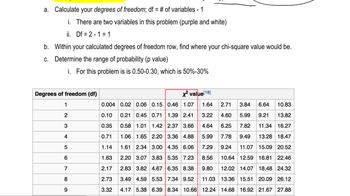
A Punnett square is a diagram used to predict the genetic makeup of offspring from a cross between two parents. It organizes the possible combinations of alleles from each parent, allowing for the visualization of potential genotypes and phenotypes in the progeny. In this case, the Punnett square will help determine the expected ratios of yellow, green, round, and wrinkled seeds in the F₂ generation.
Recommended video:
Guided course
18:27
Chi Square Analysis

Genotype and Phenotype

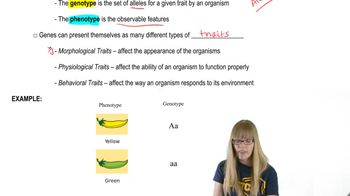
Genotype refers to the genetic constitution of an organism, specifically the alleles it carries, while phenotype is the observable expression of those genes, influenced by both genotype and environmental factors. In this example, the F₁ generation will have a genotype of YyRr, leading to a phenotype of yellow, round seeds. The self-fertilization of F₁ plants will produce a variety of genotypes in the F₂ generation, resulting in different phenotypic expressions.
Recommended video:
Guided course
07:52
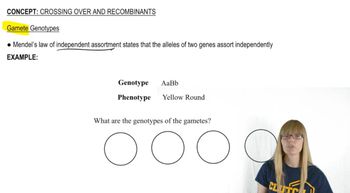
Gamete Genotypes
Related Practice
Textbook Question

The accompanying pedigree shows the transmission of albinism (absence of skin pigment) in a human family.

The female I-1 and her mate, male I-2, had four children, one of whom has albinism. What is the probability that they could have had a total of four children with any other outcome except one child with albinism and three with normal pigmentation? 

677
views
Textbook Question

The accompanying pedigree shows the transmission of albinism (absence of skin pigment) in a human family.

What is the probability that female I-3 is a heterozygous carrier of the allele for albinism? 

868
views
Textbook Question

The accompanying pedigree shows the transmission of albinism (absence of skin pigment) in a human family.

One child of female I-3 has albinism. What is the probability that any of the other four children are carriers of the allele for albinism? 

894
views
Textbook Question

A geneticist crosses a pure-breeding strain of peas producing yellow, wrinkled seeds with one that is pure-breeding for green, round seeds.

What proportion of the F₂ progeny are expected to have yellow seeds? Wrinkled seeds? Green seeds? Round seeds?

581
views
Textbook Question

A geneticist crosses a pure-breeding strain of peas producing yellow, wrinkled seeds with one that is pure-breeding for green, round seeds.

What is the expected phenotype distribution among the F₂ progeny?

411
views
Textbook Question

Suppose an F₁ dihybrid (round yellow plant from Problem 16) is crossed to the pure-breeding green, round parental strain. Use a forked-line diagram to predict the phenotypic distribution of the resulting progeny.

466
views