Pearson+ LogoPearson+ Logo
Ch. 20 - Population Genetics and Evolution at the Population, Species, and Molecular Levels
Sanders - Genetic Analysis: An Integrated Approach 3rd Edition
Sanders3rd EditionGenetic Analysis: An Integrated ApproachISBN: 9780135564172Not the one you use?Change textbook
Chapter 20, Problem 39a

New allopolyploid plant species can arise by hybridization between two species. If hybridization occurs between a diploid plant species with 2n = 14 and a second diploid species with 2n = 22, the new allopolyploid would have 36 chromosomes. Is it likely that sexual reproduction between the allopolyploid species and either of its diploid ancestors would yield fertile progeny? Why or why not?

Verified step by step guidance
1
Step 1: Understand the concept of allopolyploidy. Allopolyploidy occurs when two different species hybridize, and the resulting hybrid undergoes chromosome doubling, allowing it to become fertile. This process creates a new species with a combination of chromosomes from both parent species.
Step 2: Analyze the chromosome numbers of the parent species. The first diploid species has 2n = 14 chromosomes, meaning its haploid number (n) is 7. The second diploid species has 2n = 22 chromosomes, meaning its haploid number (n) is 11.
Step 3: Determine the chromosome composition of the allopolyploid. The hybrid initially inherits one set of chromosomes from each parent species, resulting in 7 + 11 = 18 chromosomes. After chromosome doubling, the allopolyploid has 2 sets of chromosomes from each parent species, resulting in 2(7 + 11) = 36 chromosomes.
Step 4: Evaluate the compatibility for sexual reproduction between the allopolyploid and its diploid ancestors. Fertile progeny require homologous chromosomes to pair during meiosis. The allopolyploid has 36 chromosomes, while the diploid ancestors have 14 and 22 chromosomes, respectively. The lack of homologous pairing between the allopolyploid and either diploid ancestor would likely prevent the formation of fertile progeny.
Step 5: Conclude that sexual reproduction between the allopolyploid and either diploid ancestor is unlikely to yield fertile progeny. This is because the chromosome sets of the allopolyploid and the diploid ancestors are not compatible for proper meiotic pairing, leading to sterility in the offspring.

Verified video answer for a similar problem:

This video solution was recommended by our tutors as helpful for the problem above.
Video duration:
2m
Was this helpful?

Key Concepts

Here are the essential concepts you must grasp in order to answer the question correctly.

Allopolyploidy

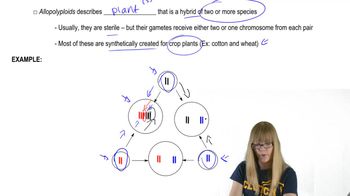
Allopolyploidy is a form of polyploidy that occurs when two different species hybridize, resulting in a new species with multiple sets of chromosomes from both parents. In this case, the new allopolyploid plant species has a chromosome number of 36, which is the sum of the chromosome sets from the two diploid parents (14 + 22). This genetic makeup can lead to unique traits and adaptations but also complicates reproduction with the parent species.
Recommended video:
Guided course
04:34
Allopolyploidy

Chromosome Compatibility

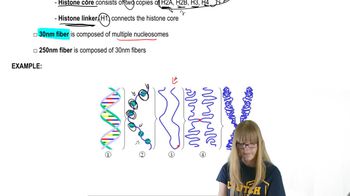
Chromosome compatibility is crucial for successful sexual reproduction. For an allopolyploid to produce fertile offspring with its diploid ancestors, the chromosome numbers must align properly during meiosis. In this scenario, the allopolyploid has 36 chromosomes, while the diploid parents have 14 and 22 chromosomes, respectively. This significant difference in chromosome number can lead to issues during gamete formation, often resulting in sterile progeny.
Recommended video:
Guided course
07:10
Chromosome Structure

Fertility and Hybridization

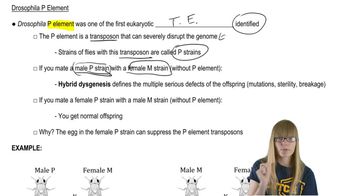
Fertility in hybridization depends on the ability of the hybrid organism to undergo meiosis and produce viable gametes. In many cases, hybrids between species with differing chromosome numbers are sterile due to improper pairing of chromosomes during meiosis. Given that the allopolyploid has a different chromosome count than its diploid ancestors, it is unlikely that sexual reproduction would yield fertile progeny, as the genetic mismatch can hinder successful gamete formation.
Recommended video:
Guided course
03:08
Drosophila P Element
Related Practice
Textbook Question

Draw a separate hypothetical pedigree identifying the inbred individuals and the inbreeding pathways for each of the following inbreeding coefficients:

F=2(1/2)⁷

404
views
Textbook Question
The human melanocortin 1 receptor gene (MC1R) plays a major role in producing eumelanin, a black-brown pigment that helps determine hair color and skin color. Jonathan Rees and several colleagues (J. L. Rees et al., Am. J. Human Genet. 66(2000): 1351–1361) studied multiple MC1R alleles in African and European populations. Although this research found several MC1R alleles in African populations, MC1R alleles that decrease the production of eumelanin were rare. In contrast, several alleles decreasing eumelanin production were found in European populations. How can these results be explained by natural selection?
665
views
Textbook Question
Achromatopsia is a rare autosomal recessive form of complete color blindness that affects about 1 in 20,000 people in most populations. People with this disorder see only in black and white and have extreme sensitivity to light and poor visual acuity. On Pingelap Island, one of a cluster of coral atoll islands in the Federated States of Micronesia, approximately 10% of the 3000 indigenous Pingelapese inhabitants have achromatopsia.Achromatopsia was first recorded on Pingelap in the mid-1800s, about four generations after a typhoon devastated Pingelap and reduced the island population to about 20 people. All Pingelapese with achromatopsia trace their ancestry to one male who was one of the 20 typhoon survivors. Provide a genetic explanation for the origin of achromatopsia on Pingelap, and explain the most likely evolutionary model for the high frequency there of achromatopsia.
441
views
Textbook Question

New allopolyploid plant species can arise by hybridization between two species. If hybridization occurs between a diploid plant species with 2n = 14 and a second diploid species with 2n = 22, the new allopolyploid would have 36 chromosomes. What type of isolation mechanism is most likely to prevent hybridization between the allopolyploid and the diploid species?

456
views
Textbook Question

New allopolyploid plant species can arise by hybridization between two species. If hybridization occurs between a diploid plant species with 2n = 14 and a second diploid species with 2n = 22, the new allopolyploid would have 36 chromosomes. What pattern of speciation is illustrated by the development of the allopolyploid species?

456
views
Textbook Question

Divide the contents of a large bag of different-colored candies randomly and approximately equally among the members of the group. Do not pick specific candy colors, but simply empty the contents of the bag onto a table and quickly divide the pile. If you are doing this exercise by yourself, divide the contents of the bag into five piles. Have each person count the number of candies of each color in they pile and calculate the frequency of each color in the pile.

461
views