The ability to taste the bitter compound phenylthiocarbamide (PTC) is an autosomal dominant trait. The inability to taste PTC is a recessive condition. In a sample of 500 people, 360 have the ability to taste PTC and 140 do not. Calculate the frequency of the recessive allele.

Sanders 3rd Edition
Ch. 20 - Population Genetics and Evolution at the Population, Species, and Molecular Levels
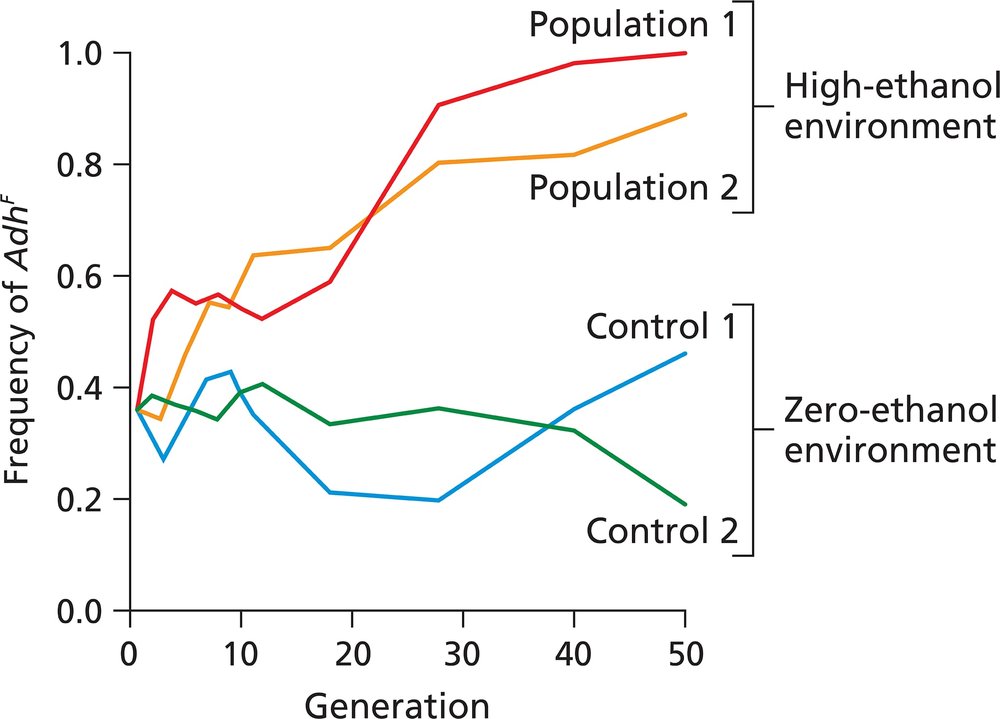
Problem 11The figure illustrates the effect of an ethanol-rich and an ethanol-free environment on the frequency of the Drosophila AdhF allele in four populations in a 50-generation laboratory experiment. Population 1 and population 2 were reared for 50 generations in a high-ethanol environment, while control 1 and control 2 populations were reared for 50 generations in a zero-ethanol environment. Describe the effect of each environment on the populations, and state any conclusions you can reach about the role of any of the evolutionary processes in producing these effects.

Verified step by step guidance
Verified video answer for a similar problem:
Key Concepts
Natural Selection
Allele Frequency and Genetic Variation
Role of Environmental Pressure in Evolution
The ability to taste the bitter compound phenylthiocarbamide (PTC) is an autosomal dominant trait. The inability to taste PTC is a recessive condition. In a sample of 500 people, 360 have the ability to taste PTC and 140 do not. Calculate the frequency of the dominant allele.
The ability to taste the bitter compound phenylthiocarbamide (PTC) is an autosomal dominant trait. The inability to taste PTC is a recessive condition. In a sample of 500 people, 360 have the ability to taste PTC and 140 do not. Calculate the frequency of each genotype.
Two populations of deer, one of them large and living in a mainland forest and the other small and inhabiting a forest on an island, regularly exchange members that migrate across a land bridge that connects the island to the mainland. If you compared the allele frequencies in the two populations, what would you expect to find?
Two populations of deer, one of them large and living in a mainland forest and the other small and inhabiting a forest on an island, regularly exchange members that migrate across a land bridge that connects the island to the mainland. An earthquake destroys the bridge between the island and the mainland, making migration impossible for the deer. What do you expect will happen to allele frequencies in the two populations over the following 10 generations?