Pearson+ LogoPearson+ Logo
Ch. 3 - Cell Division and Chromosome Heredity
Sanders - Genetic Analysis: An Integrated Approach 3rd Edition
Sanders3rd EditionGenetic Analysis: An Integrated ApproachISBN: 9780135564172Not the one you use?Change textbook
Chapter 3, Problem 2c

Our closest primate relative, the chimpanzee, has a diploid number of 2n = 48. For each of the following stages of M phase, identify the number of chromosomes present in each cell.
End of meiotic anaphase II

Verified step by step guidance
1
Understand the diploid number of the chimpanzee: 2n = 48. This means the organism has 48 chromosomes in its diploid cells, with 24 chromosomes in each haploid cell (n = 24).
Recall that meiosis consists of two divisions: meiosis I and meiosis II. Meiosis II is similar to mitosis, where sister chromatids are separated into different cells.
At the end of meiotic anaphase II, sister chromatids have been pulled apart to opposite poles of the cell. Each chromatid is now considered an individual chromosome.
Since meiosis II starts with haploid cells (n = 24), and each chromosome splits into two chromatids during anaphase II, there will be 24 chromosomes at each pole of the cell.
After the completion of anaphase II, the cell will proceed to cytokinesis, resulting in two haploid daughter cells, each containing 24 chromosomes.

Verified video answer for a similar problem:

This video solution was recommended by our tutors as helpful for the problem above.
Video duration:
2m
Was this helpful?

Key Concepts

Here are the essential concepts you must grasp in order to answer the question correctly.

Diploid and Haploid Numbers

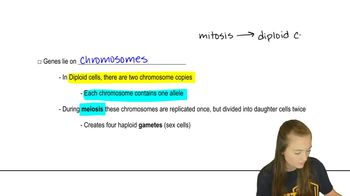
Diploid (2n) refers to cells that contain two complete sets of chromosomes, one from each parent. In the case of chimpanzees, the diploid number is 48, meaning they have 24 pairs of chromosomes. During meiosis, cells undergo two rounds of division, ultimately producing haploid (n) cells, which contain only one set of chromosomes.
Recommended video:
Guided course
27:36
Diploid Genetics

Meiosis

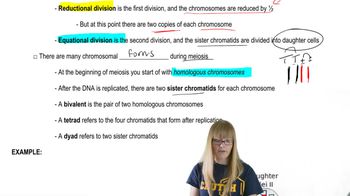
Meiosis is a specialized form of cell division that reduces the chromosome number by half, resulting in four genetically diverse haploid cells. It consists of two main stages: meiosis I, where homologous chromosomes are separated, and meiosis II, where sister chromatids are separated. Understanding the stages of meiosis is crucial for determining the chromosome number at specific points, such as anaphase II.
Recommended video:
Guided course
05:30
Meiosis Overview

Anaphase II

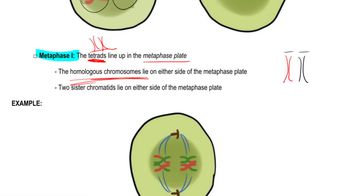
Anaphase II is a stage in meiosis II where the sister chromatids are pulled apart to opposite poles of the cell. At this point, each chromatid is considered an individual chromosome. For chimpanzees, with a diploid number of 48, during anaphase II, there would be 48 chromosomes present in total, as each of the 24 pairs has been separated into individual chromatids.
Recommended video:
Guided course
09:06
Meiosis Steps