Pearson+ LogoPearson+ Logo
Ch. 4 - Gene Interaction
Sanders - Genetic Analysis: An Integrated Approach 3rd Edition
Sanders3rd EditionGenetic Analysis: An Integrated ApproachISBN: 9780135564172Not the one you use?Change textbook
Chapter 4, Problem 4b

Fifteen bacterial colonies growing on a complete medium are transferred to a minimal medium. Twelve of the colonies grow on minimal medium.
The three colonies that do not grow on minimal medium are transferred to minimal medium supplemented with the amino acid serine (min + Ser), and all three colonies grow. Characterize these three colonies.

Verified step by step guidance
1
Identify the key difference between the complete medium and the minimal medium. The complete medium contains all necessary nutrients, while the minimal medium contains only the essential nutrients required for bacterial growth.
Analyze the observation that 12 out of 15 colonies grow on the minimal medium. This indicates that these 12 colonies can synthesize all the necessary compounds for growth from the nutrients provided in the minimal medium.
Focus on the 3 colonies that do not grow on the minimal medium. This suggests that these colonies are auxotrophic for a specific nutrient, meaning they lack the ability to synthesize a particular compound required for growth.
Examine the result of transferring the 3 non-growing colonies to the minimal medium supplemented with serine. Since all three colonies grow in this condition, it indicates that these colonies are specifically auxotrophic for serine. They cannot synthesize serine on their own and require it to be provided externally.
Characterize the three colonies as serine auxotrophs. This means they have a genetic mutation or defect in the biosynthetic pathway for serine, preventing them from producing this amino acid independently.

Verified video answer for a similar problem:

This video solution was recommended by our tutors as helpful for the problem above.
Video duration:
3m
Was this helpful?

Key Concepts

Here are the essential concepts you must grasp in order to answer the question correctly.

Minimal Medium

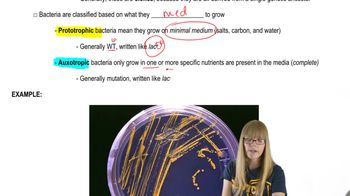
Minimal medium is a growth medium that contains only the essential nutrients required for the growth of microorganisms, such as carbon, nitrogen, and salts. It lacks additional growth factors, such as amino acids or vitamins, which some organisms may need to survive. In this context, the ability of bacterial colonies to grow on minimal medium indicates their metabolic capabilities and nutritional requirements.
Recommended video:
Guided course
04:06
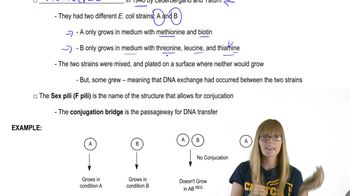
Conjugation Overview

Amino Acid Supplementation

Amino acid supplementation involves adding specific amino acids, like serine, to a growth medium to support the growth of organisms that cannot synthesize these compounds. The three colonies that failed to grow on minimal medium likely have mutations affecting their ability to produce serine, making them auxotrophic. By supplementing the medium with serine, these colonies can thrive, demonstrating their dependency on external sources of this amino acid.
Recommended video:

Auxotrophy

Auxotrophy refers to the condition of an organism that cannot synthesize a particular compound required for its growth due to a mutation. In this case, the three bacterial colonies are auxotrophic for serine, meaning they lack the genetic capability to produce it. This characteristic is crucial for understanding their growth requirements and metabolic pathways, as it highlights their reliance on external sources of nutrients.
Recommended video:
Guided course
09:35
Bacteria in the Laboratory
Related Practice
Textbook Question

Define and distinguish epistasis and pleiotropy.

668
views
Textbook Question

When working on barley plants, two researchers independently identify a short-plant mutation and develop homozygous recessive lines of short plants. Careful measurements of the height of mutant short plants versus normal tall plants indicate that the two mutant lines have the same height. How would you determine if these two mutant lines carry mutation of the same gene or of different genes?

700
views
Textbook Question

Fifteen bacterial colonies growing on a complete medium are transferred to a minimal medium. Twelve of the colonies grow on minimal medium.

Using terminology, characterize the 12 colonies that grow on minimal medium and the 3 colonies that do not.

742
views
Textbook Question

Fifteen bacterial colonies growing on a complete medium are transferred to a minimal medium. Twelve of the colonies grow on minimal medium.

The serine biosynthetic pathway is a three-step pathway in which each step is catalyzed by the enzyme product of a different gene, identified as enzymes A, B, and C in the diagram below.


Mutant 1 grows only on min + Ser. In addition to growth on min + Ser, mutant 2 also grows on min + 3-PHP and min + 3-PS. Mutant 3 grows on min + 3-PS and min + Ser. Identify the step of the serine biosynthesis pathway at which each mutant is defective.

441
views
Textbook Question

In a type of parakeet known as a "budgie," feather color is controlled by two genes. A yellow pigment is synthesized under the control of a dominant allele Y. Budgies that are homozygous for the recessive y allele do not synthesize yellow pigment. At an independently assorting gene, the dominant allele B directs synthesis of a blue pigment. Recessive homozygotes with the bb genotype do not produce blue pigment. Budgies that produce both yellow and blue pigments have green feathers; those that produce only yellow pigment or only blue pigment have yellow or blue feathers, respectively; and budgies that produce neither pigment are white (albino).

a. List the genotypes for green, yellow, blue, and albino budgies

1350
views
Textbook Question

In a type of parakeet known as a "budgie," feather color is controlled by two genes. A yellow pigment is synthesized under the control of a dominant allele Y. Budgies that are homozygous for the recessive y allele do not synthesize yellow pigment. At an independently assorting gene, the dominant allele B directs synthesis of a blue pigment. Recessive homozygotes with the bb genotype do not produce blue pigment. Budgies that produce both yellow and blue pigments have green feathers; those that produce only yellow pigment or only blue pigment have yellow or blue feathers, respectively; and budgies that produce neither pigment are white (albino).

b. A cross is made between a pure-breeding green budgie and a pure-breeding albino budgie. What are the genotypes of the parent birds?

523
views