Pearson+ LogoPearson+ Logo
Ch. 4 - Gene Interaction
Sanders - Genetic Analysis: An Integrated Approach 3rd Edition
Sanders3rd EditionGenetic Analysis: An Integrated ApproachISBN: 9780135564172Not the one you use?Change textbook
Chapter 4, Problem 38b

Draw a pedigree containing two parents and four children. Both of the parents have an AB blood type. The first child is type A, the second child is type AB, and the third child is type B.
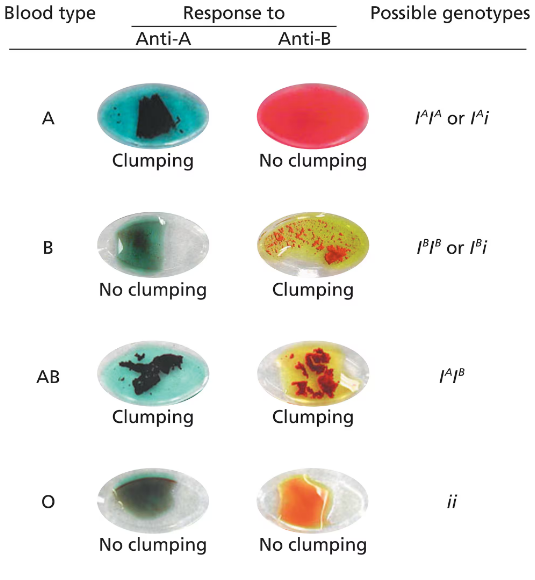
The fourth child tests as having blood type O, which is not possible given the parental genotypes. Look at the Figure below and read the description of the molecular process that generates ABO blood group antigens. What other mutation could account for this observation?
Table showing blood types A, B, AB, O with clumping reactions to Anti-A and Anti-B and possible genotypes.

Verified step by step guidance
1
Start by drawing a pedigree chart with two parents connected by a horizontal line, indicating mating, and four children connected below them with vertical lines.
Label both parents with the blood type AB. Since AB blood type means each parent has one A allele and one B allele, their genotype is I^A I^B.
Assign the blood types to the children as given: the first child is type A, the second is type AB, the third is type B, and the fourth is type O. Note that the first three children's blood types are consistent with the parents' genotypes, but the fourth child's type O is unexpected.
Recall that blood type O corresponds to the genotype I^O I^O, meaning the child must have inherited two O alleles. Since neither parent has an O allele, this is genetically impossible under normal inheritance.
Consider the molecular basis of ABO blood groups: the I^A and I^B alleles encode enzymes that modify the H antigen on red blood cells, while the I^O allele is a nonfunctional variant. A possible explanation for the fourth child's type O blood is a mutation in the FUT1 gene (which encodes the H antigen), leading to the Bombay phenotype, where the H antigen is not produced, masking the presence of A or B antigens and resulting in a type O blood phenotype despite the genotype.

Verified video answer for a similar problem:

This video solution was recommended by our tutors as helpful for the problem above.
Video duration:
2m
Was this helpful?

Key Concepts

Here are the essential concepts you must grasp in order to answer the question correctly.

ABO Blood Group Inheritance

The ABO blood group system is determined by three alleles: A, B, and O. Each parent contributes one allele, and the combination determines the blood type. Parents with AB blood type have one A and one B allele, so their children can have A, B, or AB types, but not O, since O requires two O alleles.
Recommended video:
Guided course
05:13
Organelle Inheritance

Molecular Basis of ABO Antigens

ABO blood types arise from specific glycosyltransferase enzymes encoded by the ABO gene, which modify the H antigen on red blood cells. The A and B alleles produce enzymes that add different sugar residues, while the O allele results from a nonfunctional enzyme, leaving the H antigen unmodified.
Recommended video:
Guided course
07:11
Mapping with Markers

Mutations Affecting ABO Phenotype

Mutations in the ABO gene can alter enzyme function, leading to unexpected blood types. For example, a mutation causing a loss of function in one allele of an AB parent could produce a nonfunctional enzyme similar to O, explaining a child with type O blood despite parents having AB genotypes.
Recommended video:
Guided course
10:48
Mutations and Phenotypes