Pearson+ LogoPearson+ Logo
Ch. 4 - Gene Interaction
Sanders - Genetic Analysis: An Integrated Approach 3rd Edition
Sanders3rd EditionGenetic Analysis: An Integrated ApproachISBN: 9780135564172Not the one you use?Change textbook
Chapter 4, Problem 25

The crosses shown are performed between morning glories whose flower color is determined as described in Problem 24. Use the segregation data to determine the genotype of each parental plant.


Table showing parental and offspring phenotypes for morning glory crosses in genetics.

Verified step by step guidance
1
Step 1: Analyze the inheritance pattern of flower color in morning glories. Based on the data provided, flower color is likely determined by multiple alleles or a combination of dominant and recessive traits. Identify the phenotypic ratios in the offspring to infer the genotypes of the parents.
Step 2: For cross (a) blue × blue, the offspring ratio is 3/4 blue : 1/4 purple. This suggests that both parents are heterozygous for the blue trait (e.g., Bb), where B is dominant for blue and b is recessive for purple.
Step 3: For cross (b) purple × purple, the offspring ratio is 1/4 blue : 1/2 purple : 1/4 red. This indicates that both parents are heterozygous for purple (e.g., Pp), where P is dominant for purple and p is recessive for red. The presence of blue offspring suggests a second locus interacting with the purple trait.
Step 4: For cross (c) blue × red, the offspring ratio is 1/4 blue : 1/2 purple : 1/4 red. This suggests that the blue parent is heterozygous (Bb) and the red parent is homozygous recessive (pp). The purple offspring arise from a combination of alleles at two loci.
Step 5: For cross (d) purple × red, the offspring ratio is 1/2 purple : 1/2 red. This suggests that the purple parent is heterozygous (Pp) and the red parent is homozygous recessive (pp). The absence of blue offspring indicates that the blue allele is not present in this cross.

Verified video answer for a similar problem:

This video solution was recommended by our tutors as helpful for the problem above.
Video duration:
4m
Was this helpful?

Key Concepts

Here are the essential concepts you must grasp in order to answer the question correctly.

Mendelian Genetics

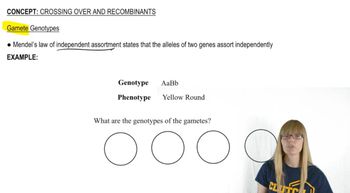
Mendelian genetics is the study of how traits are inherited through generations based on the principles established by Gregor Mendel. It involves understanding dominant and recessive alleles, as well as the segregation and independent assortment of genes during gamete formation. This framework is essential for predicting offspring phenotypes from parental genotypes.
Recommended video:
Guided course
03:45
Descriptive Genetics

Phenotype and Genotype

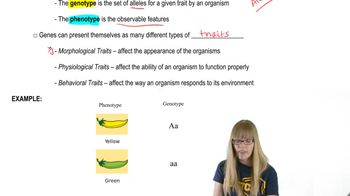
The phenotype refers to the observable characteristics or traits of an organism, such as flower color in morning glories, while the genotype is the genetic makeup that determines these traits. Understanding the relationship between genotype and phenotype is crucial for interpreting the results of genetic crosses and determining the underlying genetic mechanisms.
Recommended video:
Guided course
07:52
Gamete Genotypes

Punnett Square

A Punnett square is a diagram used to predict the genetic outcomes of a cross between two organisms. It allows for the visualization of how alleles from each parent combine to produce offspring genotypes and phenotypes. This tool is particularly useful in analyzing the segregation data provided in the question to deduce the genotypes of the parental plants.
Recommended video:
Guided course
18:27
Chi Square Analysis
Related Practice
Textbook Question

Blue flower color is produced in a species of morning glories when dominant alleles are present at two gene loci, A and B. (Plants with the genotype have blue flowers.) Purple flowers result when a dominant allele is present at only one of the two gene loci, A or B. (Plants with the genotypes and are purple.) Flowers are red when the plant is homozygous recessive for each gene (i.e., aabb).

Two pure-breeding purple strains are crossed, and all the F₁ plants have blue flowers. What are the genotypes of the parental plants?

491
views
Textbook Question

Blue flower color is produced in a species of morning glories when dominant alleles are present at two gene loci, A and B. (Plants with the genotype have blue flowers.) Purple flowers result when a dominant allele is present at only one of the two gene loci, A or B. (Plants with the genotypes and are purple.) Flowers are red when the plant is homozygous recessive for each gene (i.e., aabb).

If two F₁ plants are crossed, what are the expected phenotypes and frequencies in the F₂?

491
views
Textbook Question

Blue flower color is produced in a species of morning glories when dominant alleles are present at two gene loci, A and B. (Plants with the genotype have blue flowers.) Purple flowers result when a dominant allele is present at only one of the two gene loci, A or B. (Plants with the genotypes and are purple.) Flowers are red when the plant is homozygous recessive for each gene (i.e., aabb).

If an F₁ plant is backcrossed to one of the pure-breeding parental plants, what is the expected ratio of phenotypes among progeny? Why is the phenotype ratio the same regardless of which parental strain is selected for the backcross?

777
views
Textbook Question

Two pure-breeding strains of summer squash producing yellow fruit, Y₁ and Y₂, are each crossed to a pure-breeding strain of summer squash producing green fruit, G₁, and to one another. The following results are obtained:

Examine the results of each cross and predict how many genes are responsible for fruit-color determination in summer squash. Justify your answer. 

488
views
Textbook Question

Two pure-breeding strains of summer squash producing yellow fruit, Y₁ and Y₂, are each crossed to a pure-breeding strain of summer squash producing green fruit, G₁, and to one another. The following results are obtained:

Using clearly defined symbols of your choice, give the genotypes of parental, F₁, and F₂ plants in each cross. 

428
views
Textbook Question

Two pure-breeding strains of summer squash producing yellow fruit, Y₁ and Y₂, are each crossed to a pure-breeding strain of summer squash producing green fruit, G₁, and to one another. The following results are obtained:

If the F₁ of Crosses I and II are mated, predict the phenotype ratio of the progeny. 

531
views