Pearson+ LogoPearson+ Logo
Ch. 5 - Genetic Linkage and Mapping in Eukaryotes
Sanders - Genetic Analysis: An Integrated Approach 3rd Edition
Sanders3rd EditionGenetic Analysis: An Integrated ApproachISBN: 9780135564172Not the one you use?Change textbook
Chapter 5, Problem 30a

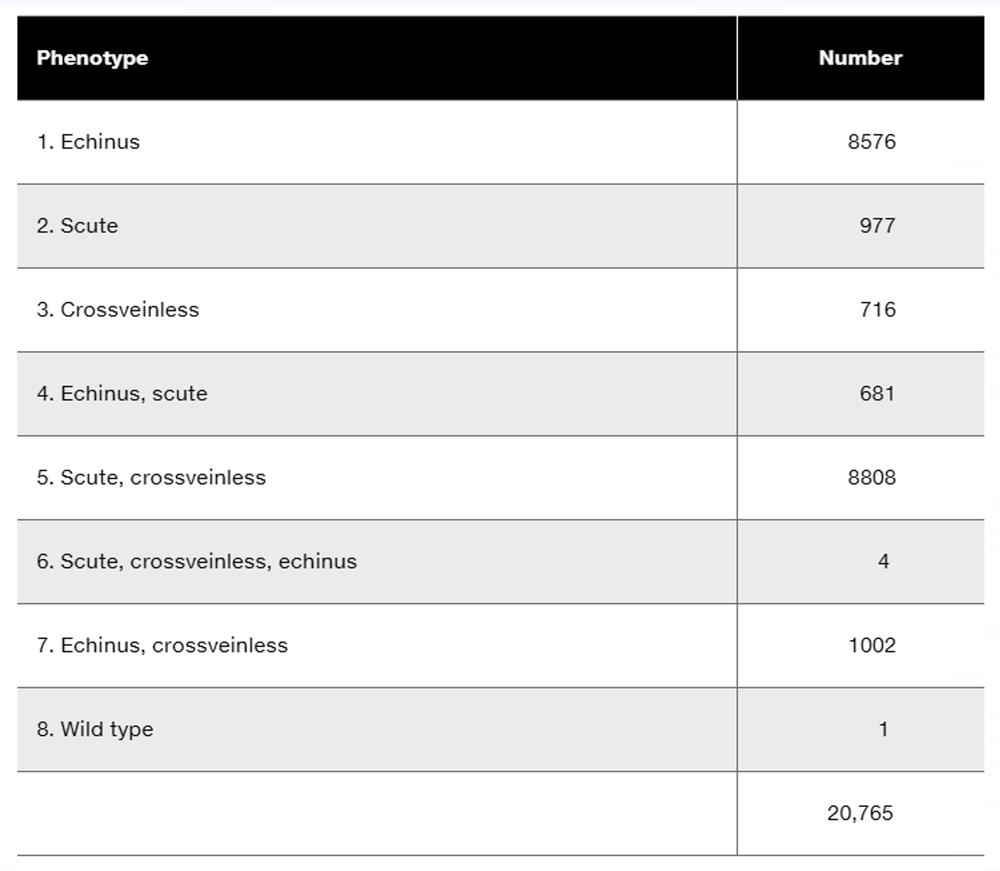
A Drosophila experiment examining potential genetic linkage of X-linked genes studies a recessive eye mutant (echinus), a recessive wing-vein mutation (crossveinless), and a recessive bristle mutation (scute). The wild-type phenotypes are dominant. Trihybrid wild-type females (all have the same genotype) are crossed to hemizygous males displaying the three recessive phenotypes. Among the 20,765 progeny produced from these crosses are the phenotypes and numbers listed in the table. Any phenotype not given is wild type.
Table displaying phenotypes and numbers from a Drosophila genetic linkage experiment with recessive mutations.
Determine the gene order and identify the alleles on the homologous X chromosomes in the trihybrid females.

Verified step by step guidance
1
Step 1: Begin by identifying the parental phenotypes and recombinant phenotypes. Parental phenotypes are the most frequent, while recombinant phenotypes are less frequent. From the data, the most frequent phenotypes are 'Echinus' (8576) and 'Scute, Crossveinless' (8808). These represent the parental combinations.
Step 2: Determine the double crossover phenotypes, which are the least frequent. In this case, the phenotypes 'Scute, Crossveinless, Echinus' (4) and 'Wild type' (1) are the double crossover events.
Step 3: Use the double crossover phenotypes to deduce the gene order. Compare the double crossover phenotypes to the parental phenotypes. The gene that appears to be 'switched' in the double crossover relative to the parental phenotypes is the middle gene. Analyze the combinations to identify the middle gene.
Step 4: Assign the alleles to the homologous X chromosomes in the trihybrid females. The trihybrid females are heterozygous for all three genes. Based on the gene order determined in Step 3, assign the wild-type alleles and mutant alleles to the homologous chromosomes.
Step 5: Verify the gene order and allele assignments by calculating recombination frequencies between pairs of genes. Use the phenotype counts to calculate the recombination frequencies and ensure they align with the expected gene order. Recombination frequency is calculated as (number of recombinant progeny / total progeny) × 100.

Verified video answer for a similar problem:

This video solution was recommended by our tutors as helpful for the problem above.
Video duration:
2m
Was this helpful?

Key Concepts

Here are the essential concepts you must grasp in order to answer the question correctly.

Genetic Linkage

Genetic linkage refers to the tendency of genes located close to each other on the same chromosome to be inherited together during meiosis. This phenomenon can affect the expected ratios of offspring phenotypes, as linked genes do not assort independently. Understanding linkage is crucial for analyzing the results of genetic crosses, especially when determining gene order and mapping distances between genes.
Recommended video:
Guided course
07:33
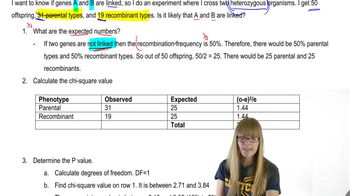
Chi Square and Linkage

Recessive and Dominant Alleles

In genetics, alleles can be classified as dominant or recessive based on their phenotypic expression. Dominant alleles mask the effect of recessive alleles in heterozygous individuals, leading to the expression of the dominant trait. In the context of the Drosophila experiment, the wild-type phenotypes are dominant, while the mutations (echinus, crossveinless, scute) are recessive, which is essential for interpreting the progeny phenotypes.
Recommended video:
Guided course
04:37
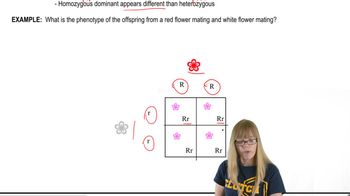
Variations on Dominance

Phenotypic Ratios and Chi-Square Analysis

Phenotypic ratios are the proportions of different phenotypes observed in the offspring of a genetic cross. Analyzing these ratios helps determine whether the observed data fit expected ratios based on Mendelian inheritance. Chi-square analysis can be employed to assess the goodness of fit between observed and expected ratios, aiding in the identification of gene order and the presence of linkage among the studied traits.
Recommended video:
Guided course
02:48
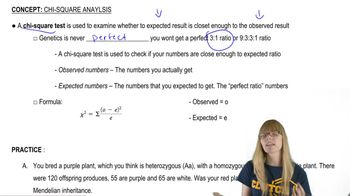
Chi Square Analysis
Related Practice
Textbook Question

A 2006 genetic study of a large American family (Ikeda et al., 2006) identified genetic linkage between DNA markers on chromosome 11 and the gene producing the autosomal dominant neuromuscular disorder spinocerebellar ataxia type 5 (SCA5). The following lod score data are taken from the 2006 study:                  

What is the maximum value for each set of lod scores?

534
views
Textbook Question

A 2006 genetic study of a large American family (Ikeda et al., 2006) identified genetic linkage between DNA markers on chromosome 11 and the gene producing the autosomal dominant neuromuscular disorder spinocerebellar ataxia type 5 (SCA5). The following lod score data are taken from the 2006 study:                  

Based on the available information, is DNA marker A linked to the gene producing SCA5? Explain your answer.

439
views
Textbook Question

A 2006 genetic study of a large American family (Ikeda et al., 2006) identified genetic linkage between DNA markers on chromosome 11 and the gene producing the autosomal dominant neuromuscular disorder spinocerebellar ataxia type 5 (SCA5). The following lod score data are taken from the 2006 study:

Based on available information, is DNA marker B linked to the gene for SCA5? Explain your answer.

592
views
Textbook Question

A Drosophila experiment examining potential genetic linkage of X-linked genes studies a recessive eye mutant (echinus), a recessive wing-vein mutation (crossveinless), and a recessive bristle mutation (scute). The wild-type phenotypes are dominant. Trihybrid wild-type females (all have the same genotype) are crossed to hemizygous males displaying the three recessive phenotypes. Among the 20,765 progeny produced from these crosses are the phenotypes and numbers listed in the table. Any phenotype not given is wild type.

Calculate the recombination frequencies between each of the gene pairs.

500
views
Textbook Question

A Drosophila experiment examining potential genetic linkage of X-linked genes studies a recessive eye mutant (echinus), a recessive wing-vein mutation (crossveinless), and a recessive bristle mutation (scute). The wild-type phenotypes are dominant. Trihybrid wild-type females (all have the same genotype) are crossed to hemizygous males displaying the three recessive phenotypes. Among the 20,765 progeny produced from these crosses are the phenotypes and numbers listed in the table. Any phenotype not given is wild type.

Compare the recombination frequencies and speculate about the source of any apparent discrepancies in the recombination data.

424
views
Textbook Question

A Drosophila experiment examining potential genetic linkage of X-linked genes studies a recessive eye mutant (echinus), a recessive wing-vein mutation (crossveinless), and a recessive bristle mutation (scute). The wild-type phenotypes are dominant. Trihybrid wild-type females (all have the same genotype) are crossed to hemizygous males displaying the three recessive phenotypes. Among the 20,765 progeny produced from these crosses are the phenotypes and numbers listed in the table. Any phenotype not given is wild type.

Use chi-square analysis to demonstrate that the data in this experiment are not the result of independent assortment.

499
views