Pearson+ LogoPearson+ Logo
Ch. 5 - Genetic Linkage and Mapping in Eukaryotes
Sanders - Genetic Analysis: An Integrated Approach 3rd Edition
Sanders3rd EditionGenetic Analysis: An Integrated ApproachISBN: 9780135564172Not the one you use?Change textbook
Chapter 5, Problem 21a

Gene R and gene T are genetically linked. Answer the following questions concerning a dihybrid organism with the genotype Rt/rT:


If r = 0.20, give the expected frequencies of gametes produced by the dihybrid.

Verified step by step guidance
1
Understand that genetic linkage means that genes R and T are located close to each other on the same chromosome, and their alleles are less likely to assort independently during meiosis.
Identify the parental and recombinant gametes. For the genotype Rt/rT, the parental gametes are Rt and rT, while the recombinant gametes are RT and rt.
Recall that the recombination frequency (r) represents the proportion of recombinant gametes produced. Here, r = 0.20, meaning 20% of the gametes are recombinant.
Divide the recombination frequency equally between the two recombinant gametes (RT and rt). Each recombinant gamete will have a frequency of r/2 = 0.20/2 = 0.10.
Calculate the frequencies of the parental gametes (Rt and rT). Since the total frequency of all gametes must equal 1, the parental gametes will have a combined frequency of 1 - r = 1 - 0.20 = 0.80. Divide this equally between the two parental gametes, so each parental gamete will have a frequency of 0.80/2 = 0.40.

Verified video answer for a similar problem:

This video solution was recommended by our tutors as helpful for the problem above.
Video duration:
3m
Was this helpful?

Key Concepts

Here are the essential concepts you must grasp in order to answer the question correctly.

Genetic Linkage

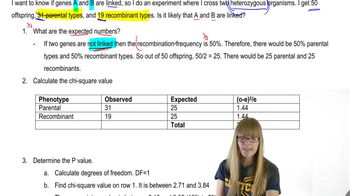
Genetic linkage refers to the tendency of genes that are located close to each other on a chromosome to be inherited together during meiosis. This phenomenon affects the assortment of alleles and can lead to non-Mendelian inheritance patterns. Understanding linkage is crucial for predicting gamete frequencies, as linked genes do not assort independently.
Recommended video:
Guided course
07:33
Chi Square and Linkage

Dihybrid Cross

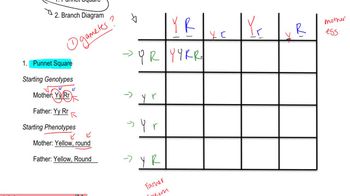
A dihybrid cross involves two traits, each represented by two alleles, allowing the study of inheritance patterns for two genes simultaneously. In this case, the organism has the genotype Rt/rT, indicating heterozygosity for both genes. The expected gametes can be determined by considering the combinations of alleles that can be produced from this genotype.
Recommended video:
Guided course
15:24
Punnet Square

Gamete Frequency Calculation

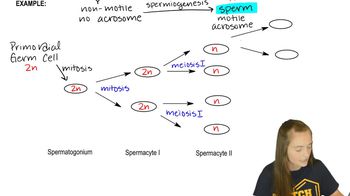
Gamete frequency calculation involves determining the proportion of different gametes produced by an organism based on its genotype and the recombination frequency. In this scenario, with a recombination frequency (r) of 0.20, the expected frequencies of the parental and recombinant gametes can be calculated using the formula that incorporates the linkage and recombination rates.
Recommended video:
Guided course
21:21
Gamete Development
Related Practice
Textbook Question

Genetic linkage mapping for a large number of families identifies 4% recombination between the genes for Rh blood type and elliptocytosis (see Problem 18). At the Rh locus, alleles R and r control Rh+ and Rh- blood types. Allele E producing elliptocytosis is dominant to the wild-type recessive allele e. Tom and Terri each have elliptocytosis, and each is . Tom's mother has elliptocytosis and is Rh- while his father is healthy and has Rh+. Terri's father is Rh+ and has elliptocytosis; Terri's mother is Rh- and is healthy.


What is the probability that the first child of Tom and Terri will be Rh− and have elliptocytosis?

749
views
Textbook Question

Genetic linkage mapping for a large number of families identifies 4% recombination between the genes for Rh blood type and elliptocytosis (see Problem 18). At the Rh locus, alleles R and r control Rh+ and Rh- blood types. Allele E producing elliptocytosis is dominant to the wild-type recessive allele e. Tom and Terri each have elliptocytosis, and each is . Tom's mother has elliptocytosis and is Rh- while his father is healthy and has Rh+. Terri's father is Rh+ and has elliptocytosis; Terri's mother is Rh- and is healthy.


What is the probability that a child of Tom and Terri who is Rh+ will have elliptocytosis?

747
views
Textbook Question

A group of families in which an autosomal dominant condition is present are studied to determine lod scores for possible genetic linkage between three RFLP markers (R1, R2, and R3) and the disease gene. The chart shows lod scores at each of the recombination distances (θ values) tested. Provide an interpretation of the lod score results for each RFLP. Be specific about any significant evidence of genetic linkage.

440
views
Textbook Question

Gene R and gene T are genetically linked. Answer the following questions concerning a dihybrid organism with the genotype Rt/rT:


If two crossover events occur between these two genes, what are the genotypes of the recombinant chromosomes?

448
views
Textbook Question

Gene R and gene T are genetically linked. Answer the following questions concerning a dihybrid organism with the genotype Rt/rT:


Can you make a general statement about how the occurrence of two crossover events between a given pair of linked genes affects the estimate of recombination frequency?

405
views
Textbook Question

T. H. Morgan's data on eye color and wing form genetic linkage between the two genes. Test the genetic linkage (shown in the figure below) data with chi-square analysis, and show that the results are significantly different from the expectation under the assumption of independent assortment.

805
views