Gene R and gene T are genetically linked. Answer the following questions concerning a dihybrid organism with the genotype Rt/rT:
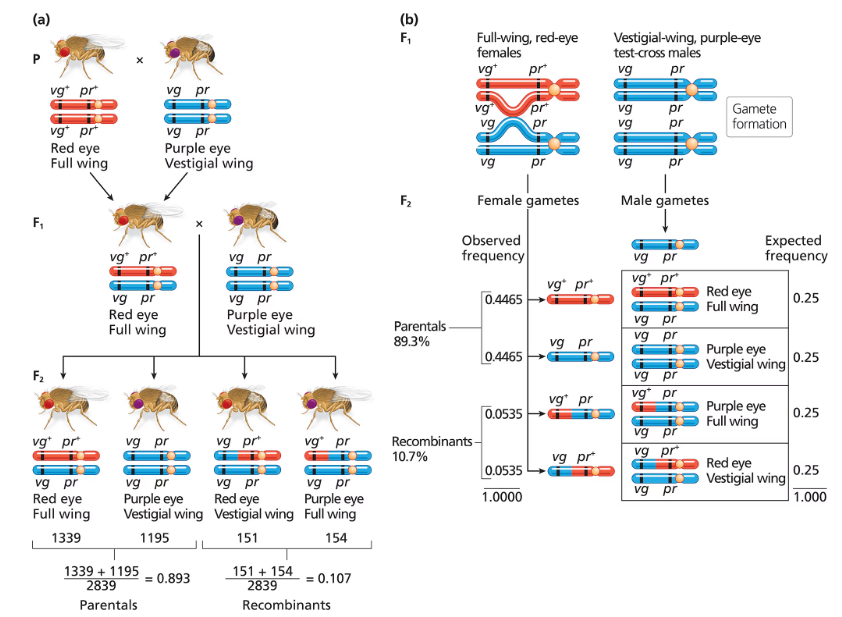
If r = 0.20, give the expected frequencies of gametes produced by the dihybrid.

Verified step by step guidance
Gene R and gene T are genetically linked. Answer the following questions concerning a dihybrid organism with the genotype Rt/rT:
If r = 0.20, give the expected frequencies of gametes produced by the dihybrid.
Gene R and gene T are genetically linked. Answer the following questions concerning a dihybrid organism with the genotype Rt/rT:
If two crossover events occur between these two genes, what are the genotypes of the recombinant chromosomes?
Gene R and gene T are genetically linked. Answer the following questions concerning a dihybrid organism with the genotype Rt/rT:
Can you make a general statement about how the occurrence of two crossover events between a given pair of linked genes affects the estimate of recombination frequency?
A wild-type trihybrid soybean plant is crossed to a pure-breeding soybean plant with the recessive phenotypes pale leaf (l), oval seed (r), and short height (t). The results of the three-point test cross are shown below. Traits not listed are wild type.
What are the alleles on each homologous chromosome of the parental wild-type trihybrid soybean plant? Place the alleles in their correct gene order. Use L, R, and T to represent dominant alleles and l, r, and t for recessive alleles.
A wild-type trihybrid soybean plant is crossed to a pure-breeding soybean plant with the recessive phenotypes pale leaf (l), oval seed (r), and short height (t). The results of the three-point test cross are shown below. Traits not listed are wild type.
Calculate the recombination frequencies between the adjacent genes.
A wild-type trihybrid soybean plant is crossed to a pure-breeding soybean plant with the recessive phenotypes pale leaf (l), oval seed (r), and short height (t). The results of the three-point test cross are shown below. Traits not listed are wild type.
Calculate the interference value for these data.