Pearson+ LogoPearson+ Logo
Ch. 5 - Genetic Linkage and Mapping in Eukaryotes
Sanders - Genetic Analysis: An Integrated Approach 3rd Edition
Sanders3rd EditionGenetic Analysis: An Integrated ApproachISBN: 9780135564172Not the one you use?Change textbook
Chapter 5, Problem 21c

Gene R and gene T are genetically linked. Answer the following questions concerning a dihybrid organism with the genotype Rt/rT:


Can you make a general statement about how the occurrence of two crossover events between a given pair of linked genes affects the estimate of recombination frequency?

Verified step by step guidance
1
Understand the concept of genetic linkage: Genetic linkage occurs when genes are located close to each other on the same chromosome, and they tend to be inherited together. Recombination frequency measures how often crossing over occurs between two linked genes during meiosis.
Recall the impact of crossover events: A single crossover event between two linked genes can result in recombinant gametes. However, when two crossover events occur between the same pair of genes, they can cancel each other out, leading to gametes that appear non-recombinant.
Consider the recombination frequency for closely linked genes: For genes with a small recombination frequency (closely linked), the likelihood of two crossover events occurring between them is very low. Therefore, the recombination frequency estimate is less affected by double crossovers.
Analyze the recombination frequency for genes farther apart: For genes with a higher recombination frequency (farther apart), the probability of double crossover events increases. These double crossovers can lead to an underestimation of the true recombination frequency because they produce gametes that appear non-recombinant.
Conclude the general statement: Double crossover events reduce the accuracy of recombination frequency estimates, especially for gene pairs with higher recombination frequencies. This is because double crossovers can mask the occurrence of recombination events, leading to an underestimation of the true frequency.

Verified video answer for a similar problem:

This video solution was recommended by our tutors as helpful for the problem above.
Video duration:
1m
Was this helpful?

Key Concepts

Here are the essential concepts you must grasp in order to answer the question correctly.

Genetic Linkage

Genetic linkage refers to the tendency of genes located close to each other on a chromosome to be inherited together during meiosis. This occurs because linked genes are less likely to be separated by recombination events. Understanding linkage is crucial for predicting inheritance patterns and calculating recombination frequencies, which indicate how often crossover events occur between genes.
Recommended video:
Guided course
07:33
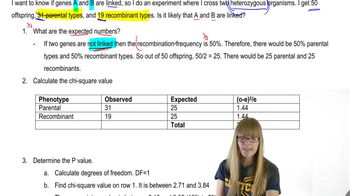
Chi Square and Linkage

Recombination Frequency

Recombination frequency is a measure of the likelihood that two genes will be separated during meiosis due to crossing over. It is calculated as the number of recombinant offspring divided by the total number of offspring. A lower recombination frequency suggests that genes are closely linked, while a higher frequency indicates they are further apart, allowing for more crossover events.
Recommended video:
Guided course
03:51
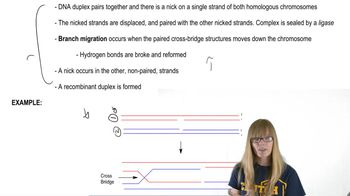
Recombination after Single Strand Breaks

Crossover Events

Crossover events occur during meiosis when homologous chromosomes exchange segments of genetic material. The number of crossover events between two linked genes can significantly influence the recombination frequency. In cases with two crossover events, the likelihood of producing recombinant gametes increases, which can lead to a more accurate estimate of the genetic distance between the genes involved.
Recommended video:
Guided course
06:14
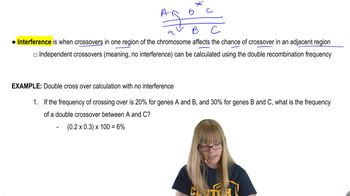
Multiple Cross Overs and Interference
Related Practice
Textbook Question

A group of families in which an autosomal dominant condition is present are studied to determine lod scores for possible genetic linkage between three RFLP markers (R1, R2, and R3) and the disease gene. The chart shows lod scores at each of the recombination distances (θ values) tested. Provide an interpretation of the lod score results for each RFLP. Be specific about any significant evidence of genetic linkage.

440
views
Textbook Question

Gene R and gene T are genetically linked. Answer the following questions concerning a dihybrid organism with the genotype Rt/rT:


If r = 0.20, give the expected frequencies of gametes produced by the dihybrid.

490
views
Textbook Question

Gene R and gene T are genetically linked. Answer the following questions concerning a dihybrid organism with the genotype Rt/rT:


If two crossover events occur between these two genes, what are the genotypes of the recombinant chromosomes?

448
views
Textbook Question

T. H. Morgan's data on eye color and wing form genetic linkage between the two genes. Test the genetic linkage (shown in the figure below) data with chi-square analysis, and show that the results are significantly different from the expectation under the assumption of independent assortment.

805
views
Textbook Question

A wild-type trihybrid soybean plant is crossed to a pure-breeding soybean plant with the recessive phenotypes pale leaf (l), oval seed (r), and short height (t). The results of the three-point test cross are shown below. Traits not listed are wild type.

What are the alleles on each homologous chromosome of the parental wild-type trihybrid soybean plant? Place the alleles in their correct gene order. Use L, R, and T to represent dominant alleles and l, r, and t for recessive alleles.

575
views
Textbook Question

A wild-type trihybrid soybean plant is crossed to a pure-breeding soybean plant with the recessive phenotypes pale leaf (l), oval seed (r), and short height (t). The results of the three-point test cross are shown below. Traits not listed are wild type.

Calculate the recombination frequencies between the adjacent genes.

446
views