Pearson+ LogoPearson+ Logo
Ch. 5 - Genetic Linkage and Mapping in Eukaryotes
Sanders - Genetic Analysis: An Integrated Approach 3rd Edition
Sanders3rd EditionGenetic Analysis: An Integrated ApproachISBN: 9780135564172Not the one you use?Change textbook
Chapter 5, Problem 13e

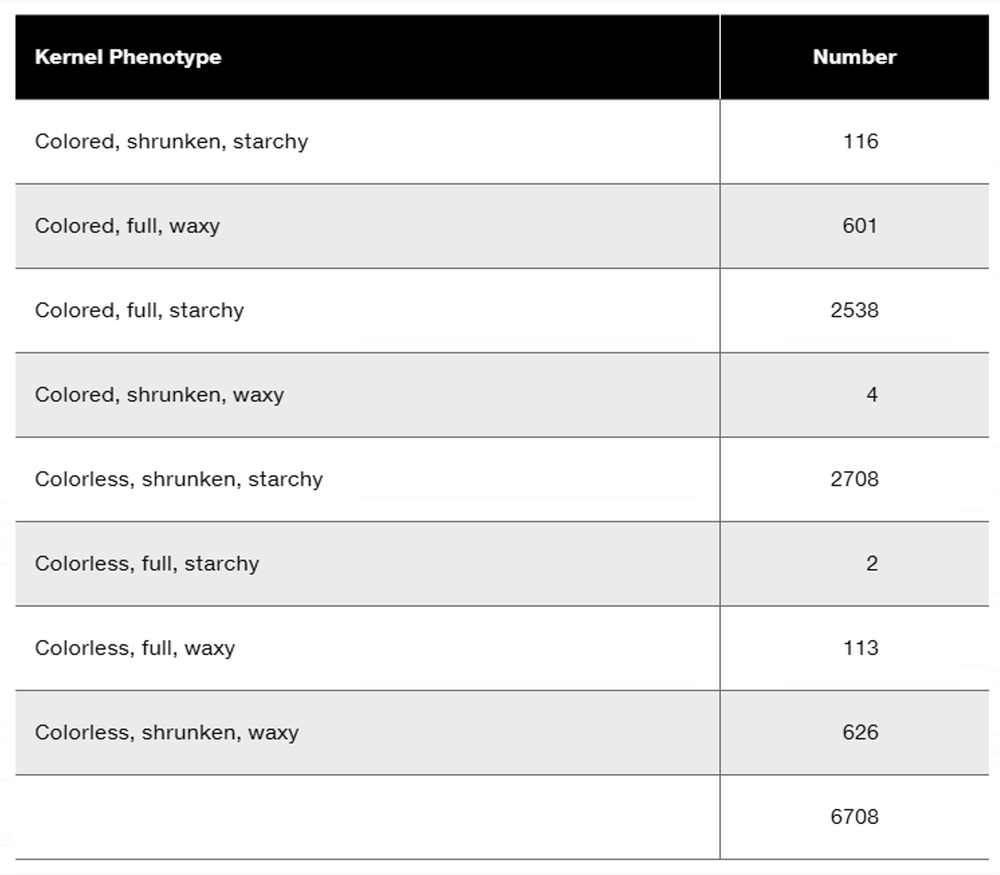
Researchers cross a corn plant that is pure-breeding for the dominant traits colored aleurone (C1), full kernel (Sh), and waxy endosperm (Wx) to a pure-breeding plant with the recessive traits colorless aleurone (c1), shrunken kernel (sh), and starchy (wx). The resulting F₁ plants were crossed to pure-breeding colorless, shrunken, starchy plants. Counting the kernels from about 30 ears of corn yields the following data.
Table displaying kernel phenotypes and their corresponding counts from a trihybrid cross in corn plants.
What is the interference value for this data set?

Verified step by step guidance
1
Step 1: Understand the concept of interference. Interference is a measure of how one crossover event affects the likelihood of another crossover event occurring nearby. It is calculated using the formula: I = 1 - (observed double crossovers / expected double crossovers).
Step 2: Identify the observed double crossovers from the data. In this case, the observed double crossover phenotypes are '+ cu + / se cu e' and 'se + e / se cu e', with numbers 16 and 10 respectively. Add these values to find the total observed double crossovers.
Step 3: Calculate the expected double crossovers. To do this, first determine the recombination frequencies between the genes based on the phenotypic data provided. Multiply the recombination frequencies between the first and second genes and between the second and third genes, then multiply this product by the total number of offspring (6708).
Step 4: Plug the observed and expected double crossover values into the interference formula: I = 1 - (observed double crossovers / expected double crossovers).
Step 5: Interpret the interference value. If the interference value is close to 1, it indicates strong interference (few double crossovers occur). If the value is close to 0, it indicates weak or no interference.

Verified video answer for a similar problem:

This video solution was recommended by our tutors as helpful for the problem above.
Video duration:
9m
Was this helpful?

Key Concepts

Here are the essential concepts you must grasp in order to answer the question correctly.

Trihybrid Cross

A trihybrid cross involves the genetic crossing of organisms that differ in three traits, each controlled by different genes. In this scenario, the traits are represented by dominant and recessive alleles, allowing researchers to study inheritance patterns and phenotypic ratios in the offspring. Understanding the principles of Mendelian genetics, including dominance, segregation, and independent assortment, is crucial for analyzing the results of such crosses.
Recommended video:
Guided course
26:08
Trihybrid Cross

Phenotypic Ratios

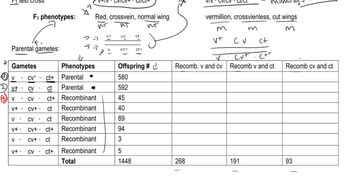
Phenotypic ratios represent the relative frequencies of different observable traits in the offspring resulting from a genetic cross. In the context of the question, the phenotypic ratios can be derived from the counts of various kernel types, which help in understanding the inheritance patterns of the traits involved. Analyzing these ratios allows researchers to predict the expected outcomes based on Mendelian principles and assess deviations that may indicate genetic linkage or other factors.
Recommended video:
Guided course
10:48
Mutations and Phenotypes

Genetic Interference

Genetic interference refers to the phenomenon where the occurrence of one crossover event in a chromosome affects the likelihood of another crossover event occurring nearby. This concept is important when analyzing the results of a trihybrid cross, as it can influence the expected ratios of phenotypes. The interference value can be calculated using observed and expected double crossover frequencies, providing insights into the genetic linkage and the arrangement of genes on chromosomes.
Recommended video:
Guided course
06:59
RNA Interference
Related Practice
Textbook Question

Researchers cross a corn plant that is pure-breeding for the dominant traits colored aleurone (C1), full kernel (Sh), and waxy endosperm (Wx) to a pure-breeding plant with the recessive traits colorless aleurone (c1), shrunken kernel (sh), and starchy (wx). The resulting F₁ plants were crossed to pure-breeding colorless, shrunken, starchy plants. Counting the kernels from about 30 ears of corn yields the following data.


Perform a chi-square test to determine if these data show significant deviation from the expected phenotype distribution.

479
views
Textbook Question

Researchers cross a corn plant that is pure-breeding for the dominant traits colored aleurone (C1), full kernel (Sh), and waxy endosperm (Wx) to a pure-breeding plant with the recessive traits colorless aleurone (c1), shrunken kernel (sh), and starchy (wx). The resulting F₁ plants were crossed to pure-breeding colorless, shrunken, starchy plants. Counting the kernels from about 30 ears of corn yields the following data.

What is the order of these genes in corn?

439
views
Textbook Question

Researchers cross a corn plant that is pure-breeding for the dominant traits colored aleurone (C1), full kernel (Sh), and waxy endosperm (Wx) to a pure-breeding plant with the recessive traits colorless aleurone (c1), shrunken kernel (sh), and starchy (wx). The resulting F₁ plants were crossed to pure-breeding colorless, shrunken, starchy plants. Counting the kernels from about 30 ears of corn yields the following data.

Calculate the recombination frequencies between the gene pairs.

648
views
Textbook Question

Nail–patella syndrome is an autosomal disorder affecting the shape of nails on fingers and toes as well as the structure of kneecaps. The pedigree below shows the transmission of nail–patella syndrome in a family along with ABO blood type. Is nail–patella syndrome a dominant or a recessive condition?

Is nail–patella syndrome a dominant or a recessive condition? Explain your reasoning.

579
views
Textbook Question

Nail–patella syndrome is an autosomal disorder affecting the shape of nails on fingers and toes as well as the structure of kneecaps. The pedigree below shows the transmission of nail–patella syndrome in a family along with ABO blood type.

Does this family give evidence of genetic linkage between nail–patella syndrome and ABO blood group? Why or why not?

815
views
Textbook Question

Nail–patella syndrome is an autosomal disorder affecting the shape of nails on fingers and toes as well as the structure of kneecaps. The pedigree below shows the transmission of nail–patella syndrome in a family along with ABO blood type.

Using N and n to represent alleles at the nail–patella locus and Iᴬ, Iᴮ and i to represent ABO alleles, write the genotypes of I-1 and I-2 as well as their five children in generation II.

598
views