Pearson+ LogoPearson+ Logo
Ch. 6 - Genetic Analysis and Mapping in Bacteria and Bacteriophages
Sanders - Genetic Analysis: An Integrated Approach 3rd Edition
Sanders3rd EditionGenetic Analysis: An Integrated ApproachISBN: 9780135564172Not the one you use?Change textbook
Chapter 6, Problem 18d

An interrupted mating study is carried out on Hfr strains 1, 2, and 3 identified in Problem 17. After conjugation is established, a small sample of the mixture is collected every minute for 20 minutes to determine the distance between genes on the chromosome. Results for each of the three Hfr strains are shown below. The total duration of conjugation (in minutes) is given for each transferred gene.
Hfr strain 1     oriT  met  ala  lac  gal
Duration (min)   0     2    8   13   17
Hfr strain 2     oriT  met  leu  thr   azi
Duration (min)   0     2    7   10   17
Hfr strain 3     oriT  gal   pro  trp   azi
Duration (min)   0     3    8   14   19
Write out the interrupted mating results you would expect after 20 minutes of conjugation for Hfr strains 4 and 5. Use the format shown at the beginning of this problem.

Verified step by step guidance
1
Identify the key concept: Interrupted mating studies are used to map the relative positions of genes on a bacterial chromosome by determining the order and timing of gene transfer during conjugation. The time at which a gene is transferred corresponds to its distance from the origin of transfer (oriT).
Analyze the data for Hfr strains 1, 2, and 3. Note the order of genes and the time intervals for each gene transfer. For example, in Hfr strain 1, the order is oriT, met, ala, lac, gal, and the times are 0, 2, 8, 13, and 17 minutes, respectively.
Understand that Hfr strains 4 and 5 will have different starting points (oriT) on the circular bacterial chromosome. The order of genes transferred will depend on the location of oriT and the direction of transfer. Use the data from strains 1, 2, and 3 to infer the possible gene order for strains 4 and 5.
Predict the gene order and transfer times for Hfr strains 4 and 5. For example, if oriT in strain 4 is located near a different gene (e.g., gal), the order might start with gal and proceed to adjacent genes in the direction of transfer. Similarly, for strain 5, oriT might be near another gene (e.g., thr), and the order would reflect that starting point.
Write out the expected interrupted mating results for strains 4 and 5 in the same format as provided in the problem. Include the gene order starting from oriT and the approximate times for each gene transfer based on the distances inferred from the other strains.

Verified video answer for a similar problem:

This video solution was recommended by our tutors as helpful for the problem above.
Video duration:
1m
Was this helpful?

Key Concepts

Here are the essential concepts you must grasp in order to answer the question correctly.

Hfr Strains and Conjugation

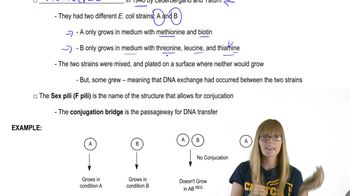
Hfr (high frequency of recombination) strains are bacterial strains that have integrated a plasmid into their chromosomal DNA, allowing them to transfer genetic material to other bacteria through conjugation. During this process, a donor bacterium forms a pilus to connect with a recipient bacterium, facilitating the transfer of chromosomal genes. The order and timing of gene transfer can provide insights into the relative positions of genes on the chromosome.
Recommended video:
Guided course
04:06
Conjugation Overview

Interrupted Mating Technique

The interrupted mating technique is a method used to study gene transfer during bacterial conjugation. By interrupting the mating process at specific time intervals, researchers can determine which genes have been transferred based on the duration of conjugation. This allows for the mapping of genes on the bacterial chromosome, as genes that are transferred earlier are located closer to the origin of transfer (oriT).
Recommended video:
Guided course
07:55
Non-Random Mating

Gene Mapping and Distance Measurement

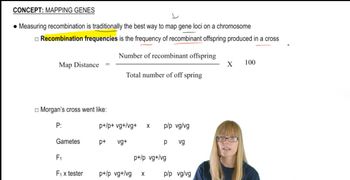
Gene mapping involves determining the relative positions of genes on a chromosome based on their transfer frequencies during conjugation. The distance between genes is often measured in minutes of conjugation time, with closer genes being transferred in shorter time intervals. This quantitative approach helps in constructing genetic maps, which are essential for understanding gene function and interactions within the genome.
Recommended video:
Guided course
09:09
Mapping Genes
Related Practice
Textbook Question

An interrupted mating study is carried out on Hfr strains 1, 2, and 3 identified in Problem 17. After conjugation is established, a small sample of the mixture is collected every minute for 20 minutes to determine the distance between genes on the chromosome. Results for each of the three Hfr strains are shown below. The total duration of conjugation (in minutes) is given for each transferred gene.

Hfr strain 1     oriT  met  ala  lac  gal

Duration (min)   0     2    8   13   17

Hfr strain 2     oriT  met  leu  thr   azi

Duration (min)   0     2    7   10   17

Hfr strain 3     oriT  gal   pro  trp   azi

Duration (min)   0     3    8   14   19

For each Hfr strain, draw a time-of-entry profile.

1225
views
Textbook Question

An interrupted mating study is carried out on Hfr strains 1, 2, and 3 identified in Problem 17. After conjugation is established, a small sample of the mixture is collected every minute for 20 minutes to determine the distance between genes on the chromosome. Results for each of the three Hfr strains are shown below. The total duration of conjugation (in minutes) is given for each transferred gene.

Hfr strain 1     oriT  met  ala  lac  gal

Duration (min)   0     2    8   13   17

Hfr strain 2     oriT  met  leu  thr   azi

Duration (min)   0     2    7   10   17

Hfr strain 3     oriT  gal   pro  trp   azi

Duration (min)   0     3    8   14   19

Using the chromosome map you prepared in answer to Problem 17, determine the distance in minutes between each gene on the map.

850
views
Textbook Question

An interrupted mating study is carried out on Hfr strains 1, 2, and 3 identified in Problem 17. After conjugation is established, a small sample of the mixture is collected every minute for 20 minutes to determine the distance between genes on the chromosome. Results for each of the three Hfr strains are shown below. The total duration of conjugation (in minutes) is given for each transferred gene.

Hfr strain 1     oriT  met  ala  lac  gal

Duration (min)   0     2    8   13   17

Hfr strain 2     oriT  met  leu  thr   azi

Duration (min)   0     2    7   10   17

Hfr strain 3     oriT  gal   pro  trp   azi

Duration (min)   0     3    8   14   19

Explain why azi is the last gene of strain 2 to transfer in the 20 minutes of conjugation time. How many minutes of conjugation time would be needed to allow the next gene on the map to transfer from Hfr strain 2?

714
views
Textbook Question

An interrupted mating study is carried out on Hfr strains 1, 2, and 3 identified in Problem 17. After conjugation is established, a small sample of the mixture is collected every minute for 20 minutes to determine the distance between genes on the chromosome. Results for each of the three Hfr strains are shown below. The total duration of conjugation (in minutes) is given for each transferred gene.

Hfr strain 1     oriT  met  ala  lac  gal

Duration (min)   0     2    8   13   17

Hfr strain 2     oriT  met  leu  thr   azi

Duration (min)   0     2    7   10   17

Hfr strain 3     oriT  gal   pro  trp   azi

Duration (min)   0     3    8   14   19

In minutes, what is the total length of the chromosome in the donor species?

1061
views
Textbook Question

An Hfr strain with the genotype cys⁺ lue⁺ met⁺ strˢ is mated with an F- strain carrying the genotype cys⁻ lue⁻ met⁻ strᴿ. In an interrupted mating experiment, small samples of the conjugating bacteria are withdrawn every 3 minutes for 30 minutes. The withdrawn cells are shaken vigorously to stop conjugation and then placed on three different selection media, composed as follows:


Medium 1: Minimal medium plus leucine, methionine, and streptomycin

Medium 2: Minimal medium plus cysteine, methionine, and streptomycin

Medium 3: Minimal medium plus cysteine, leucine, and streptomycin


The following table shows the number of colonies growing on each selection medium. The sampling time indicates how many minutes have passed since conjugation began.


Sampling Time (minutes)       Number of Colonies

                      Plate 1    Plate 2    Plate 3

      3                 0         0         0

      6                 0         0         0

      9                 0        62         0

     12                 0        87         0

     15                 51       124        0

     18                 79       210        62

     21                109       250        85

     24                144       250       111

     27                152       250       122

     30                152       250       122


Suppose a fourth selection medium containing leucine and streptomycin is prepared. At what sampling time do you expect the first-growing colonies to appear? Explain your reasoning.

928
views
Textbook Question

An Hfr strain with the genotype cys⁺ lue⁺ met⁺ strS is mated with an F- strain carrying the genotype cys⁻ lue⁻ met⁻ strᴿ. In an interrupted mating experiment, small samples of the conjugating bacteria are withdrawn every 3 minutes for 30 minutes. The withdrawn cells are shaken vigorously to stop conjugation and then placed on three different selection media, composed as follows:


Medium 1: Minimal medium plus leucine, methionine, and streptomycin

Medium 2: Minimal medium plus cysteine, methionine, and streptomycin

Medium 3: Minimal medium plus cysteine, leucine, and streptomycin


What donor gene is the selected marker in each medium?

712
views