Pearson+ LogoPearson+ Logo
Ch. 6 - Genetic Analysis and Mapping in Bacteria and Bacteriophages
Sanders - Genetic Analysis: An Integrated Approach 3rd Edition
Sanders3rd EditionGenetic Analysis: An Integrated ApproachISBN: 9780135564172Not the one you use?Change textbook
Chapter 6, Problem 5d

Explain the importance of the following features in conjugating donor bacteria:
the relaxosome

Verified step by step guidance
1
Understand the concept of bacterial conjugation: Bacterial conjugation is a process of horizontal gene transfer where genetic material is exchanged between a donor and a recipient bacterium through direct contact. The relaxosome plays a critical role in this process.
Define the relaxosome: The relaxosome is a protein-DNA complex that forms at the origin of transfer (oriT) on the conjugative plasmid in the donor bacterium. It is responsible for initiating the transfer of genetic material during conjugation.
Explain the function of the relaxosome: The relaxosome contains proteins that recognize and bind to the oriT sequence. One of its key components, the relaxase enzyme, nicks the DNA at the oriT site, creating a single-stranded DNA that is ready for transfer to the recipient bacterium.
Describe the role of the relaxosome in DNA transfer: After the relaxosome prepares the single-stranded DNA, it interacts with the type IV secretion system (T4SS), a specialized structure that facilitates the transfer of the DNA strand from the donor to the recipient bacterium.
Highlight the importance of the relaxosome: The relaxosome is essential for ensuring the precise initiation and regulation of DNA transfer during conjugation. Without the relaxosome, the donor bacterium would be unable to properly process and transfer its genetic material to the recipient.

Verified video answer for a similar problem:

This video solution was recommended by our tutors as helpful for the problem above.
Video duration:
2m
Was this helpful?

Key Concepts

Here are the essential concepts you must grasp in order to answer the question correctly.

Relaxosome

The relaxosome is a multi-protein complex essential for the process of conjugation in bacteria. It facilitates the unwinding of the plasmid DNA, allowing it to be transferred from the donor to the recipient bacterium. This complex recognizes specific DNA sequences, enabling the precise cleavage and transfer of genetic material, which is crucial for horizontal gene transfer and genetic diversity among bacterial populations.

Conjugation

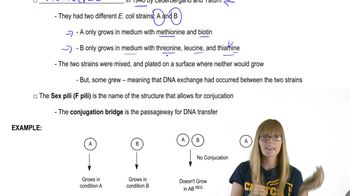
Conjugation is a form of horizontal gene transfer in bacteria, where genetic material is transferred from one bacterium (the donor) to another (the recipient) through direct contact. This process often involves the formation of a pilus, which connects the two cells, allowing for the transfer of plasmids or chromosomal DNA. Conjugation plays a significant role in the spread of antibiotic resistance and other traits among bacterial communities.
Recommended video:
Guided course
04:06
Conjugation Overview

Plasmids

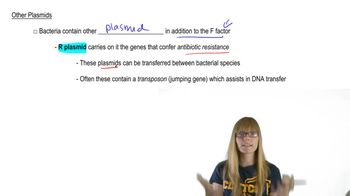
Plasmids are small, circular DNA molecules that exist independently of chromosomal DNA in bacteria. They often carry genes that confer advantageous traits, such as antibiotic resistance or metabolic capabilities. During conjugation, plasmids can be transferred from donor to recipient bacteria, facilitating the rapid spread of these traits within a population, which is vital for adaptation and survival in changing environments.
Recommended video: