Pearson+ LogoPearson+ Logo
Ch. 7 - DNA Structure and Replication
Sanders - Genetic Analysis: An Integrated Approach 3rd Edition
Sanders3rd EditionGenetic Analysis: An Integrated ApproachISBN: 9780135564172Not the one you use?Change textbook
Chapter 7, Problem 14b

Bacterial DNA polymerase I and DNA polymerase III perform different functions during DNA replication.
If mutation inactivated DNA polymerase I in a strain of E. coli, would the cell be able to replicate its DNA? If so, what kind of abnormalities would you expect to find in the cell?

Verified step by step guidance
1
Understand the roles of DNA polymerase I and DNA polymerase III in DNA replication. DNA polymerase III is the primary enzyme responsible for synthesizing the majority of the new DNA strand, while DNA polymerase I is involved in removing RNA primers and replacing them with DNA.
Consider the specific function of DNA polymerase I. It has 5' to 3' exonuclease activity, which allows it to remove RNA primers laid down by primase, and it also has 5' to 3' polymerase activity to fill in the gaps with DNA nucleotides.
Analyze the impact of inactivating DNA polymerase I. Without this enzyme, the RNA primers would not be removed and replaced with DNA, leaving RNA fragments in the newly synthesized DNA strand.
Determine whether DNA replication can still occur. DNA polymerase III can still synthesize the majority of the DNA strand, so replication can proceed, but the resulting DNA will have abnormalities due to the presence of RNA primers.
Conclude the abnormalities expected. The DNA in the cell would contain RNA fragments where the primers were not replaced, potentially leading to issues with stability, function, and further replication of the DNA.

Verified video answer for a similar problem:

This video solution was recommended by our tutors as helpful for the problem above.
Video duration:
4m
Was this helpful?

Key Concepts

Here are the essential concepts you must grasp in order to answer the question correctly.

DNA Replication

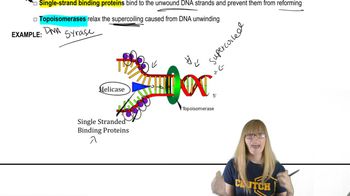
DNA replication is the biological process by which a cell duplicates its DNA before cell division. This process involves unwinding the double helix and synthesizing new strands complementary to the original ones. Key enzymes, including DNA polymerases, play crucial roles in adding nucleotides to the growing DNA strand and ensuring fidelity in the replication process.
Recommended video:
Guided course
11:59
Steps to DNA Replication

Functions of DNA Polymerases

DNA polymerases are enzymes that synthesize DNA molecules from nucleotides. In E. coli, DNA polymerase I is primarily involved in removing RNA primers and filling in gaps during replication, while DNA polymerase III is the main enzyme responsible for synthesizing the new DNA strand. Understanding their distinct roles is essential for predicting the effects of mutations affecting these enzymes.
Recommended video:
Guided course
08:26
Functional Genomics

Mutations and Their Effects

Mutations are changes in the DNA sequence that can affect gene function and protein production. Inactivating DNA polymerase I would hinder the removal of RNA primers and gap filling, potentially leading to incomplete DNA strands and replication errors. This could result in abnormalities such as increased mutation rates, genomic instability, and impaired cell division.
Recommended video:
Guided course
03:38
Maternal Effect