Ch. 7 - DNA Structure and Replication
Chapter 7, Problem 15

Diagram a replication fork in bacterial DNA and label the following structures or molecules.
a. DNA pol III
b. Helicase
c. RNA primer
d. Origin of replication
e. leading strand (label its polarity)
f. DNA pol I
g. Topoisomerase
h. SSB protein
i. Lagging strand (label its polarity)
j. Primase
k. Okazaki fragment

Verified step by step guidance
1
Start by drawing a replication fork, which is a Y-shaped structure formed during DNA replication. This fork represents the point where the double-stranded DNA is being unwound into two single strands.
Label the origin of replication (d). This is the specific sequence in the DNA where replication begins. It is located at the base of the replication fork.
Indicate the direction of the leading strand (e) and lagging strand (i). The leading strand is synthesized continuously in the 5' to 3' direction, moving toward the replication fork. The lagging strand is synthesized discontinuously in the 5' to 3' direction, moving away from the replication fork, and consists of Okazaki fragments (k).
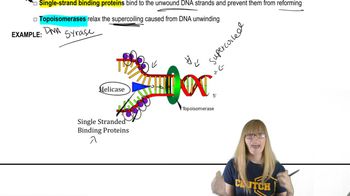
Add the enzymes and proteins involved in replication: (b) helicase unwinds the DNA at the replication fork, (h) SSB proteins stabilize the unwound single strands, (g) topoisomerase relieves supercoiling ahead of the fork, and (j) primase synthesizes RNA primers (c) to initiate DNA synthesis.
Label the DNA polymerases: (a) DNA pol III synthesizes the new DNA strand by adding nucleotides to the RNA primer, and (f) DNA pol I replaces the RNA primers with DNA nucleotides on the lagging strand.

Verified video answer for a similar problem:

This video solution was recommended by our tutors as helpful for the problem above.
Video duration:
2m
Was this helpful?

Key Concepts

Here are the essential concepts you must grasp in order to answer the question correctly.

DNA Replication

DNA replication is the biological process by which a cell duplicates its DNA, ensuring that each daughter cell receives an identical copy. This process involves unwinding the double helix structure of DNA, synthesizing new strands using existing strands as templates, and requires various enzymes and proteins to facilitate the accurate and efficient copying of genetic material.
Recommended video:
Guided course
11:59
Steps to DNA Replication

Enzymes Involved in DNA Replication

Several key enzymes play critical roles in DNA replication. DNA polymerase III synthesizes new DNA strands, helicase unwinds the DNA double helix, primase synthesizes RNA primers to initiate replication, and DNA polymerase I replaces RNA primers with DNA. Topoisomerase alleviates the tension created ahead of the replication fork, while single-strand binding (SSB) proteins stabilize unwound DNA strands.
Recommended video:
Guided course
11:59
Steps to DNA Replication

Leading and Lagging Strands

During DNA replication, the leading strand is synthesized continuously in the direction of the replication fork, while the lagging strand is synthesized discontinuously in short segments called Okazaki fragments, which are later joined together. The leading strand has a 5' to 3' polarity, whereas the lagging strand is synthesized in the opposite direction, requiring multiple RNA primers for initiation.
Recommended video:
Guided course
03:03
Double Strand Breaks